Sports Betting Arbitrage Finder: How to Check Alerts in Australia
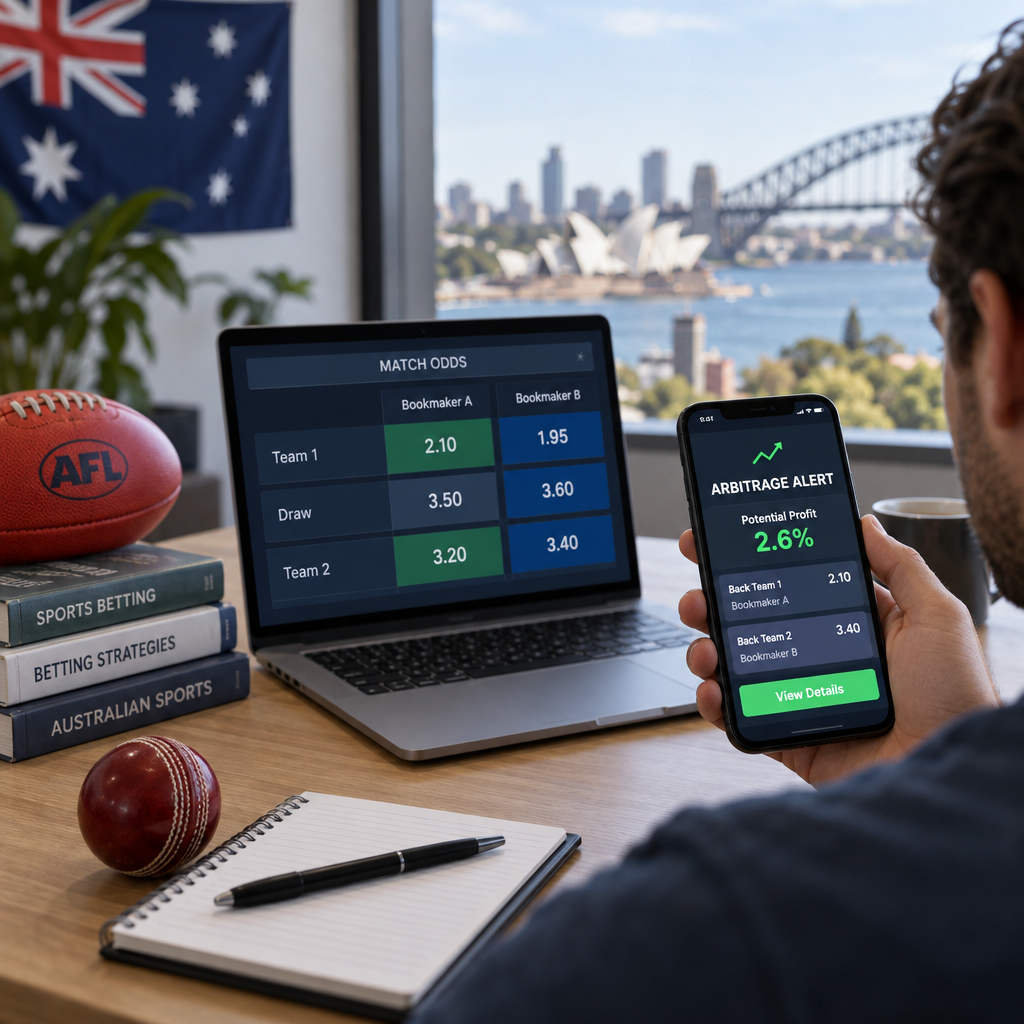
A sports betting arbitrage finder compares odds and flags combinations that appear to cover the possible outcomes of an event at favourable prices. It can make discrepancies easier to spot, but an alert is not proof that a profit is available. You still need to check the event and settlement rules, recalculate the stakes, and confirm that every bet can be placed at the required price. This guide explains that process for Australian adults, including the practical, legal and financial uncertainties a scanner cannot resolve for you.
How a sports betting arbitrage finder works
A sports arbitrage scanner monitors prices from selected bookmakers or exchanges and identifies combinations that may produce a positive return across all covered outcomes. For example, one bookmaker might offer a higher price on one team while another offers a higher price on its opponent.
The finder’s role is discovery. An odds comparison site may display prices without checking whether the selections cover every outcome. An arbitrage betting calculator instead uses entered odds to work out a stake split. Some services combine these functions, while others focus on a particular type of comparison.
A positive expected value bet is different from an arbitrage: a single attractive price does not, by itself, cover the other outcomes. You can also compare odds manually and use a calculator, although prices may move before you finish checking them.
- Find: identify the event, markets and quoted prices in the alert.
- Verify: check that the selections cover all relevant outcomes and settle consistently.
- Calculate: work out the required stakes and account for applicable costs.
- Confirm: check the current prices and whether the required stakes are available.
How to check an apparent arbitrage calculation
For a simple calculation, assume two mutually exclusive outcomes cover the whole market, both bets have identical settlement rules, and there are no commissions or transaction fees. With decimal odds, add one divided by each price. If the total is below 1, the quoted prices suggest a positive return under those assumptions.
Consider a hypothetical market with odds of 2.10 on outcome A and 2.15 on outcome B. The combined implied probability is 1 ÷ 2.10 + 1 ÷ 2.15 = 0.941307, or approximately 94.13%.
To balance the returns, calculate each stake as the total stake multiplied by the inverse of that outcome’s odds, divided by the combined implied probability. With A$100 in total, the rounded split is as follows.
- Outcome A: A$50.59 at 2.10; gross return if A wins is approximately A$106.24.
- Outcome B: A$49.41 at 2.15; gross return if B wins is approximately A$106.23.
What the calculated return does and does not mean
Gross return includes the winning stake. After subtracting the A$100 total staked, the illustrative profit is about A$6.23 to A$6.24, depending on the outcome and rounding. That result depends on both bets being accepted at those prices and settling as assumed.
The 5.87 percentage-point difference between 100% and the combined implied probability is not the return on stake. Before rounding, the theoretical return on stake is approximately 6.235%, calculated as 1 ÷ 0.941307 − 1.
An arbitrage betting calculator can perform the split, but it cannot establish that the prices are still available or that the two operators have matching rules. The two-back-bet formula above also should not be applied directly to a bookmaker back bet paired with an exchange lay bet. A back–lay calculation needs to account for commission and the funds required to cover lay liability.
Costs can change the result. Betfair says exchange commission is calculated on net market winnings, with the applicable market rate and possible additional charges depending on the circumstances. A scanner subscription is a separate recurring expense, rather than automatically a charge on each bet.
Incomplete execution creates a different risk. If only the A$50.59 bet on A is accepted, there is no balanced position: that stake can be lost if A loses. Recalculating after the second price changes does not undo the first bet.
Match the event, outcomes and settlement rules
Selections that look opposite are not necessarily equivalent. Check the competition, fixture and participants first, then compare the market name, scoring period and any handicap or total line. Read how each operator treats extra time, overtime, postponements, withdrawals and errors.
Draws are an important example. A standard three-way football match-result market has home win, draw and away win outcomes. Backing only the two teams leaves the draw uncovered. A different two-way market may handle draws under its own rules, so do not infer its structure from the sport or a “head-to-head” label alone.
Exceptional events can also lead to different settlements even when normal outcomes appear covered. Sportsbet’s tennis match-betting rule says a bet on a player who retires or is disqualified is void, while a bet on the player progressing wins. Betfair’s sportsbook rules distinguish competitions and, in some cases, whether the first set has been completed.
That contrast is a reason to check the exact market and competition, not a rule to apply to every tennis bet. Betfair’s sportsbook rules should not be assumed to govern its exchange. Bonusbank also warns that alerts can contain data errors, including reversed odds or incorrect lines.
- Do the event, participants, market period and line match exactly?
- Are all possible outcomes covered, including a draw where relevant?
- Do the rules align for overtime, retirement, postponement, voids and errors?
Check prices, limits and exchange liquidity
Even when the markets match, the displayed prices may not be available by the time you act. Check the current odds at each provider and whether each will accept the amount required by the calculation. An account limit or a change in price can make the original split unusable.
Sportsbet’s terms, for example, allow it to refuse all or part of a bet, impose account limits and void bets in specified material-error circumstances. These are Sportsbet-specific provisions; other operators may have different terms.
On an exchange, a displayed price also needs sufficient liquidity for the required amount. An order may be only partly matched, leaving less coverage than expected. For a lay bet, the liability is the amount needed to cover a potential loss and is not the same as the lay stake.
Checking each leg does not remove the possibility that a price changes between placements. Cash-out is not a dependable fallback: Sportsbet’s terms say it may be unavailable or a request may be denied.
- Check the live price rather than relying only on the alert.
- Check the available stake or exchange liquidity at that price.
- Confirm what has actually been accepted or matched.
- Reassess applicable commission and other costs if anything changes.
How to choose an arbitrage betting tool in Australia
Compare the specific plan rather than a headline claim about the software. Useful sports betting arbitrage software should give you enough information to identify the providers, event, market and selections, then reproduce the calculation independently.
Ask which Australian operators and markets are covered, whether prices are prematch or in-play, and whether the tool includes three-way markets and exchange commission. A published refresh interval is not necessarily the age of a particular quote when you see it, nor proof that the quoted stake remains available.
Check the total subscription cost, renewal and cancellation terms, device requirements and privacy policy. Also distinguish a service that displays information from one that requests wagering credentials or control over bets. An operator listed by a scanner is not necessarily licensed for the service you intend to use; check ACMA’s register separately.
Vendor examples show why scope matters. Arbi says its odds refresh every minute; its researched free tier showed up to five opportunities at a time but hid bookmaker names and stake splits. Those hidden details can make an alert difficult to verify independently. The refresh claim is the vendor’s, not an independent test of quote latency.
Bonusbank’s tool reference distinguishes ATM, which compares bookmaker back bets with Betfair lay bets, from its bookmaker-versus-bookmaker Dutching Software. It also lists a free back–lay calculator. Check current coverage and plan features before relying on either description; these examples are not rankings or recommendations.
- Can I see the provider, market and selections before paying?
- How old is this particular quote, and can I reproduce the stake calculation?
- Does the calculation include the relevant commission and market structure?
- What happens at renewal, and how can I cancel?
- What personal information or account access does the tool request?
Australian rules, accounts and tax
Arbitrage betting in Australia describes a way of combining bets; it does not provide a universal legal clearance for every service, market or automated arrangement. The rules depend on the particular activity, where the customer is located, applicable state or territory law and the provider’s terms.
ACMA identifies unlicensed online sports betting services and online in-play sports betting for customers physically in Australia among prohibited services. Its guidance also describes specified voice-call and place-based exceptions, subject to requirements and local law. This is not the same as saying every form of in-play wagering is prohibited.
Before using a wagering provider, check its trading name and exact website against ACMA’s licensed-provider register. A licence does not establish that every market or third-party arrangement is compliant. For a specific arrangement, check current rules and consider qualified legal advice.
A bookmaker-versus-bookmaker comparison generally requires an account with each relevant bookmaker; a bookmaker–exchange comparison uses the relevant bookmaker and exchange accounts. Read each provider’s identity, access and automation terms. Sportsbet, for example, prohibits a person from holding multiple Sportsbet accounts; do not assume that restriction or another provider’s rules apply identically elsewhere.
ACMA says wagering operators cannot accept deposits using credit cards, credit-linked funds or digital currency. That restriction concerns wagering deposits and should not automatically be treated as a rule about paying for a separate scanner subscription.
Tax treatment is fact-specific. An ATO Community response says gambling winnings are generally not assessable and losses generally not deductible unless the person carries on a betting or gambling business. Using a finder alone does not establish business status. Check current ATO guidance and consult a qualified tax adviser if your circumstances warrant it.
Set limits and know where to get support
A positive-looking calculation does not remove the possibility of loss. Only consider amounts you can afford to lose, set limits before betting and avoid chasing losses. If betting becomes difficult to control, stopping and seeking support are more useful steps than looking for another alert.
Gambling Help Online offers free support across Australia, 24 hours a day, on 1800 858 858. BetStop provides free national self-exclusion from Australian-licensed online and phone wagering providers for a period of at least three months and up to a lifetime. It does not cover every form of gambling.
FAQ
Is arbitrage betting legal in Australia?
Arbitrage is a method of combining bets, not a blanket exemption from gambling law. The legality of a particular arrangement depends on the services and markets involved, applicable local rules and other circumstances. Check ACMA’s guidance and licensed-provider register, review operator terms and seek legal advice if needed.
Can an arbitrage finder guarantee a profit?
No. A theoretical result depends on equivalent settlement rules, accepted prices and stakes, and applicable costs. If the second bet is rejected after the first is accepted, for example, you may be left with an ordinary exposed bet that can lose.
What is the difference between a finder and an arbitrage betting calculator?
A finder monitors prices and flags possible opportunities. A calculator works out stakes from odds entered into it. Some products combine both functions, but a calculator does not independently prove that the markets match or that the displayed prices and stakes are available.
Are free arbitrage finders reliable?
Free or paid status alone does not establish reliability. Check the tool’s coverage, quote timestamps and visible market details, then try to reproduce an alert independently. A free plan that hides provider names, for example, may not provide enough information to verify a specific opportunity.
Do I need multiple betting accounts?
A comparison between two bookmakers generally requires an account with each bookmaker. A bookmaker–exchange arrangement instead involves the relevant bookmaker and exchange accounts. Requirements depend on the opportunity and provider terms; do not open duplicate accounts to evade restrictions.
Treat an alert as a lead to investigate, not evidence that a profit has been secured. Recalculate the stakes, compare settlement rules, check prices and available amounts, and account for costs. Verify provider licensing and your own limits too. These checks can reveal problems, but they cannot eliminate execution or settlement risk.