South Australian Election Betting: Markets, Odds and Rules
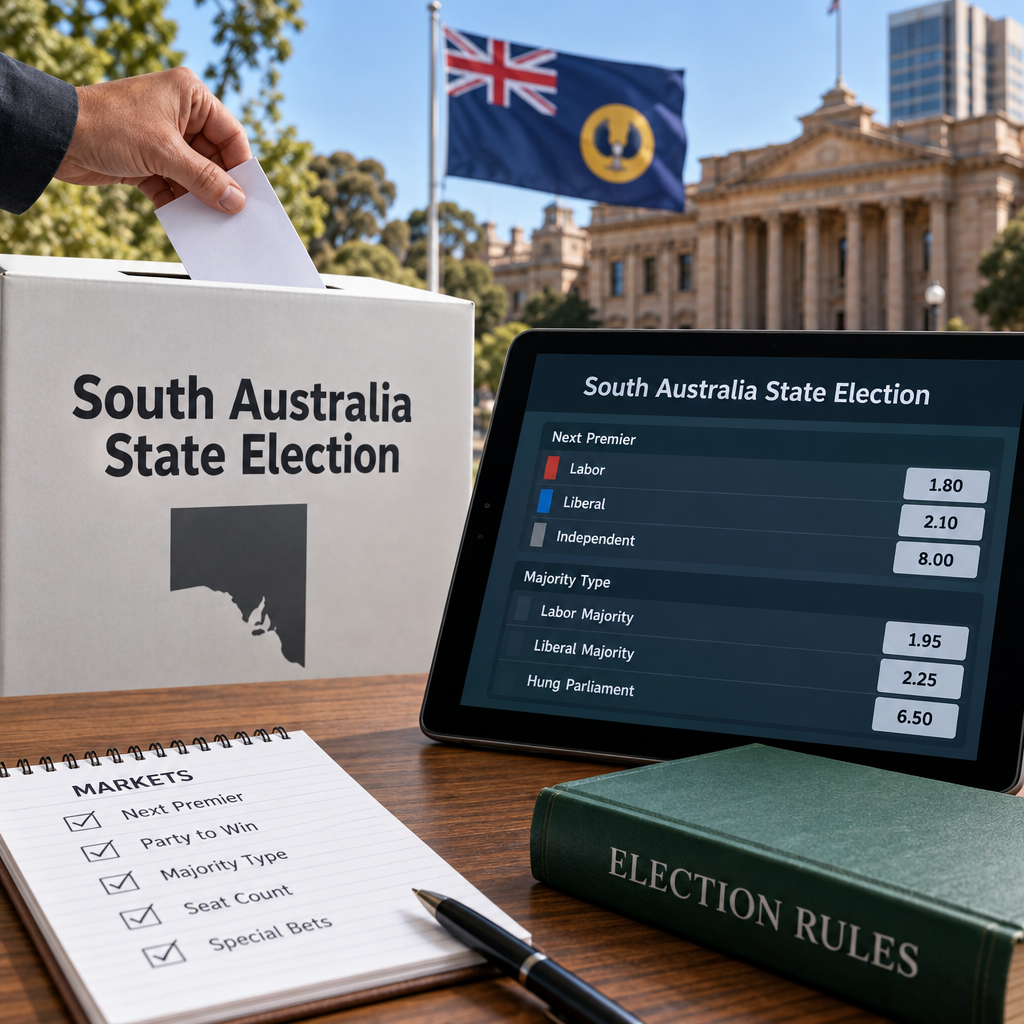
SA election betting refers here to betting on a South Australia state election. The last election took place on 21 March 2026, and the next ordinary election is expected on 16 March 2030, subject to statutory exceptions. Specified state-election betting propositions are included in South Australia’s approved-contingency framework, but that does not mean a bookmaker must offer them. Research dated 5 November 2026 did not verify an open market or live price for the 2030 election. This guide explains the distinction between approval and availability, how different bets work, and what to check before placing one.
Which South Australian election does this cover?
A South Australian state election chooses members of the state Parliament. It is different from a federal election, which chooses members of the Commonwealth Parliament, and from a local council election. A federal seat located in South Australia is still a federal seat, so an election market mentioning an SA electorate is not necessarily a state-election market.
The Electoral Commission of South Australia, or ECSA, identified 21 March 2026 as polling day for the last state election. Under the ordinary four-year cycle, the next election is expected on 16 March 2030. The South Australian Constitution provides for exceptions, so the expected date should not be treated as unconditional.
For context, ABC’s final 2026 House of Assembly tally recorded Labor with 34 seats, the Liberal Party with five, One Nation with four and others with four. The House has 47 seats, making 24 a majority. These figures describe the previous result; they do not establish what the next election’s odds or outcome will be.
- State election: elects the South Australian Parliament.
- Federal election: elects the Commonwealth Parliament, including representatives from South Australia.
- Council election: elects local government representatives and should not be assumed to fall under the state-election betting approval.
Is SA election betting legal?
South Australia’s approved betting contingencies include specified propositions relating to Australian federal and state elections. The Consumer and Business Services (CBS) notice describes election bets including a nominated individual being elected to an office, a party or grouping forming government, and a party or grouping attaining a specified number or range of seats.
That approval is not a blanket permission for every political novelty bet. Whether a particular proposition can be offered depends on the contingency, the provider’s authorisation and applicable conditions. The consolidated notice in the supplied research is dated 23 May 2025; readers should check CBS for any later changes.
CBS is the state’s gambling regulator, while ECSA administers elections. The two roles answer different questions: election information from ECSA does not itself establish that a betting proposition is approved.
For someone in South Australia, the practical question is both whether the provider is authorised and whether the particular market falls within the applicable rules. SA government guidance for interstate operators includes conditions concerning approved contingencies and preventing children from betting. Wagering customers must be at least 18 and meet relevant identity and location requirements.
This is general information, not a determination that a particular provider or bet is lawful in every circumstance. A register listing is useful for checking a service, but it does not independently prove that a specific election proposition is approved or currently offered.
- Check the operator on the Australian Communications and Media Authority (ACMA) register of legal online wagering services.
- Consult the CBS authorised interstate-operator register where relevant.
- Confirm your age, identity and location eligibility with the provider.
- Read the precise proposition and the operator’s applicable election and market rules.
What election betting markets might exist?
South Australian election betting markets can describe several different events. The following are examples of proposition categories contemplated by the approved-contingency framework, subject to the provider’s authorisation and the precise wording. They are not claims that any particular market was open for 2030.
A party-to-form-government proposition asks which nominated party or grouping forms government. That is not necessarily the same question as which party wins the most seats. A party may have more seats than any rival without reaching a majority, and the relevant market wording determines what outcome counts.
For example, suppose Party A wins 22 House of Assembly seats, more than any other party. It has the most seats, but it falls short of the 24 required for a majority in the 47-seat House. A bet on forming government depends on what happens next and on the operator’s definition; the seat count alone may not settle that question.
A most-seats proposition is useful for understanding that distinction, but its precise contingency and authorisation should be checked before assuming a particular version is approved or available. A next-premier proposition also needs separate scrutiny: becoming premier and a party forming government are not automatically identical betting events.
An individual-election proposition concerns a nominated person being elected to a specified office. For example, a hypothetical bet might ask whether Candidate B is elected in a named state electorate. Check the office and electorate carefully, and do not assume a market exists for every candidate or seat.
A party seat-total proposition can instead refer to a number, majority or range. A hypothetical selection of ‘Party A wins at least 24 House seats’ is different from a candidate winning an individual electorate. Check which chamber is covered, the exact threshold and the result source. Terms for ties, uncontested seats or candidate changes can matter.
- Form government: check how the provider defines the party or grouping that forms government.
- Most seats or majority: check the exact event, tie rules and whether a threshold applies.
- Individual elected: check the named person, office and electorate.
- Seat total or range: check the chamber, threshold and settlement source.
- Next premier: check the event definition and authorisation rather than assuming it matches an election-winner bet.
How to read SA election odds
No live 2030 South Australian election price was verified in the research dated 5 November 2026. If a price becomes available, check when it was displayed and which outcome it describes. Odds can change, and two similar-looking selections may have different settlement conditions.
Australian bookmakers commonly express odds in decimal form. To calculate a potential total return, multiply the stake by the decimal price. The total includes the original stake if the selection wins; profit is the total return minus that stake.
For a purely hypothetical example, a $10 stake at decimal odds of 2.50 would return $25 in total if successful, including the $10 stake. The profit would be $15. If the selection loses, the $10 stake is lost.
The simple implied probability of 2.50 is 1 divided by 2.50, or 40%. This is a percentage derived from the price, not a guarantee or necessarily an exact forecast of the event. Bookmaker margins can affect prices.
Odds and polls are also different. A poll estimates the stated views of a sample at a particular time; a betting price is a quote for a defined outcome. Neither guarantees the election result, and a longer-odds selection can still win.
How to check a market and place a bet
If you find a relevant market, first establish that the provider is appropriately licensed and authorised for your location. Complete any required identity checks and decide whether you want to set a deposit limit before adding funds.
Next, confirm that the listing refers to the South Australian state election, not a federal election involving an SA seat or a local council contest. Check the year, the chamber or office and the exact selection. A market title alone may not explain the event fully.
Before confirming a bet, review the stake, displayed price, potential return and any listed close or suspension time. No universal closing time was verified for these markets. In particular, a polling-place closing time should not be treated as the bookmaker’s deadline.
Finally, read both the general election rules and any terms attached to the specific market. Look for the result source, treatment of ties and candidate withdrawals, and provisions for delays or disputes. If a term is unclear, ask the provider before deciding whether to bet.
How election bet settlement can differ from the count
Election bet settlement is the process by which an operator determines the winning selections and accounts for bets under its rules. It should not automatically be assumed to occur only after the final official declaration. Providers may specify different sources, timing or treatments for exceptional situations.
Sportsbet’s published general election rules provide one example, not a rule for the entire industry. They state that all-in betting applies unless otherwise stated, and describe ‘all in, run or not’ treatment for specified next-leader and similar markets. Under an applicable all-in rule, a candidate’s withdrawal might not result in a refund.
Sportsbet’s general rules also allow the use of projected election information and early data for settlement. Those provisions do not prove that Sportsbet offers a 2030 South Australian election market, and they may be affected by the terms of a particular market.
Counting and disputes can continue after polling day. Do not assume that a later recount will always reopen a settled bet, that every withdrawn candidate will be refunded, or that all providers use the same result source. The applicable operator and market-specific rules are the starting point.
Payments, limits and gambling support
An election bet can lose its full stake. Consider setting a deposit limit before betting and reviewing your activity statements to understand what you have spent. Limits may need to be set separately with each provider, and using them does not make losses impossible.
Since 11 June 2024, Australian online and telephone wagering providers have been prohibited from accepting deposits using credit cards, funds linked to credit cards, including through digital wallets, or digital currency. That restriction does not establish that a particular debit card, wallet or transfer method is accepted by a provider.
BetStop provides self-exclusion from all Australian-licensed interactive wagering providers. It is not a blanket exclusion from every physical gambling venue. For free, confidential help, Gambling Help Online is available on 1800 858 858, 24 hours a day. Gambling Harm Support SA provides a further state-specific source of support.
FAQ
Can I bet on the next South Australian election?
Specified state-election propositions are included in South Australia’s approved-contingency framework, subject to the provider’s authorisation and applicable rules. Research dated 5 November 2026 did not verify an open market for the expected 2030 election. That does not establish that betting is prohibited or that no provider offers a market.
When do SA election betting markets close?
No universal closing time was verified. Check the individual market’s displayed closing or suspension time and its terms. Do not assume a bookmaker will accept bets until polling places close, or that every election proposition has the same deadline.
What happens if no party wins a majority?
The answer depends on what the bet asks. Winning the most seats, achieving a majority and forming government are different events. A party can have the most seats without reaching the 24-seat majority threshold in the House of Assembly. Check the market terms rather than assuming every bet will be void.
Are election odds the same as polls?
No. Election odds are a price for a defined betting outcome, while polls estimate the views of a sample at a particular time. An implied probability calculated from odds is not necessarily a precise forecast, and neither a poll nor a price guarantees the result.
What if a candidate withdraws or the result is disputed?
Check the operator’s general election rules and the specific market terms. For example, Sportsbet’s general rules describe all-in treatment unless otherwise stated and permit the use of projected information in settlement. Those operator-specific provisions do not establish a universal refund or recount rule.
Does a licensed operator have to offer every approved election bet?
No. Approval of a specified contingency is not a requirement that an operator offer it. An operator-register listing can help you check the service, but it does not prove that a particular proposition is approved or currently available.
The next ordinary South Australian state election is expected in 2030, and specified election propositions are included in the state’s approved-contingency framework. Research dated 5 November 2026 did not verify an open 2030 market; that is not proof that none exists. Availability, prices and rules can change, so check the provider’s authorisation and exact terms before betting. For election dates and official election information, consult ECSA.