Online Bitcoin Sports Betting in Australia: Rules, Payments and Risks
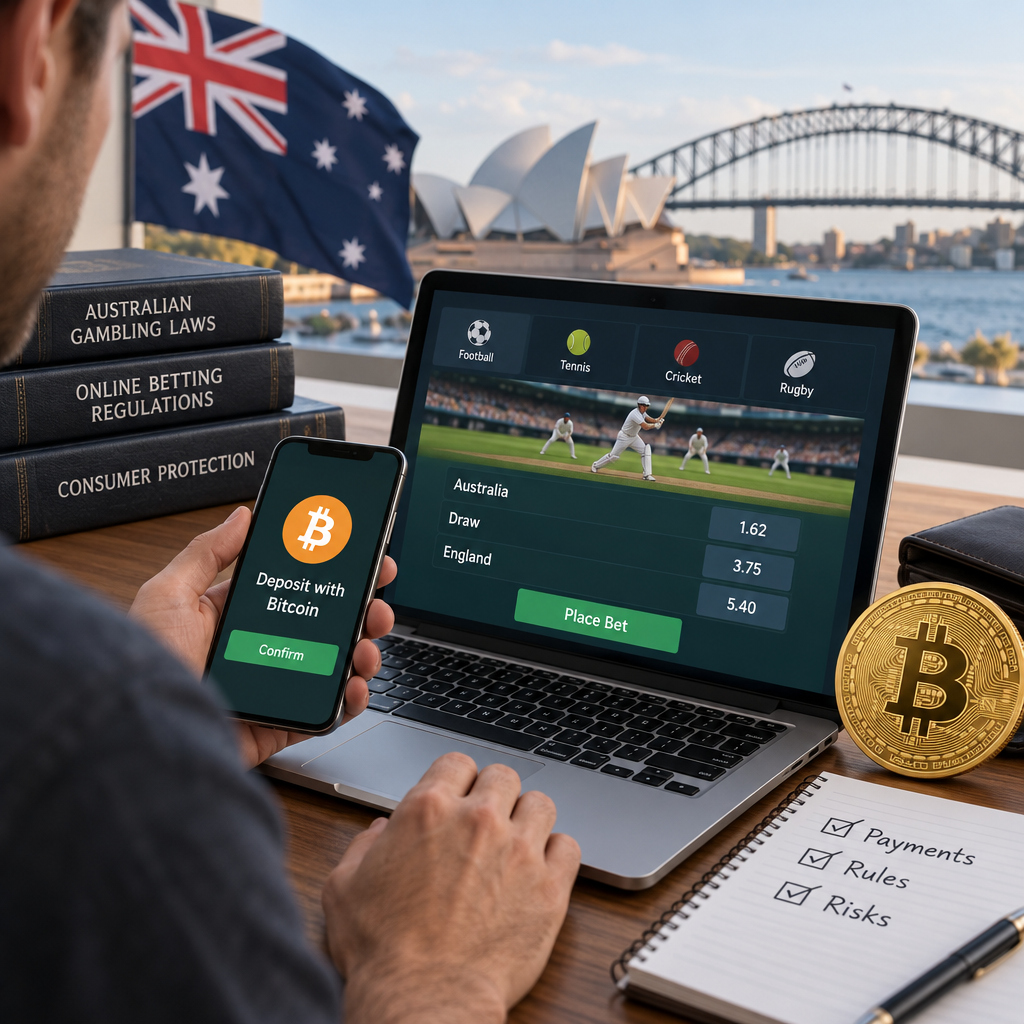
Australians searching for online bitcoin sports betting may find websites advertising BTC deposits, but access to a website does not establish that it is authorised to operate in Australia. Australian-licensed online and telephone wagering providers cannot accept digital currency directly as a payment method. This guide explains the distinction between the wager and its funding, how to check a provider, and what to consider before converting or transferring bitcoin. The regulatory information reflects the supplied research checked on 5 November 2026 and applies to people physically in Australia.
Is bitcoin sports betting legal in Australia?
Some online sports wagering is permitted in Australia when the provider holds the appropriate state or territory licence and offers an authorised service. That is a separate question from whether the provider may accept bitcoin: covered online and telephone wagering providers cannot accept digital currency as payment.
The payment restriction began on 11 June 2024. It also applies to credit cards and certain credit-linked methods. It is not a ban on cryptocurrency itself or on every form of gambling; lotteries are outside this particular payment ban.
An overseas licence, an Australian-facing website or an app that can be downloaded in Australia does not establish Australian authorisation. ACMA identifies unlicensed online sports betting as a service that cannot be offered to people in Australia. Its guidance focuses on providers; it does not establish that every customer who uses an offshore site automatically commits a federal offence.
Online in-play sports betting is also prohibited from being offered to people in Australia. Do not assume that this online restriction applies identically to every telephone or venue wager placed during an event. Product rules and licensing conditions can differ.
For example, a pre-event online sports wager with an appropriately licensed provider is a different proposition from depositing BTC with an offshore site that lacks the required Australian authorisation. Even for a licensed provider, check that the particular product and payment method are permitted.
Selling bitcoin for Australian dollars is a separate transaction
Selling BTC separately and later depositing the Australian-dollar proceeds with a licensed provider is not the same transaction as paying that provider in bitcoin. In the former case, the provider receives conventional money rather than digital currency.
Consider a simple illustration: a person sells BTC, receives AUD and later uses an independently accepted conventional payment method to fund an account. That distinction follows from the nature of the payment received by the provider; it is not a specific approval of every arrangement.
Exchange, bank and bookmaker terms may affect whether a particular transaction is accepted. Do not assume a crypto-linked card, intermediary or credit facility is an approved workaround. Selling crypto can also have tax consequences, regardless of what happens to a subsequent wager.
How to check a provider and raise a complaint
ACMA maintains a register of licensed interactive gambling providers. Use it before relying on a bookmaker’s claims, and check the details rather than just recognising a brand or seeing a licence badge.
ACMA accepts reports about prohibited interactive gambling services and banned payment methods. Other complaints about a licensed operator generally go to its state or territory licensing authority. Keep a copy of your complaint and ask the relevant authority about its process.
Australian remedies may be limited if an illegal offshore service withholds funds or treats a customer unfairly. ACMA warns it cannot resolve certain disputes of that kind, and a report does not guarantee reimbursement. Independent legal advice may be useful if a substantial amount is in dispute.
- Search the ACMA register and check the trading name, legal licence holder and website address.
- Note the listed licensing authority and contact it if the provider’s status, website or product scope is unclear.
- Check the product itself: holding a licence does not automatically authorise every type of wager.
- Retain account records, transaction IDs, correspondence and the terms that applied when the dispute arose.
How bitcoin deposits work at services elsewhere
Some services outside Australia advertise crypto-funded accounts. The following explanation describes general payment mechanics, not a direct-payment option available with an Australian-licensed online wagering provider or a recommendation to use an offshore site.
A service accepting BTC may provide a deposit address, which identifies the destination for a transfer. The sender may use a wallet or an exchange account; a separate self-custody wallet is not necessarily required. The service’s rules determine when it credits a received payment.
The asset and network need to match the receiving service’s requirements. On-chain bitcoin, a token representing bitcoin on another network and a Lightning payment are not automatically interchangeable. A QR code can convey payment details, but it does not prove that a recipient is legitimate.
A first on-chain confirmation means the transaction has been included in a block; further confirmations accrue as later blocks are added. A service may leave a deposit pending until it reaches its chosen threshold. Requirements and delays vary, so there is no universal crediting time.
Balances, odds and bitcoin withdrawals
A service may keep an account balance in BTC or convert a deposit into fiat currency. If it remains in BTC, its Australian-dollar value can change as the bitcoin price moves. If it is converted, the exchange rate and spread affect the amount credited; later exposure depends on the currency in which the balance is held.
Decimal odds describe the total return per unit staked on a winning bet. For example, at hypothetical odds of 2.00, a winning $10 wager returns $20, including the original $10 stake. A losing wager generally loses the stake. This illustration assumes normal acceptance and settlement and excludes fees.
A winning result is not the same as money arriving in a wallet. A service may first process or approve a withdrawal, after which an on-chain transfer still requires confirmation. Its terms may also allow identity or account-ownership checks. Neither processing nor payment should be assumed to occur within a particular period.
Before relying on any advertised withdrawal method, examine the terms and consider whether the service is authorised for the customer and product. A published policy is not a guarantee that a disputed withdrawal will be paid.
- Check whether the balance and withdrawal are denominated in BTC or a conventional currency.
- Identify the conversion rate, spread and any deposit or withdrawal charges.
- Check destination network requirements, minimums, maximums and identity requirements.
- Read the rules on processing, account closure, disputed bets and complaints.
Costs, transfer errors and offshore risks
Several different costs can reduce the amount received. A trading fee is not necessarily the same as a spread: the spread is the difference between quoted buying and selling prices. A platform’s withdrawal charge may also differ from the underlying network fee.
On-chain bitcoin fees depend on transaction size, the fee rate and network demand, rather than being a fixed percentage of the value sent. The amount charged by a particular exchange or service depends on its own terms.
A confirmed bitcoin transaction generally cannot be reversed by the sender. Recovery after an error may depend on the recipient or a custodian being able and willing to help, and is not assured. An unconfirmed transfer is a different situation and should not automatically be treated as permanently settled.
Price movements, stolen credentials, delays and limited recourse against an offshore provider can compound gambling losses. Protect wallet and exchange access, and never disclose a wallet recovery phrase.
- Exchange trading fee or spread: a possible cost of buying or selling BTC.
- Network fee: a cost associated with an on-chain transfer.
- Exchange or custodian withdrawal fee: a platform charge that may be separate from the network fee.
- Operator charge: any deposit, conversion or withdrawal charge specified by the service.
Tax: distinguish a crypto disposal from the wager
Selling bitcoin for AUD or converting it into another asset can have capital gains tax consequences. The ATO distinguishes a disposal from moving crypto between wallets while retaining ownership. Keep dates, Australian-dollar values, exchange records and relevant fees so the transactions can be assessed.
The ATO says capital gains and losses made directly from gambling winnings or losses are disregarded for capital gains tax purposes. That does not mean every associated crypto transaction is tax-free. A later disposal of cryptocurrency received as winnings may have consequences depending on the circumstances.
For example, selling BTC for AUD before making a deposit is a separate transaction from the eventual gambling result. Tax treatment can depend on how and why an asset was held. Seek Australian tax advice if you are unsure how the rules apply to you.
Conventional payments, identity checks and support
An ordinary debit card is a potential payment method with a licensed wagering provider that accepts it. Check the provider’s current options and your bank’s terms. Do not assume a card linked to credit or another prohibited facility is acceptable.
Licensed sports wagering is an activity for adults aged 18 and over. Australian online gambling providers must complete applicable customer identification procedures before creating an account or commencing the designated service. Further checks may occur later; using cryptocurrency elsewhere does not establish a right to anonymous betting.
If you choose to gamble, decide on spending and time limits beforehand, take breaks and avoid chasing losses. These measures can reduce exposure but cannot eliminate gambling harm.
BetStop is a free national self-exclusion service covering all Australian-licensed online and telephone wagering providers. Registration can last from at least three months up to a lifetime. It does not cover illegal services, so it should not be assumed to block every gambling website.
Gambling Help Online offers free, confidential support. The Gambling Helpline is 1800 858 858 and is available across Australia 24 hours a day, seven days a week.
FAQ
Can I use bitcoin directly with an Australian sportsbook?
No. Australian-licensed online and telephone wagering providers cannot accept digital currency as payment. Selling bitcoin separately and later making a conventional AUD deposit is a different transaction, but that distinction does not approve every intermediary, card or payment arrangement.
Are offshore bitcoin betting sites legal for Australians?
Providers cannot offer unlicensed online sports wagering to people in Australia. An offshore licence or accessible website does not establish Australian authorisation. The provider-focused rules do not, by themselves, establish that every customer automatically commits a federal offence.
What fees can apply to bitcoin deposits and withdrawals?
Possible costs include exchange trading fees and spreads, on-chain network fees, exchange withdrawal charges and any service-specific conversion or withdrawal charges. Not every charge applies to every transaction, and amounts vary. Check the terms of each platform involved.
Do I need to verify my identity to use an Australian wagering account?
Australian online gambling providers must complete applicable identification procedures before creating an account or commencing the designated service. They may request further checks later. Practices at overseas services vary and do not establish an entitlement to anonymous wagering.
What happens if bitcoin goes to the wrong address?
A confirmed transfer generally cannot be reversed by its sender. Recovery may depend on the recipient, a custodian and the circumstances, and is not guaranteed. Contact the relevant wallet or exchange promptly, but do not assume it can retrieve the funds.
Does BetStop cover offshore betting sites?
BetStop covers all Australian-licensed online and telephone wagering providers, but not illegally provided services. It is free and offers exclusion for at least three months and up to a lifetime; it does not block every gambling website.
Is selling bitcoin for AUD to fund a betting account taxable?
Selling bitcoin can have capital gains tax consequences depending on the transaction and your circumstances. The sale is separate from the later gambling result. Keep records of dates, AUD values and relevant fees, and seek Australian tax advice if needed.
Australian-licensed online and telephone wagering providers cannot accept bitcoin directly. Selling BTC separately and depositing AUD is a different transaction, but its tax treatment and the payment provider’s terms still matter. Check the ACMA register and the specific product before using a service, and be cautious about offshore sites where Australian remedies may be limited. If gambling is causing concern, consider BetStop or contact Gambling Help Online.