Military Alphabet Chart: A–Z Code Words and Pronunciation
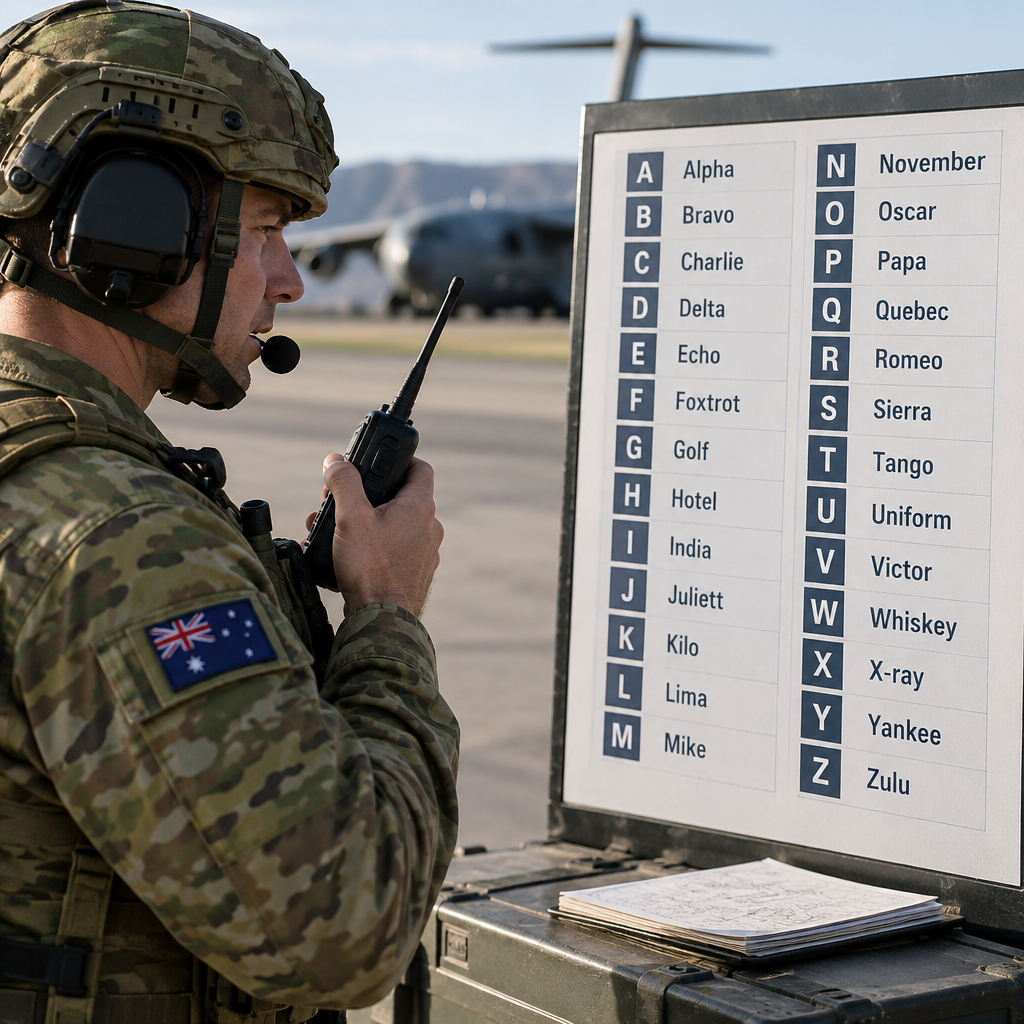
The military alphabet assigns a spoken word to each letter to make spelling clearer over radio, telephone or in person. A is Alfa, B is Bravo and C is Charlie: the familiar “alpha bravo charlie” sequence begins with Alfa in the international chart. Also known as the NATO phonetic alphabet, it is called the International Radiotelephony Spelling Alphabet by the International Civil Aviation Organization (ICAO). It is not exclusively military. Use the chart below to find a word, check its approximate pronunciation and practise spelling a name or reference. The system helps reduce confusion, but it cannot guarantee that a message will be heard correctly.
Military alphabet chart: A–Z code words and pronunciation
The chart uses ICAO’s written code words and approximate pronunciation based on the Airservices Australia chart dated 19 March 2026. Capital letters in the pronunciation column show emphasis. These are English pronunciation aids, not International Phonetic Alphabet transcriptions, and you do not need to suppress an Australian accent to use them.
Letter | Code word | Approximate pronunciation A | Alfa | AL-fah B | Bravo | BRAH-voh C | Charlie | CHAR-lee or SHAR-lee D | Delta | DELL-tah E | Echo | ECK-ho F | Foxtrot | FOKS-trot G | Golf | GOLF H | Hotel | ho-TELL I | India | IN-dee-A J | Juliett | JEW-lee-ETT K | Kilo | KEY-loh L | Lima | LEE-mah M | Mike | MIKE N | November | no-VEM-ber O | Oscar | OSS-cah P | Papa | pah-PAH Q | Quebec | keh-BECK R | Romeo | ROW-me-oh S | Sierra | see-AIR-rah T | Tango | TANG-go U | Uniform | YOU-nee-form or OO-nee-form V | Victor | VIK-tah W | Whiskey | WISS-key X | X-ray | ECKS-ray Y | Yankee | YANG-key Z | Zulu | ZOO-loo
The Airservices guidance lists both pronunciations shown for Charlie and Uniform. For listening practice, the Defence International Training Centre has a phonetic alphabet exercise, listed in the sources below. It is a useful supplement to the chart, not a substitute for formal radio training.
How to use the military alphabet
Each code word represents one letter. Find the word for each letter, then say the words in the same order as the original spelling.
For example, to spell SAM, use Sierra for S, Alfa for A and Mike for M. Say “Sierra – Alfa – Mike”. A listener can take the initial letter of each word and reconstruct the name.
For a fictional booking reference BNE, say “Bravo – November – Echo”. If the person on an ordinary phone call is unfamiliar with the alphabet, you could make the connection explicit: “B as in Bravo, N as in November, E as in Echo.” That is a conversational aid, not a universal radio procedure.
You normally need to spell only the part of a message that needs clarification, rather than every word. Leave a little space between code words and ask the listener to confirm the result if accuracy matters. If a word is missed, repeat or clarify it: a distinctive code word cannot repair a transmission that was not heard.
- Identify the letters you need to communicate.
- Say one code word for each letter, in order.
- Confirm the spelling or repeat any part that remains uncertain.
Why are Alfa and Juliett spelled differently?
The ICAO chart writes A as Alfa and J as Juliett, even though Alpha and Juliet may look more familiar to English readers. ICAO explains that Alfa uses an “f” because speakers of some languages might not recognise the English “ph” as the intended sound. The extra final “t” in Juliett helps discourage French speakers from treating a single final “t” as silent.
These written forms were intended to support consistent pronunciation across languages. The difference is worth knowing when looking up a chart or checking a written procedure.
Some Australian documents use the familiar English spellings instead. A Defence International Training Centre worksheet and an Australian Communications and Media Authority marine-radio syllabus print Alpha and Juliet. ICAO and the dated Airservices aviation chart print Alfa and Juliett.
That is a difference in published spelling; it does not, by itself, mean the documents prescribe entirely different spoken words. Alpha and Juliet are not always wrong simply because the ICAO chart uses different written forms. When working under a particular procedure, use the applicable document for your service.
The phonetic alphabet in Australia
Australian Defence training and civil aviation materials both reference the international spelling alphabet. That does not establish that every Australian organisation uses an identical written chart or follows the same communication procedure.
The Defence International Training Centre teaches the alphabet in a military-English resource, including exercises for recognising and spelling words. A teaching resource demonstrates that the system is taught in that context; it is not, on its own, proof of an operational directive covering every Australian Defence Force unit.
In civil aviation, the Airservices Australia Aeronautical Information Publication dated 19 March 2026 specifies the alphabet when proper names, service abbreviations and words of doubtful spelling are spelled out in radiotelephony. This does not mean that every word in a radio call must be spelled.
CASA’s Visual Flight Rules Guide illustrates an aircraft-registration callsign, VH-ZTQ, with “Zulu Tango Quebec”. This is an example from the guide, not a rule for every callsign: the applicable procedure depends on the operation.
Other sectors have their own documents. ACMA publishes a marine-radio syllabus containing a letter chart, while RailSafe publishes a rail communication procedure with letter and number guidance. Check that a document applies to your service and is currently effective before relying on it operationally.
The aviation chart cited here is dated, and later AIP amendment cycles exist. Pilots and radio operators should consult the currently effective instructions rather than treating this article as operational training.
Do radio numbers use the same rules?
Numbers have separate pronunciation and grouping rules from the A–Z chart. Those rules depend on the service and context: the dated Airservices aviation guidance includes exceptions to reading numbers digit by digit, while RailSafe gives different pronunciation forms for some numbers.
Do not assume that a number rule used in one setting applies to another. For formal communication, check the current guidance for your organisation or service.
A brief history of the alphabet
The words used to spell letters have changed over time. An earlier system included “Able Baker”, rather than today’s “Alfa Bravo”. International standardisation addressed the need for words that could be recognised by speakers from different language backgrounds.
ICAO records 1 March 1956 as the implementation date for the final alphabet, and NATO identifies the same date as its effective date for NATO use. The widely recognised NATO phonetic alphabet is now encountered well beyond military settings, including in Australian aviation and training materials.
FAQ
What is the military alphabet used for?
It helps people distinguish individual letters when spelling names, identifiers or other words aloud. It can be useful over a radio or telephone, where similar-sounding letter names may be confused. It reduces the chance of misunderstanding but cannot guarantee reception.
How do you pronounce the military alphabet?
Use the approximate pronunciations in the chart, with capital letters indicating the syllables to emphasise. For example, Hotel is shown as ho-TELL. The respellings are guides rather than exact sound transcriptions, and you do not need to change your Australian accent.
Why do some charts say Alpha and Juliet?
ICAO uses Alfa and Juliett for cross-language pronunciation reasons. Some Australian documents, including a Defence training worksheet, use the familiar written forms Alpha and Juliet. The different spellings alone do not establish that the spoken code words are different.
Is there an Australian version of the phonetic alphabet?
Australian Defence training and civil aviation materials reference the international system, but published spellings and procedures can differ. For example, the Defence worksheet uses Alpha and Juliet, while the dated Airservices aviation chart uses Alfa and Juliett. Check the document applicable to your organisation.
Is the military alphabet a secret code?
No. It makes letters easier to understand; it does not conceal them. Anyone familiar with the system can recognise that “Sierra – Alfa – Mike” spells SAM. An encrypted message could be spoken using the alphabet, but encryption is a separate process.
Is the NATO phonetic alphabet the same as the International Phonetic Alphabet?
No. The NATO spelling alphabet uses words such as Bravo to communicate written letters. The International Phonetic Alphabet uses symbols to represent speech sounds. The approximate pronunciations in this article are not International Phonetic Alphabet transcriptions.
To use the military alphabet, choose one code word for each letter and say the words in order. Practise with a name or fictional reference, then ask a listener to repeat the letters back. For formal radio work, consult the current procedures for your service: the chart is a helpful starting point, not a replacement for operational training.