How to Find Sports Betting Arbitrage Opportunities in Australia and India
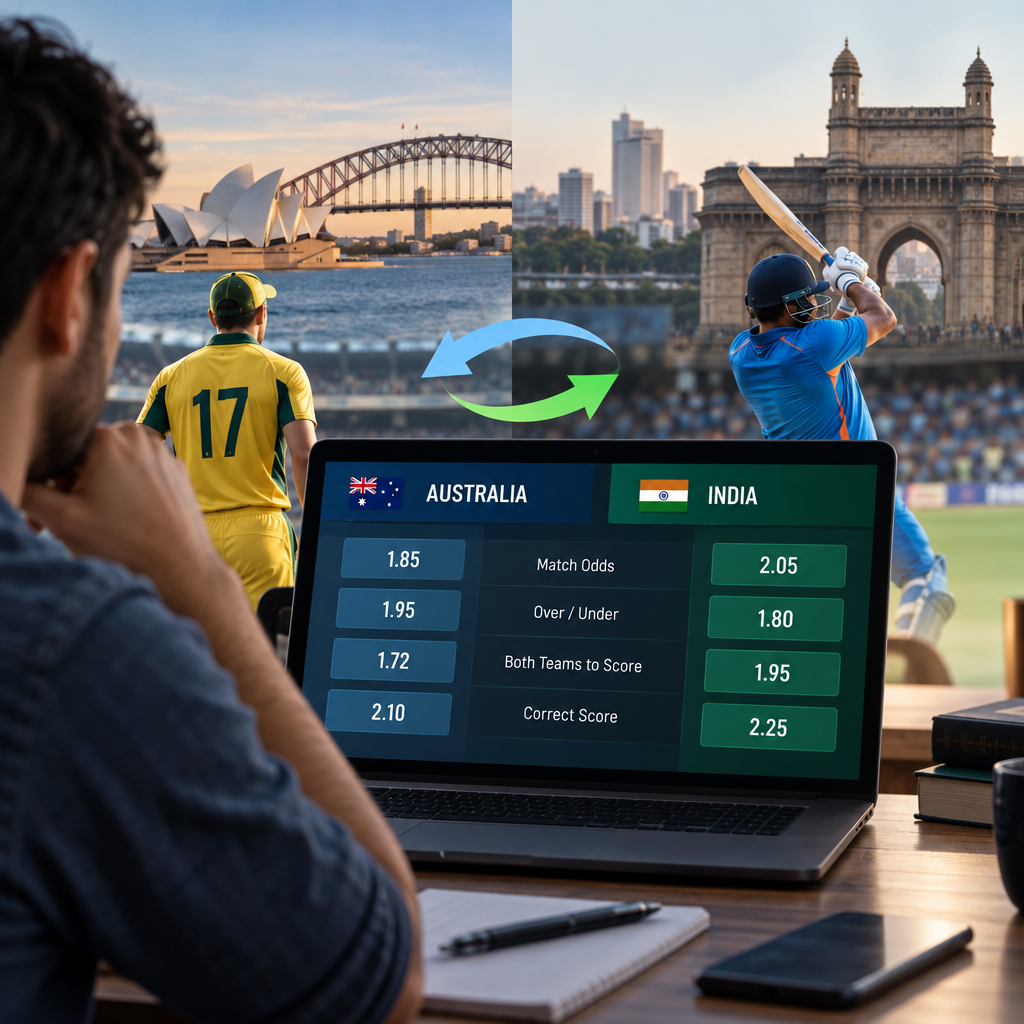
How do people find sports betting arbitrage opportunities, and do the same rules apply in India and Australia? The starting point is to compare prices on every possible outcome of the same market. If their combined implied probability is below 100%, there may be a potential opportunity before costs. The calculation works the same way in both countries, but access and gambling laws do not. India’s national online-gaming framework changed in 2026, while Australia has its own licensing and wagering restrictions. An apparent mathematical opportunity is neither proof of lawful access nor a promise of profit. The steps below explain how to match markets, calculate stakes and check what could go wrong.
What sports betting arbitrage means
Sports betting arbitrage, sometimes called arbing, involves combining prices on outcomes that cannot both occur and that together cover every relevant result. With suitable stakes, compatible settlement rules and accepted bets, the combined position can produce a positive pre-cost profit whichever covered outcome occurs.
Decimal odds express the total winning return per unit staked, including the stake. For example, a winning A$1 bet at odds of 2.10 returns A$2.10 before costs. The price’s implied probability is one divided by the decimal odds; it is derived from the price and is not necessarily the outcome’s true probability.
Return and profit are different. Return includes the winning stake, while profit subtracts all stakes and applicable costs. The expression “sure bet” describes the intended mathematical position, not a guarantee that every bet will be accepted or settled as expected.
Arbitrage also differs from value betting. A value bettor judges one price to be favourable compared with an estimate of the outcome’s true probability. An arbitrage calculation combines prices across the complete outcome set; one attractive price alone does not establish an arbitrage.
How to identify an apparent opportunity
To find arbitrage opportunities in sports betting, start with a specific event and a market whose outcomes you understand. For the Australian examples in this article, use pre-match prices: online in-play sports betting is prohibited, subject to limited exceptions.
The following process is a screen for a possible position, not an instruction to assume every displayed price can be obtained. Confirm that you can lawfully access the services and that their rules fit the proposed coverage.
- Identify the same event: check the competition, participants and scheduled start time.
- Choose equivalent markets and list every outcome that can determine settlement.
- Record the best quoted decimal odds for each outcome, the source and the time checked.
- Add the implied probabilities. A total below 100% is a potential pre-cost signal.
- Calculate the stakes and check the return under every possible covered result.
- Check current prices, eligibility, available balances, limits, fees and settlement rules before treating the position as viable.
Compare equivalent markets and settlement rules
The same team names do not necessarily mean two bets cover the same proposition. A regulation-time soccer result can have home win, draw and away win outcomes. A differently named winner market may instead include extra time or penalties. Combining those markets without checking the rules can leave a result uncovered.
Read each operator’s rules for postponements, abandonment and walkovers. Player markets may also depend on whether a participant starts or takes part. If two services handle the same interruption differently, one bet might stand while the other is void.
Handicaps and totals need particular care: matching team names is not enough if the lines differ, and a push or partial settlement is possible. The simple formula below is for ordinary back bets covering an exhaustive outcome set. A lay bet is a different proposition and requires separate treatment of liability, matching and commission.
- Check the event, market name and settlement period.
- Include a draw wherever it is a separate settlement outcome.
- Compare regulation-time, overtime and penalty provisions.
- Check abandonment, postponement, withdrawal and player-participation terms.
- For handicaps or totals, check the exact line and how pushes or partial settlements work.
Compare bookmaker odds manually or with a tool
Manual comparison means collecting prices yourself from the relevant markets, recording when you saw them and checking the underlying rules. It can be useful for understanding exactly which outcomes you are comparing, although quotes can change between checks.
An odds-comparison tool or arbitrage scanner can help organise prices, but a displayed result is only a lead. It may be delayed, incomplete, unavailable to you or based on markets that settle differently. Reopen each underlying market and verify the current offer, terms and your eligibility.
A comparison tool does not establish that a service is licensed in Australia or that access is lawful from India. Neither a manual search nor a scanner guarantees that an opportunity will be found or that all legs can be placed.
Calculate the implied-probability total
For each outcome, divide one by its decimal odds, then add the results. Call the sum S. For a complete set of compatible ordinary back bets, S below 1 indicates a potential arbitrage before costs; S equal to 1 is theoretical break-even; and S above 1 gives a pre-cost loss under an equal-return allocation.
Consider a fictional pre-match event with exactly two outcomes and compatible rules. If the quoted odds are 2.10 for outcome A and 2.20 for outcome B, the calculation is: 1 ÷ 2.10 + 1 ÷ 2.20 = approximately 0.93074, or 93.074%.
The total is below 100%, so the prices pass the preliminary test. They are deliberately generous fictional figures, not evidence of available or typical prices. The test assumes both quotes can be accepted at the required stakes and that no fees or settlement differences affect the result.
Do not treat the gap between 100% and the implied-probability total as the profit percentage on total stake. The equal-return calculation produces a different figure: before costs and rounding, the profit proportion is 1 ÷ S minus 1.
Calculate arbitrage stakes and returns
To allocate a chosen total stake across the outcomes, calculate each stake as: total stake × (1 ÷ that outcome’s odds) ÷ S. Before costs and rounding, each winning return is the total stake divided by S. Subtract the total stake to find the pre-cost profit.
Using A$100 with the fictional 2.10 and 2.20 prices gives the rounded stakes below. They add up to A$100, but their returns differ slightly because the stakes have been rounded to cents.
If A wins, the return is A$107.436 and the pre-cost profit is approximately A$7.44. If B wins, the return is A$107.448 and the pre-cost profit is approximately A$7.45. Without stake rounding, either return would be approximately A$107.44.
This arbitrage stake calculation is a starting point. Minimum stakes, maximums, accepted increments and fees may change the outcome. If a price or permitted stake changes, recalculate all legs rather than assuming the original allocation still works.
- Outcome A: odds 2.10; stake A$51.16; return if it wins A$107.436.
- Outcome B: odds 2.20; stake A$48.84; return if it wins A$107.448.
Costs, execution and settlement risks
The main practical problem is that a quote is not an accepted wager. If the first leg is accepted and the second is rejected, partly accepted or repriced, the bettor may be left with an exposed position. A price that passes the test on screen can also disappear before all bets are placed.
Balances, minimum and maximum stakes, account restrictions and stake increments can prevent the calculated allocation. Funds may also need to be held across services while waiting for settlement or withdrawal.
Settlement differences can be just as important as price changes. If an event is postponed and one operator returns a stake while another settles its bet, the original equal-return calculation may no longer apply. That is different from every leg being void. Check any terms on mistaken prices and adjustments as well.
Use actual fee terms when calculating each net outcome. For example, Betfair Australia says its exchange commission is calculated on net winnings for the market; that is an operator-specific example, not a reason to subtract a flat percentage from every combined return. Currency conversion and other applicable costs can also remove a pre-cost edge.
If tax treatment would materially affect a decision, check the current rules and obtain individual advice. Whatever the cause of a change, recalculate every possible net outcome rather than relying on the original screen.
Australia: check the operator, market and payment rules
ACMA says services offering sports betting to people in Australia need an Australian licence. Before using a service, check its actual trading name and website against ACMA’s register and note the licensing authority. A listing does not guarantee that a particular market, price or account is available to you.
Australian sports betting rules also restrict the method of placing a bet. Online in-play sports betting is prohibited, with limited exceptions that include qualifying telephone bets. Do not assume that constructing a bet in an app and then calling necessarily meets the telephone exception.
Since 11 June 2024, restrictions on deposits for online and telephone wagering have included credit cards, credit-card-linked funds and digital currency. Check both the current ACMA guidance and the operator’s permitted payment methods; the restriction does not mean every other method is available.
If a dispute arises, identify the regulator responsible for the operator and check its process. For example, the Northern Territory’s procedure has its own exclusions, including certain complaints about bets that were never accepted or were refused. Other jurisdictions may apply different procedures.
As of 5 November 2026, ACMA identifies most reforms under the Interactive Gambling Amendment (Gambling Reform) Act 2026 as commencing on 1 January 2027. Check their implementation and the current register before relying on this information after that date.
- Check the operator and licensing authority on the ACMA register.
- Check that the market and betting method comply with current restrictions.
- Read the settlement and payment terms for the actual service.
- If necessary, consult the relevant state or territory regulator about complaints.
India: check the national framework and local circumstances
The arithmetic for sports betting arbitrage in India is the same, but an Australian licence does not establish that a service can lawfully be used from India. Older descriptions of Indian online gambling as only a state-by-state grey area do not account for the national framework introduced in 2026.
India’s Promotion and Regulation of Online Gaming Act, 2025 and associated rules commenced on 1 May 2026, according to the official materials identified in the research. The Act broadly defines online money games and addresses offering or facilitating defined services, advertising and payments. Its territorial wording also covers certain services operated from outside India.
A MeitY advisory discusses blocked online betting platforms and warns intermediaries, including VPN providers, against facilitating access. An offshore account or VPN does not itself establish lawful access.
The statutory provisions about services and facilitation should not be turned into a claim that every individual bettor commits the same offence. Nor does the available research conclusively classify every sports-wagering product or resolve every individual circumstance. State law can also matter; Tamil Nadu, for example, has its own online-gambling legislation.
The application of national and state rules, including any relevant court orders, requires a current check. Consult MeitY’s official materials and seek qualified local legal advice before participating.
FAQ
Is sports betting arbitrage risk-free?
No. A positive theoretical calculation depends on all bets being accepted at the assumed prices and settling under compatible rules. A rejected second leg, changed odds, costs or a one-sided void can leave a loss. Even an accepted position should be assessed against the relevant settlement and mistaken-price terms.
Can I find arbitrage opportunities without a scanner?
Yes. You can manually record prices for every outcome in matching markets, add their implied probabilities and calculate the stakes. Check the time, current offer and rules for each quote. A scanner may help with comparison, but neither method guarantees discovery, access or acceptance.
Does the calculation work for a three-outcome market?
Yes, if all three outcomes are included and the markets have compatible settlement rules. For fictional regulation-time home, draw and away odds of 2.50, 3.40 and 4.00, the implied probabilities add to approximately 94.41%. That is a preliminary pre-cost screen, not an executable offer or proof of profit.
What happens if one arbitrage bet is void?
If one stake is returned but another bet stands, the remaining position may no longer have the intended equal return and could lose money. For example, operators may apply different rules after a postponement. Check each market’s terms; a case where all legs are void has a different result.
Is arbitrage betting legal in Australia or India?
There is no single conclusion here for every arrangement. In Australia, check the operator’s licence and the restrictions on the market, betting method and payments. In India, check the current national framework, relevant state law and your circumstances. An offshore account or VPN is not proof of lawful access; seek local advice where appropriate.
Do fees always cancel an apparent arbitrage?
Not necessarily, but they can remove a pre-cost edge. Calculate the net result for each outcome using the actual terms. An exchange may charge commission on net market winnings rather than the whole combined return, while rounding or currency conversion may also affect the calculation.
Treat sports betting arbitrage as a calculation to investigate, not a promised outcome. Match the markets, include every outcome, calculate stakes and net returns, and revisit the result whenever a price or term changes. Check the rules and services applicable to your location before participating. Australian readers can use the ACMA register to check operators. BetStop offers self-exclusion from Australian-licensed online and telephone wagering services, while Gambling Help Online offers support on 1800 858 858.