Gamble online slots in Australia: legality, pokies mechanics and risks
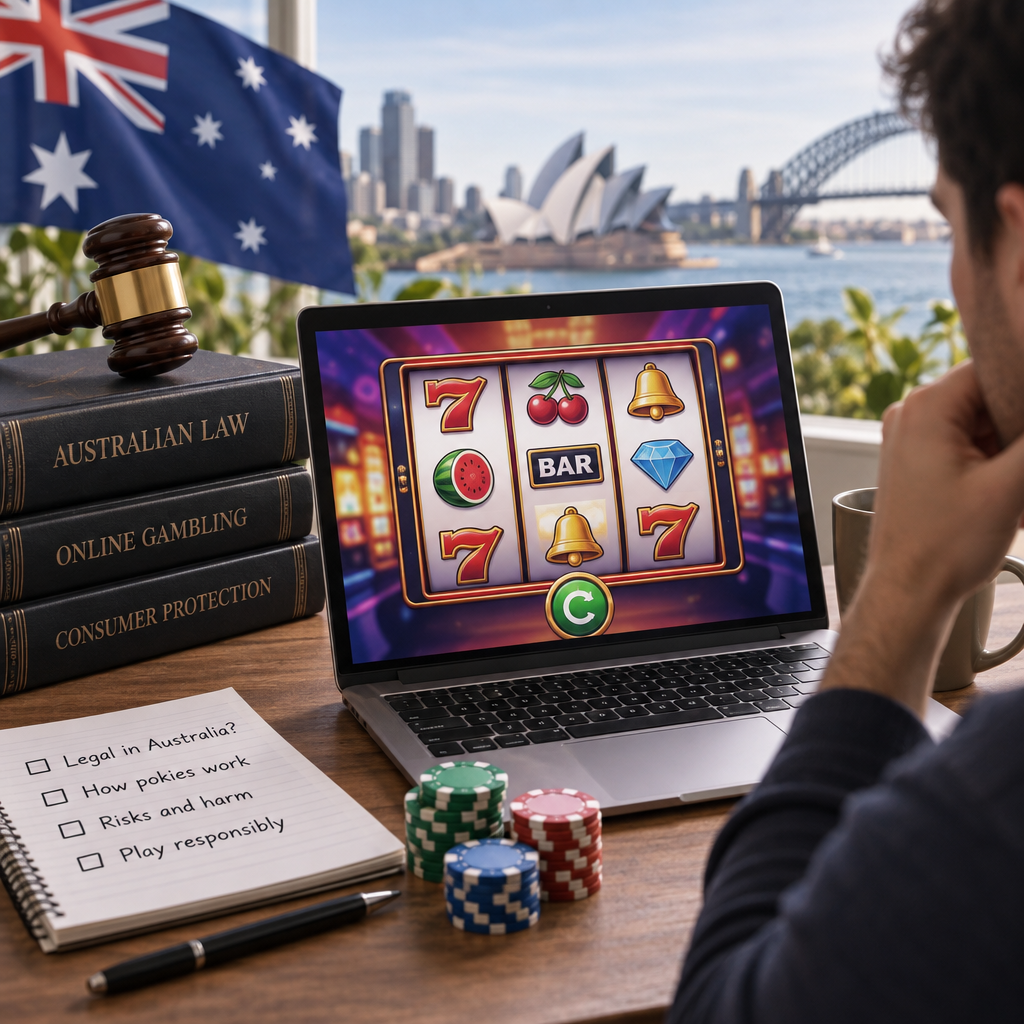
If you have searched for “gamble online slots”, the first thing to know is that providers are prohibited from offering real-money online casino slots to people physically in Australia. That restriction on providers is a separate question from whether an individual commits an offence by using a site. Online pokies, as Australians often call digital slot-style games, also involve financial and consumer-protection risks. Here is how the law, game mechanics, free-play alternatives and support options fit together.
Are online slots legal in Australia?
The Australian Communications and Media Authority (ACMA) identifies online casino games, including slots or pokies, as prohibited services when offered to people in Australia. The federal Interactive Gambling Act 2001 is the starting point for understanding these restrictions. Being physically present in Australia matters to the assessment; an offshore website does not avoid the restriction simply because it operates from another country.
This is not a blanket prohibition on all online gambling. Online wagering and lotteries are subject to different rules, and permission to offer a wagering product does not give a provider permission to offer online casino slots.
The restriction on a provider and the legal position of an individual using a site are distinct. AUSTRAC says participation on the illegal online gambling websites discussed in its fact sheet is not itself illegal. That statement is not a guarantee covering every individual situation or every state or territory law, and it is not an endorsement of those services.
The practical risks remain significant. AUSTRAC warns that users of illegal services can be denied access to funds or winnings. ACMA also warns about problems such as withheld winnings and unauthorised withdrawals.
An overseas licence does not establish permission to offer real-money online pokies to people in Australia. Nor do an accessible website, Australian-dollar payments or a familiar payment method establish that the offering is authorised.
ACMA’s register can help people check licensed interactive wagering providers. It is not an approval list for online casinos, and an entry concerning wagering does not authorise a provider’s slot games. ACMA also investigates gambling providers and requests blocking of some illegal websites.
Land-based gaming machines are regulated separately, with rules that differ between jurisdictions. Their availability in a hotel, club or casino should not be taken as evidence that an online slot offering is permitted.
Free-play and social slots: what is different?
Free online slots and social casino games can look similar to real-money pokies, but the label “free” does not explain everything about their costs or legal status. The important questions include whether a person pays to participate and whether a prize can be redeemed for money or something else of value.
In its 2023 market snapshot, ACMA described social casinos as typically free to download and play, sometimes offering in-game purchases and not played to win real money. The social casinos examined were not regulated under the Interactive Gambling Act. That snapshot does not decide the status of every app or game.
- No paid stake and no valuable prize: this is different from a real-money gambling game, although it may still carry behavioural risks.
- Purchased virtual credits without cash-out or a valuable prize: the purchase creates a real cost, but buying credits alone does not establish that the game is prohibited online gambling.
- Money or another valuable prize: a “free” or “social” label does not settle the legal question. The payment, prize, rules and applicable law need closer examination.
Video-game classification is a separate question
Australian video-game classification rules distinguish simulated gambling from certain other chance-based features. Since 22 September 2024, the rules have specified an R 18+ classification for games containing simulated gambling and a minimum M classification for games with chance-based in-game purchases, such as paid loot boxes.
These classifications do not themselves determine whether a particular game is a prohibited gambling service. Games classified before the newer rules generally are not automatically reclassified, although a relevant update can trigger reassessment. Do not assume that every older app has been assessed under the newer requirements.
For a social game, check both the classification information and what the game actually lets users buy or redeem. A classification label is useful information, but it is not a substitute for examining the product’s terms.
How online slot machines work
In a typical slot round, a player selects a stake and starts a spin. The game determines an outcome and displays it through reels, symbols or another visual arrangement. The rules and paytable explain which combinations or features pay and how the payout relates to the stake.
Layouts differ. Some games use paylines, while others describe winning combinations as “ways” or use different feature rules. The paytable should also explain how the total stake is calculated and whether particular features change what is paid or wagered.
A displayed payout is not necessarily a profit. As a simple arithmetic example, if a $1 round returns 40 cents, the round has produced a 60-cent net loss, even if the game presents the result as a win.
Random number generators use hardware or software to generate number sequences that a game maps to outcomes under its rules. Technical guidance from the UK Gambling Commission helps explain this technology, but it does not verify the operation of an offshore service available to Australians.
For a game with independent random outcomes, previous results do not make a particular future result due. Ten losing rounds do not make a win on round eleven inevitable or predictable. Not every gambling machine worldwide uses the same design, so independence should not be assumed without regard to the game’s rules.
Slot RTP, house edge and volatility
Slot RTP, or return to player, is the theoretical proportion of total stakes returned as prizes over a very large number of plays under the specified game rules. It is not the probability of winning an individual round, a refund on a deposit or a promise about a particular session.
For a fixed theoretical RTP without other adjustments, the house edge is 100% minus the RTP. The following calculation uses a hypothetical figure, not the advertised return of a specific game:
These are expected values in a long-run model. A session may return much more or much less, and a player can lose their available funds before anything resembling a long-run average appears. Total stakes are also different from an initial deposit: replaying prizes adds to the amount staked.
Slot volatility describes variation in possible results rather than the average return. Two hypothetical games could have the same RTP but different payout patterns. A higher-volatility design may have longer gaps between substantial payouts; a lower-volatility design may produce smaller payouts more often. Neither tendency predicts the next round or guarantees a profit.
Labels such as “low” or “high” volatility should be treated as the publisher’s or provider’s descriptions, not assumed to be independently verified ratings on a common Australian regulatory scale. A published RTP, likewise, does not establish that a service is authorised or will pay a withdrawal.
- Hypothetical RTP: 96%.
- Theoretical house edge: 100% minus 96%, or 4%.
- For $100 in total stakes, the model implies $96 in expected prizes and $4 in expected loss over the relevant long run.
Costs, payment risks and support
Small individual stakes can add up over repeated paid rounds. In a hypothetical example, twenty $1 rounds amount to $20 in gross stakes. If those rounds pay $6 in prizes and the player retains that amount, the net loss is $14, before any other costs. Optional paid features or in-app purchases can add to spending.
The way a service accepts money is not proof of safety or authorisation. AUSTRAC warns that so-called PayID pokies can involve transfers to nominated accounts and that users may be denied access to funds. A familiar payment method cannot guarantee that a provider will return money or honour a claimed prize.
Setting an affordable limit, taking breaks and stopping rather than chasing losses are ways to reduce risk, not guarantees against harm. If spending feels difficult to control, or gambling is affecting finances or relationships, support is available for the person gambling and for people affected by someone else’s gambling.
- National Gambling Helpline: call 1800 858 858 for free, confidential support, 24 hours a day, seven days a week.
- Gambling Help Online: free counselling is available, including online chat, at gamblinghelponline.org.au/immediate-help.
- BetStop: free self-exclusion from Australian-licensed online and phone wagering services is available for a period from three months up to a lifetime. It should not be assumed to block illegal offshore casinos, social games or land-based venues.
- Financial counselling: the helpline can assist with referrals if gambling is contributing to financial difficulties.
Questions to ask before using a game or service
A game’s appearance, clear rules or spending controls do not make a prohibited offering authorised. Use these questions to identify the product and its risks, rather than as a checklist for choosing an offshore casino.
- Is this a real-money online casino slot offered to someone physically in Australia? ACMA identifies that type of offering as prohibited.
- Can virtual credits be purchased, and can anything won be redeemed for money or another valuable prize?
- Are the stake, paytable, paid features and in-app purchase costs clear?
- Am I mistaking an offshore licence, wagering-register entry, accessible website or published RTP for Australian authorisation or payment security?
- If spending is a concern, do I know where to stop and how to contact support?
FAQ
Are online pokies and online slots the same thing?
“Pokies” is a common Australian term for poker machines, while “slots” is a broader international term. Online pokies generally means digital slot-style games. Terminology used in gaming laws can be more specific, so the words are not a substitute for checking how a particular product is regulated.
Can Australians legally play real-money online slots?
Providers are prohibited from offering real-money online pokies to people in Australia. AUSTRAC says participation on the illegal websites described in its fact sheet is not itself illegal, but that is not a guarantee about every individual circumstance. Users may also have funds or winnings withheld.
Are free online slots gambling?
A game with no paid stake and no prize of value differs from real-money gambling. Some social games sell virtual credits without offering cash-out; those purchases still cost money. If money or another valuable prize is available, the payment, prize and game rules need to be assessed rather than relying on a “free” label.
Can a slot strategy improve my chances of winning?
Reading the paytable helps explain stakes and possible payouts, but betting patterns and previous results do not predict the next outcome of an independent random game. A losing streak does not make a win due. Increasing a stake to chase losses can increase the amount at risk.
Does a higher RTP mean I will win?
No. RTP is a theoretical long-run proportion of total stakes returned as prizes, not a promise for an individual session or the probability of winning a round. Actual results can be much higher or lower, and the amount staked may exceed the initial deposit if prizes are replayed.
Does BetStop block online casinos?
BetStop provides self-exclusion from Australian-licensed online and phone wagering services. It should not be assumed to block illegal offshore casinos, social games or land-based venues. Someone concerned about those forms of gambling can contact the National Gambling Helpline or Gambling Help Online for support.
Providers are prohibited from offering real-money online pokies to people in Australia, even when a site is based offshore. The position of an individual participant is a separate legal question, and access to a site does not make it safe. Understanding RTP and game rules can clarify costs, but cannot guarantee a result or payment. Check ACMA for current guidance, and contact the National Gambling Helpline or Gambling Help Online if gambling is causing concern.