Federal Politics Odds in Australia: Markets, Prices and Settlement
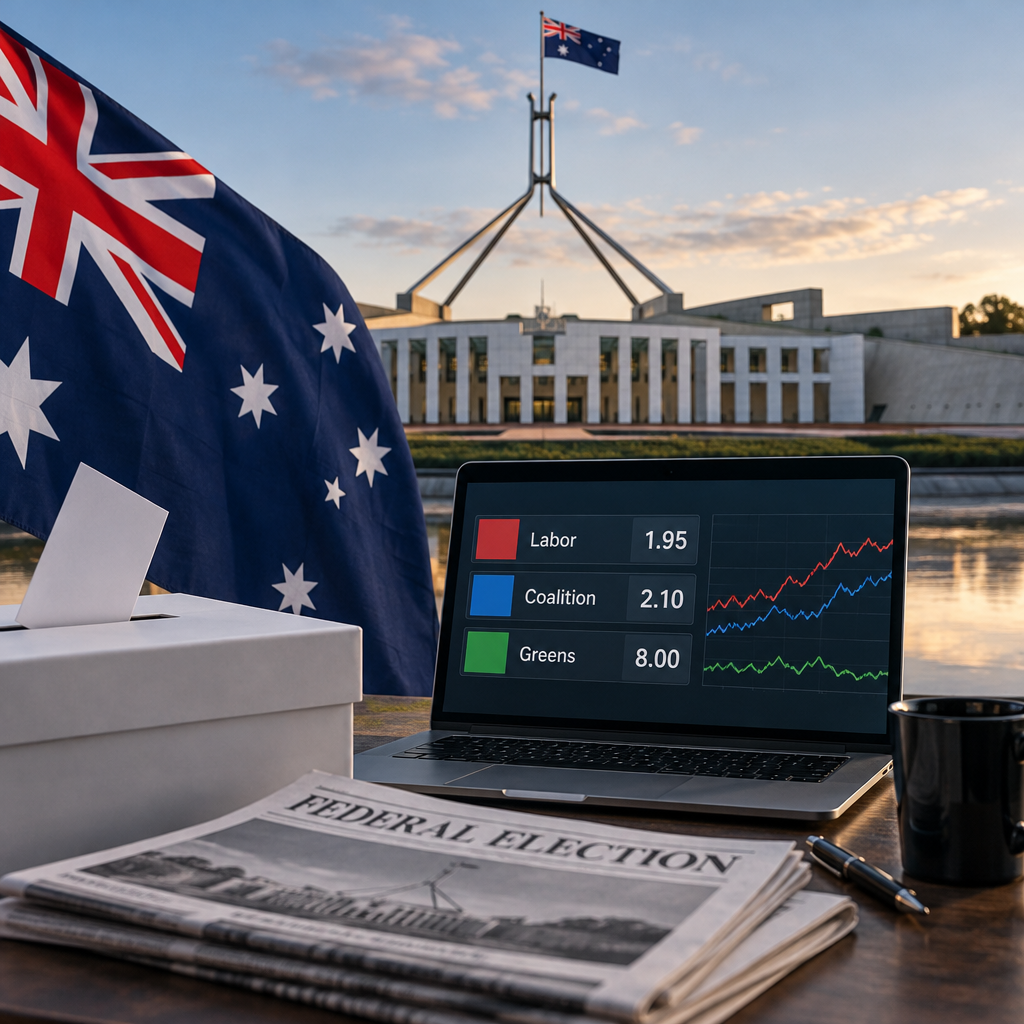
Federal politics odds offer prices on particular Australian political outcomes, but similar-looking markets can settle in very different ways. A bet on a party supplying the prime minister, for example, is not necessarily a bet on that party winning the most seats. This guide explains the main federal market types, how to read decimal odds and what to check in the settlement rules. It does not provide a live odds feed or predict an election result. Prices, terms and availability can change, so check the provider’s current listing before relying on a quote.
What Australian federal political markets cover
Australian federal election odds may concern an individual, a party, a coalition or a result measured by seats. The market name is only a starting point: its description should explain the specific outcome being priced.
Sportsbet has listed separate markets on the first prime minister sworn in after the next federal election and on the party supplying the prime minister in the 49th Parliament. Those listings illustrate different market structures; they do not establish that either market is still open or that every provider offers an equivalent.
Other possible categories include the most House of Representatives seats, a seat-total range, a majority government or a minority government. Availability and definitions vary, and an open federal market for each category has not been verified here.
The political distinction matters because the party or coalition able to command the confidence of the House of Representatives forms government. A minority government can hold that confidence with support from independents or minor-party members.
For example, imagine Party A wins more seats than any other single party but falls short of a majority. Party B and its supporters then secure House confidence and form government. A most-seats selection on Party A and a government-outcome selection on Party B could both win, depending on the wording of their respective markets. Neither result should be assumed from the label alone.
- Individual outcome: a named person meets the market’s prime minister or leadership condition.
- Party outcome: a specified party meets a defined condition, such as supplying the prime minister.
- Coalition outcome: a grouping qualifies under the provider’s particular definition of that grouping.
- Seat outcome: a party or grouping reaches a stated number or range, or wins the most seats.
Next prime minister odds: check the trigger
The phrase next prime minister odds can describe more than one event. A market on the next person to become prime minister at any time is conceptually different from one on the first prime minister sworn in after a federal election. An intervening leadership change may be relevant to the first description but not settle the second.
The Sportsbet post-election PM market observed in the research was framed around the first prime minister sworn in after the next federal election. Its displayed conditions also referred to an election held on or before 20 May 2028. That was a market condition, not an announcement that polling would occur on that date.
The Parliamentary Library’s election-timing analysis distinguishes deadlines for different election types, including a later potential deadline for a House-only election. The observed market wording did not resolve what would happen if the relevant election occurred after its cutoff, or if an incumbent continued without an immediate new swearing-in. Check the current wording and ask the provider for written clarification rather than assuming how either scenario would settle.
How to read decimal odds and compare prices
Australian election betting odds for federal markets are commonly displayed as decimal numbers. To calculate the potential total return on a winning selection, multiply the stake by the decimal price. The total includes the original stake; profit is the total less that stake.
Consider a hypothetical $10 bet at decimal odds of 2.50. These figures are an illustration, not a currently available offer or an expected return.
- Potential total return if successful: $10 × 2.50 = $25.
- Potential profit if successful: $25 − $10 = $15.
- Raw price-implied probability: 1 ÷ 2.50 = 40%.
- If the selection loses, the $10 stake is lost.
What a price-implied probability does and does not mean
The 40% figure above is the reciprocal of the price. It is not proof that the outcome has a true 40% chance, and it does not guarantee any particular pattern of results. Bookmaker prices can include a margin, so the implied figures for a complete set of outcomes may add up to more than 100%. Adjusting those figures to total 100% still does not establish the true chances.
A poll and a betting price also measure different things. A poll might estimate a party’s share of votes, while an odds-derived figure relates to the price of a specified outcome, such as supplying the prime minister. A vote-share estimate is not itself the probability of forming government.
Prices can change before an election. Polling, leadership developments, possible alliances and a provider’s pricing decisions are all possible influences, but a particular movement should not be attributed to one cause without evidence.
A higher decimal price is not necessarily a better like-for-like comparison. One provider may price the party with the most seats while another prices the party supplying the prime minister. Check the event, selection and settlement trigger first. If recording a quote, note the provider, exact market, selection, price, date and time zone; an old snapshot is not a live price.
How federal political bets are settled
Settlement is the provider’s process for deciding whether a bet wins, loses, carries over or is voided under the applicable terms. Read the individual market description as well as the provider’s general election and settlement rules. If the wording appears inconsistent or does not address your scenario, ask the provider which rule applies before betting.
Sportsbet’s observed 49th Parliament market described the outcome as the party supplying the prime minister after the election, not simply the party winning the most seats. Its description defined Coalition as the Liberal and National parties only and described certain other deals or mergers as Any Other Result. Those are examples from one provider’s market, not universal definitions.
The same observed description said bets would carry over in a specified situation where the Governor-General did not swear in a prime minister because supply could not be guaranteed. It does not follow that every political market carries over in every delayed government-formation scenario. Ask about a particular arrangement if the wording is unclear.
A named-person market can also settle differently from a party market. Hypothetically, a party could supply the prime minister after a leadership change while a selection on its former leader does not meet the individual market’s trigger. The actual result depends on the precise terms and timing of both bets.
Sportsbet’s general rules say it may use projected information for settlement, and dead-heat rules may apply to its most-seats markets. Check whether the relevant market refers to an official result, a projection or another trigger, and how ties are treated. Do not assume that a provider waits for the same milestone in every market.
Withdrawals, election delays and refunds
A candidate’s withdrawal does not automatically mean a stake will be returned. Sportsbet’s general election rules say markets are all-in unless stated otherwise. For relevant next-leader and next-PM markets, its rules generally say stakes are not refunded for ineligibility, failure to stand or withdrawal unless an exception is stated.
In practical terms, all-in is a warning to read the conditions before assuming that a selection is removed and refunded if circumstances change. Another provider or market may have different terms.
There is also no verified universal refund rule for a postponed federal election. TAB’s NSW rules include a general provision for postponed events, but event-specific provisions can matter. It would be unsafe to apply a general postponement period automatically to every election market.
If a market includes a deadline, check what happens if the election is delayed beyond it. A void may result in a refund under the applicable terms, but neither a void nor a carryover should be assumed without checking.
- What happens if the named candidate withdraws, becomes ineligible or does not stand?
- What happens if the election is postponed or held after a stated cutoff?
- How are an unlisted candidate and an Any Other Result selection treated?
- Which rule applies if the general rules and market description appear unclear?
Australian authorisation, eligibility and safer gambling
Federal political wagering can be available through Australian-licensed providers, subject to the event, provider authorisation, applicable location rules and customer eligibility. Australia’s states and territories license gambling products and services, while federal and state or territory responsibilities intersect.
The Australian Communications and Media Authority, or ACMA, maintains a register for checking Australian-licensed interactive wagering providers. A provider’s appearance on the register does not establish that every market it lists is available or approved in every location, or that every customer is eligible. An offshore licence alone should not be treated as proof that an operator may serve Australian customers.
Location and event type matter. For example, TAB’s NSW rules distinguish national political events from NSW state and council elections. That example is not a complete account of the rules in every Australian jurisdiction. For a location-specific question, consult the relevant regulator and the provider.
Wagering is for adults aged 18 and over. Providers require identity verification, although the steps can differ between operators. Check the provider’s current requirements rather than assuming a particular onboarding process.
A political bet can lose its entire stake, and funds may be committed for a long time while an event and its settlement are pending. Choosing not to bet is an option. If you do bet, consider an affordable limit and the possibility that the full amount will be lost; a limit does not prevent losses.
Gambling Help Online provides free, confidential support, including online chat and a 24/7 telephone service on 1800 858 858. BetStop offers self-exclusion from Australian-licensed online and telephone wagering providers for at least three months. It is not a universal block on land-based gambling.
Checklist before relying on a political price
A quick comparison should establish that the quotes describe the same outcome and that their conditions are sufficiently similar. If an important term remains ambiguous, contact the provider rather than relying on the market title.
- Confirm the election and whether the selection is an individual, party, coalition or seat outcome.
- Identify the settlement trigger and any cutoff date.
- Read the market-specific and general rules on withdrawals, delays, ties and other outcomes.
- Check the provider on ACMA’s register and confirm the market is available to you.
- Record the provider, price, date and time zone when each quote was checked.
FAQ
Do election odds predict who will win?
They express prices on specified outcomes, not certain forecasts. The reciprocal of a decimal price gives a raw implied figure, but that figure can include a bookmaker margin and is not necessarily the true probability. Polls measure something different: an estimated vote share, for example, is not the same as the chance of forming government.
Are federal political bets legal in Australia?
They can be available through Australian-licensed wagering providers, subject to the event, provider authorisation, location rules and customer eligibility. Check the ACMA register and the specific market terms. A provider’s register listing alone does not mean a particular market is available to every Australian customer.
What happens if a federal election is postponed?
There is no verified universal outcome. Check the market description and the provider’s rules on postponement, cancellation and settlement. A market-specific condition may matter alongside a general rule. If a cutoff or the interaction between rules is unclear, ask the provider before betting; do not assume an automatic refund.
Can political odds change before an election?
Yes. A price displayed earlier may no longer be available later, and a market can close. Polling, leadership developments, possible alliances and provider pricing decisions are potential influences. That does not establish why a particular price moved. For any quote you compare, record when it was checked.
Does a party need a majority for a political bet to win?
Not necessarily. A minority government can hold the confidence of the House with support from other members. A market on supplying the prime minister or forming government can therefore have a different trigger from a majority-seat market. The relevant provider’s wording determines how the selection is assessed.
Will I get my stake back if my selected candidate withdraws?
Not necessarily. Sportsbet’s general election rules say its markets are all-in unless stated otherwise, and its relevant next-leader and next-PM rules generally do not refund stakes for withdrawal, ineligibility or failure to stand unless an exception applies. Other providers may use different terms, so check the individual market and its general rules.
Federal politics odds are prices on defined outcomes, not guarantees or interchangeable forecasts. Before comparing them, identify exactly what is being priced, read how the provider will settle it and check that the quote and terms are current. If a withdrawal, deadline or coalition condition is unclear, seek clarification. You can also choose not to bet.