Dead heat rules: Ladbrokes Australia payout calculations
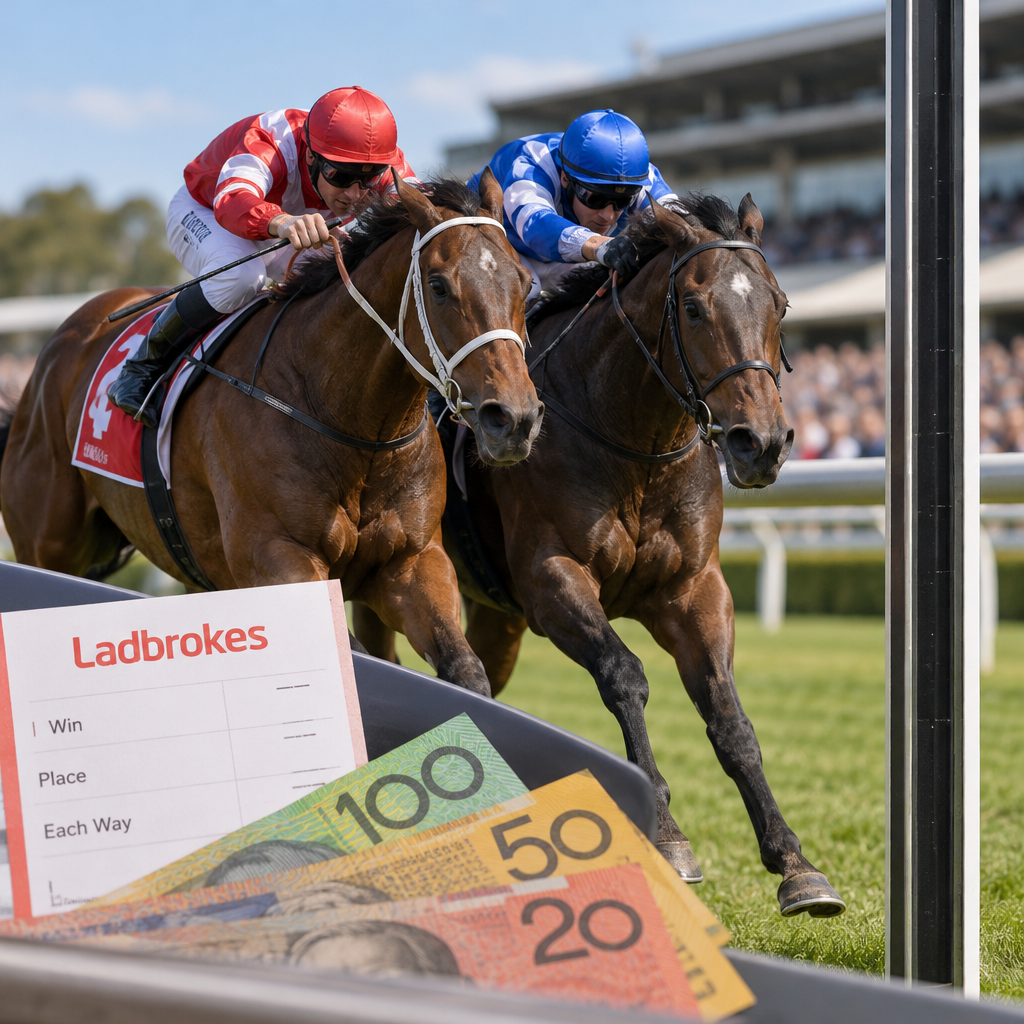
Checking the dead heat rules at Ladbrokes can help explain why a winning racing selection has returned less than its displayed outright-win amount. In Ladbrokes Australia’s racing rules version 54, dated 17 February 2025, the fixed-odds return is the bet’s face value divided by the number of runners involved in the dead heat. For a straightforward cash win bet, that means multiplying the stake by the decimal odds, then dividing by the number tied for first. The examples below explain that calculation. Check the rules applicable to your bet, as the current version and the treatment of other markets or features may differ.
What is a dead heat in betting?
A racing dead heat occurs when two or more runners finish in an exact tie for a placing. For example, two horses might officially share first place because the judge cannot separate them.
Ladbrokes’ Australian help page says the on-course judge determines a dead heat and stewards confirm the decision when correct weight is declared. The dated racing rules say bets are settled on the relevant authority’s official result declared on the day, rather than an indicative interim result.
Dead-heat provisions also appear in some sports markets, but a tied game or score does not automatically mean the racing calculation applies. The relevant sport, market and settlement period matter. Dead heat betting rules in Australia can also differ between operators, so another bookmaker’s terms should not be assumed to apply to Ladbrokes.
A draw is not the same as dead-heat settlement
A draw or tie can be an outcome you select when placing a bet. A dead heat, by contrast, is a way of settling certain bets when selections finish tied. Whether either applies depends on the particular market.
The distinction appears in Ladbrokes’ 2025 golf rules. In the specified 18-hole two-ball market, a tie price is offered. In three-ball betting, the rules provide for dead-heat treatment when two or more players finish with the same score.
That example does not establish a rule for every golf bet or every sport. Before calculating a return, check the market description and its settlement terms, including the period of play covered.
How a Ladbrokes dead heat payout is calculated
Under racing rule 1.4 in the dated Australian rules, the return on a fixed-odds dead-heat bet is the face value divided by the total number of runners involved in the dead heat. The rules apply that treatment to win bets.
For a straightforward cash fixed-odds racing win bet, with no deductions, bonus conditions or special features, the practical calculation is: total return = cash stake × decimal odds ÷ number of runners tied for first.
Include your own selection when counting the tied runners. The result is the total return, not the profit. To calculate net profit or loss, subtract the original stake from that return.
For this simple cash example, dividing the stake by the number tied and then multiplying by the original odds gives the same arithmetic result, provided rounding or another adjustment does not change it. Ladbrokes’ published rule, however, describes dividing the bet’s face value.
The examples below use figures that produce exact-dollar results. The available material did not establish Ladbrokes’ rounding method or a minimum-return safeguard, so check with the operator if either affects your settlement.
Worked examples for two-way and three-way ties
Two-way dead heat: suppose you place a $10 cash win bet at decimal odds of 4.00. An outright win would have a potential total return of $40: the $10 stake multiplied by 4.00.
If your runner and one other officially tie for first, divide $40 by two. The illustrative dead-heat return is $20. After subtracting the original $10 stake, the net profit is $10.
Three-way dead heat: suppose you place $12 at 4.00, and your selection shares first with two other runners. The potential outright-win return is $48. Divide that by all three tied runners to get a $16 total return. Subtracting the $12 stake leaves a $4 net profit.
A reduced return can also be less than the original stake under the simple arithmetic. For example, $10 at 1.80 has an $18 potential outright-win return; divided by two, that is a $9 return and a $1 net loss.
These are illustrations, not promises of an actual settlement. They assume a cash win bet without deductions or special conditions. In particular, the $9 example does not establish whether Ladbrokes applies a minimum-return policy in any particular case.
Dead heat each-way and place bets
An each-way bet has separate win and place components. Each needs to be assessed against its own applicable terms: the win component depends on the result for first place, while the place component depends on the finishing position and the paid-place terms.
Ladbrokes’ dated racing rules say dead-heat rules apply to place bets. They also distinguish ordinary place terms from separately offered Top 2, Top 3 and Top 4 markets. Check which market appears on your accepted bet rather than assuming they all settle identically.
Ordinary place terms can depend on field size and when the bet was struck relative to scratchings. For a runner tied at the last advertised paid position, those details and the official finishing order are important to understanding the result.
The located rule does not clearly explain every allocation where a tie spans multiple paid positions or sits wholly within them. The simple win formula above should therefore not be used as a definitive place-bet calculator. Ask Ladbrokes for a component-by-component explanation if the settlement is unclear.
- Check the stake and terms for both the win and place components on the bet record.
- Confirm the official finishing order, the runners involved in the tie and the number of paid places applicable to your bet.
- Review relevant scratchings, deductions and the terms of the specific place or Top market.
- Compare each component with the settled amounts and ask support to explain any difference.
Dead heat multiple bets and special features
A tied selection can affect a multi, but the straightforward single-win calculation should not be applied mechanically to every product. Ladbrokes’ 2025 racing rules say dead-heat rules apply to Same Race Multis; they also contain more specific provisions for certain leg types.
For a blended leg, the dated rules distinguish a tie with a runner outside the blended leg from a tie with another runner in the same blended leg. The former has a specified reduced-stake treatment, while the latter is paid in full. These product-specific provisions are not a general formula for all multis.
Ladbrokes’ Flex Multi help page says dead heats can change the final return. It also says a pending bet may continue to display its original or maximum potential return until settlement. An unchanged pending figure is therefore not necessarily the amount the settled bet will return.
If your bet includes a bonus stake or a special feature, check its own terms before using a cash-bet example. The available information does not establish a general bonus-bet dead-heat calculation. Do not assume that every tied leg simply halves the entire multi.
How to check a settled Ladbrokes bet
Start with the accepted bet record and the official result. A displayed potential return is useful for comparison, but it may not reflect a dead heat, deductions or product-specific adjustments.
For a straightforward cash racing win bet, compare the settled return with the face-value calculation described above. For an each-way bet or multi, review the relevant components and product terms separately.
Version 54 is dated 17 February 2025; the available research did not establish that it remains the current version for every bet. Check the terms that applied when you placed your bet and any relevant settlement rules, then contact Ladbrokes support if you cannot reconcile the result.
- Record the bet ID, stake, accepted price, market, selections, placement date and settled return.
- Check the official declared result, not just an interim racing display.
- Review applicable place terms, scratchings, deductions, multi type and any feature conditions.
- Ask support for a component-by-component calculation and identify the result or term you are unsure about.
FAQ
Does Ladbrokes reduce the odds or the stake in a dead heat?
The located Australian racing rule describes dividing the bet’s face value by the number of tied runners. For a simple cash win bet, dividing the stake first and multiplying by the original odds gives the same arithmetic result, subject to rounding or other adjustments. That equivalent calculation is not the wording of the published rule.
What happens if three or more runners dead-heat?
For the straightforward fixed-odds racing win example under the dated rule, divide the face value by the total number of runners tied for first, including your selection. For example, $12 at 4.00 gives a $48 potential outright return; a three-way tie gives an illustrative $16 return. Check the applicable terms rather than extending that calculation to every place or multi bet.
Can a dead-heat return be less than my stake?
It can be under the simple arithmetic. A $10 cash win bet at 1.80 has an $18 potential return, which becomes $9 when divided by two. The available Ladbrokes material did not establish a minimum-return safeguard, so this calculation alone does not confirm how every actual bet would be settled.
Does a dead heat affect both parts of an each-way bet?
The win and place components must be assessed separately under their respective terms. The dated Ladbrokes rules say dead-heat rules apply to place bets, but the available wording does not clearly resolve every tie across paid positions. Check your receipt and the official result, and ask for a breakdown if needed.
Is there a Ladbrokes dead heat calculator?
No official Ladbrokes Australia dead-heat calculator was located in the research, although that does not prove one does not exist. For a straightforward cash racing win bet, you can use the formula in this article. For place bets, multis or bets with special conditions, ask Ladbrokes how the applicable terms affect the calculation.
Are a draw and a dead heat the same thing?
No. A draw or tie can be a selectable outcome, while a dead heat is a settlement treatment used in certain markets. The dated Ladbrokes golf rules, for example, distinguish a two-ball market with a tie price from three-ball betting with dead-heat provisions. Always check the specific market and settlement period.
Why did my pending multi show a higher return than I received?
Ladbrokes’ Flex Multi help says a pending figure may remain at the original or maximum potential return until settlement, when adjustments such as a dead heat can affect the final amount. Review the settled bet and its product terms; if the difference remains unclear, ask support for the calculation.
For a simple cash fixed-odds racing win bet, Ladbrokes’ dated rule describes dividing face value by the number of runners in the dead heat. Compare that calculation with your accepted bet and the official result, but check the applicable terms before relying on it for an actual settlement. Place bets, multis, deductions and special features may require separate consideration. If the return still does not make sense, ask Ladbrokes support to explain how each component was settled.