Boxed trifecta on Sportsbet: costs, flexi and settlement
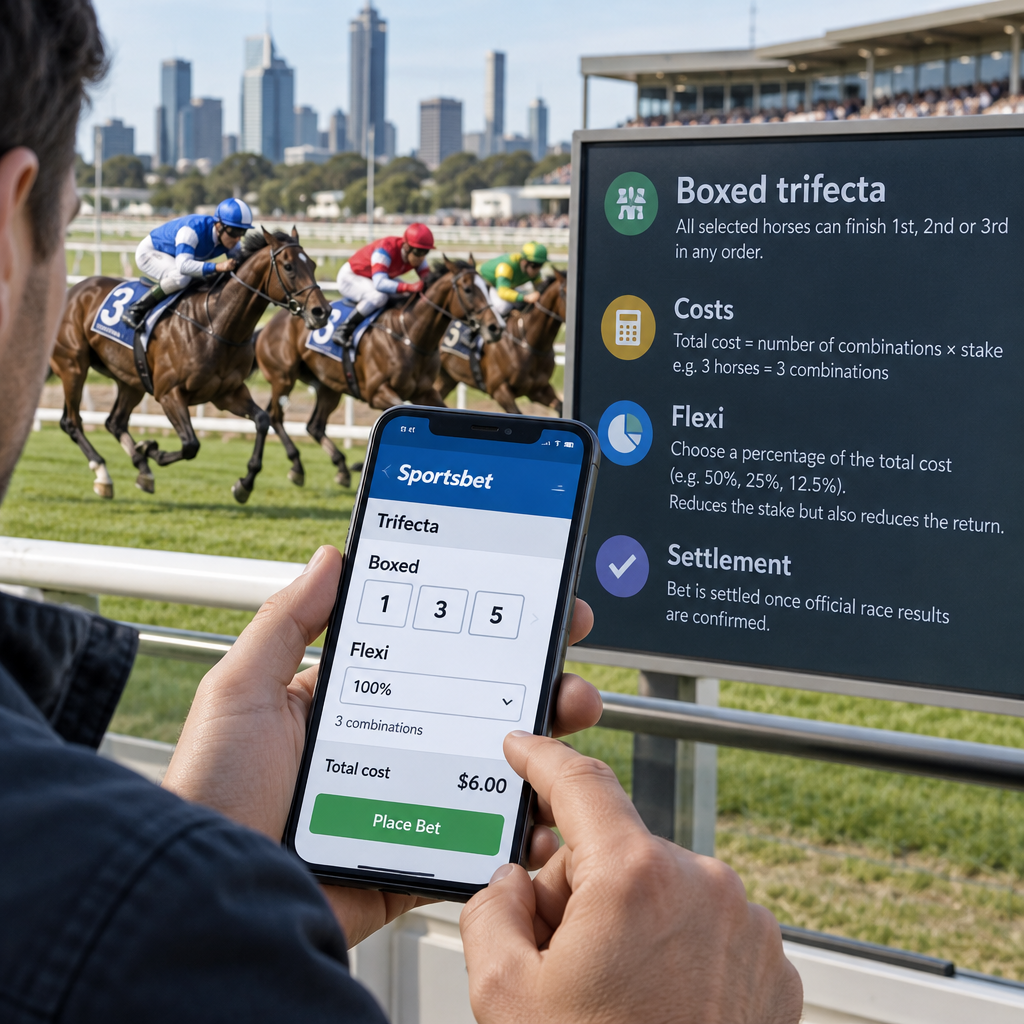
A boxed trifecta on Sportsbet covers every possible first-, second- and third-place order made from at least three selected runners. The cost depends on how many combinations the box contains and how much you stake on each one. This guide explains the maths, flexi percentages, the operator-described placement process and the rules that can affect settlement. More coverage does not guarantee a return or a profit.
What is a boxed trifecta on Sportsbet?
A trifecta asks you to select the first three finishers in a race in the correct order. A box covers every possible order of three different runners from your selections, rather than requiring you to nominate one finishing order.
If you select more than three runners, only three of them need to fill the official first three places. The others do not also need to place. Subject to the applicable settlement rules, an unselected runner finishing in the top three defeats the box.
For example, a Sportsbet boxed trifecta containing runners A, B, C and D covers a result of C–A–D. It does not cover C–A–E, because E is not one of the selections.
Boxed, straight and standout trifectas compared
A straight trifecta specifies one exact order, such as A first, B second and C third. A three-runner box on A, B and C covers that order and five other orders. At the same stake per combination, the box therefore costs six times as much as the straight bet.
A standout trifecta fixes a selected runner in a nominated position while other selections fill the remaining positions. For example, A might be required to win, with B, C and D available for second and third. It covers fewer outcomes than a full box of those four runners, but loses if A does not finish first.
The formats involve different choices about coverage and outlay. Covering more combinations does not by itself establish better value or a particular return.
How to calculate boxed trifecta cost
For a full box of n distinct runners, the number of combinations is n × (n − 1) × (n − 2). There are n choices for first place, one fewer for second and two fewer for third.
For example, a four-runner box contains 4 × 3 × 2, or 24, combinations. To find the total stake when every combination has the same stake, multiply the number of combinations by the stake per combination.
The following figures are arithmetic examples in Australian dollars. They are not mandatory Sportsbet stakes or a guarantee that a particular bet will be accepted.
- 3 runners: 6 combinations; $6 at $1 per combination or $3 at $0.50 per combination.
- 4 runners: 24 combinations; $24 at $1 per combination or $12 at $0.50 per combination.
- 5 runners: 60 combinations; $60 at $1 per combination or $30 at $0.50 per combination.
- 6 runners: 120 combinations; $120 at $1 per combination or $60 at $0.50 per combination.
How many runners can you box?
You need at least three distinct runners to fill the three finishing positions. Each additional runner increases the number of possible orders substantially: adding a sixth runner to a five-runner box doubles the combination count from 60 to 120.
Sportsbet’s published racing rules cap fixed-odds exotic bets at 1,000 combinations. An 11-runner full box produces 990 combinations, whereas a 12-runner box produces 1,320. Eleven is therefore the mathematical maximum for a full box under that cap, not a verified selection limit or a promise that the bet will be offered or accepted.
The same rule does not specify a combination limit for tote-based exotics. That does not mean runner selection is unlimited: the field, market and interface can impose other constraints. Check the available options on the relevant race.
Flexi stakes and percentage returns
Where flexi is available, you can enter a total investment that is spread across the combinations. Divide the total stake by the number of combinations to find the investment per combination. Expressed as a share of a $1 unit, the flexi percentage is the total stake divided by the number of combinations, multiplied by 100.
For example, a five-runner box has 60 combinations. A $12 total stake allocates $0.20 to each combination, equivalent to 20% of a $1 unit. If the winning combination’s applicable dividend is a hypothetical $200 per $1 unit, the return at 20% is $40. That is $28 above the original $12 stake, before any refunds or other applicable conditions.
A winning combination does not necessarily mean an overall profit. If the applicable hypothetical dividend were $40 per $1 unit instead, the 20% return would be $8 on the $12 stake. The lower stake buys a smaller share of the applicable return, not the full dividend at a discount.
Sportsbet’s published minimum flexi investment is the greater of $0.01 per combination or $1, or another amount Sportsbet determines. For 120 combinations, the formula gives $1.20 if the alternative minimum remains $1. Check the actual slip for the amount accepted.
Flexi is not established for every race or code. Sportsbet’s rules list eligible thoroughbred and harness exotics, with specified exclusions for South African, New Zealand and English thoroughbred racing. Check the race and current terms rather than assuming the option is available.
How to place a boxed trifecta on Sportsbet
Sportsbet’s guide describes a Trifecta tab and a Boxed toggle on its app and website. The following is the operator-described process; a logged-in bet slip was not independently tested for this guide. Labels and steps can vary by platform, race and market.
Before confirming, distinguish the total stake from the stake per combination. If a flexi percentage is shown, check that it matches the share of the return you intend to purchase. Also check whether the market is tote-based or fixed odds and review any displayed terms.
A fixed-odds box may show an average across combinations. That average is not necessarily the price of the combination that wins; individual orders can have different prices.
- Log in and open an eligible race.
- Find Trifecta on the race card and look for the Boxed option.
- Select at least three runners.
- Enter the total stake or flexi percentage, where available.
- Review the runners, combination count, price type, stake and terms before confirming.
How payouts and settlement work
The return depends on the winning combination, the price type and the stake allocated to that combination. Sportsbet’s rules describe both tote-based and fixed-odds trifectas, and events such as scratchings or dead heats can affect settlement.
For a tote-based exotic, Sportsbet pays recognised winning combinations using the dividend declared by the National tote, subject to its terms and payout limits. The dividend is not known simply from the number of runners you select.
For a fixed-odds exotic, the applicable combination’s accepted price is the starting point for settlement, subject to the racing rules. Different orders in a box can have different prices, and applicable scratching or dead-heat rules can affect the outcome. Neither price type is necessarily offered for every race.
What happens if a runner is scratched?
A selected scratching does not necessarily cancel the whole box. Under Sportsbet’s published trifecta rules, tote combinations containing the scratched runner are refunded while valid combinations remain. For a fixed-odds trifecta, affected combinations are voided and their line stakes refunded.
Suppose a four-runner box has 24 combinations and a $12 total stake, or $0.50 per combination. If one selected runner is scratched, 18 combinations contain that runner and are affected. Their stakes total $9. The six combinations using the remaining three runners stand with $3 allocated to them.
An unselected scratching can matter too. Sportsbet’s fixed-odds exotic rule says remaining combination prices are recalculated using the relevant runners’ starting prices at the jump when an unselected runner is scratched. Do not assume the originally displayed prices are immune to change.
Check the actual settlement and current race-specific rules. Do not assume a scratched trifecta selection is automatically replaced by the favourite or that the entire box will be refunded.
Dead heats and recognised combinations
A dead heat can create a more complicated settlement than a single finishing order. For tote-based exotics, Sportsbet refers to the correct-order combinations and dividends recognised by the National tote.
Fixed-odds exotics have a separate dead-heat rule and payout limits. The effect depends on the product and the recognised winning combinations, so it is not safe to assume that every dead heat simply halves every return. Consult Sportsbet’s current racing terms for the circumstances of the race.
Eligibility and responsible betting
Sportsbet’s general rules say account holders must be at least 18 years old and reside in Australia. Market access can also be restricted by location, so an account does not imply that every market is available everywhere.
Before betting, decide on an amount you can afford to lose and check the total outlay. Adding runners increases the number of combinations; if the budget stays fixed, the stake and potential return share per combination fall.
For support, the National Gambling Helpline is available on 1800 858 858. The Australian Government describes it as free, confidential and available 24 hours a day. Gambling Help Online is another support option. BetStop allows people to exclude themselves from all Australian licensed online and phone wagering providers.
- Set a spending limit before placing a bet.
- Check the total stake as well as the flexi percentage.
- Remember that a covered result can still return less than the original outlay.
FAQ
How much does a four- or five-runner boxed trifecta cost?
Four runners produce 24 combinations and five produce 60. At $1 per combination, the respective total stakes are $24 and $60. These are examples, not mandatory minimums; the actual outlay depends on the stake and any available flexi option.
Do boxed selections have to finish in a particular order?
You do not nominate one particular order: the box covers every ordered top-three combination of your selections. If you select more than three runners, any three of them can fill the first three places. An unselected runner in the official top three defeats the box, subject to applicable settlement rules.
Can I use flexi for a boxed trifecta on Sportsbet?
Sportsbet’s rules allow flexi on eligible trifectas, subject to minimums and exclusions. The total stake is divided across the combinations, and an applicable winning return is paid at the resulting percentage. Check the particular race and slip because flexi is not available everywhere.
What happens if one of my runners is scratched?
Under the published trifecta rules, combinations containing a selected scratched runner are refunded, or voided and refunded for fixed odds, while valid combinations can remain. This can be a partial refund rather than a refund of the whole box. Check the settlement and current racing terms.
Can a winning boxed trifecta return less than its stake?
Yes. The return on the winning combination can be lower than the total invested across all combinations. For example, a 20% share of a hypothetical $40 dividend returns $8, even if the whole box cost $12.
Is every Sportsbet trifecta paid on the tote?
No. Sportsbet’s rules describe tote-based and fixed-odds trifectas. Check the price type on the market and bet slip; neither type is necessarily available for every race.
What is the maximum number of runners I can box?
Sportsbet’s published fixed-odds exotic cap is 1,000 combinations. A full box of 11 runners has 990 combinations, while 12 runners have 1,320. That calculation does not establish that an 11-runner box will be offered or accepted; check the race and slip.
A boxed trifecta covers multiple finishing orders, but each additional runner creates more combinations. At a fixed budget, that reduces the amount allocated to each combination. Before confirming, check your selections, total stake, price type, flexi percentage and the applicable scratching rules. Coverage is not a guarantee of a return or profit.