Blackjack multiplayer online: a guide for Australian players
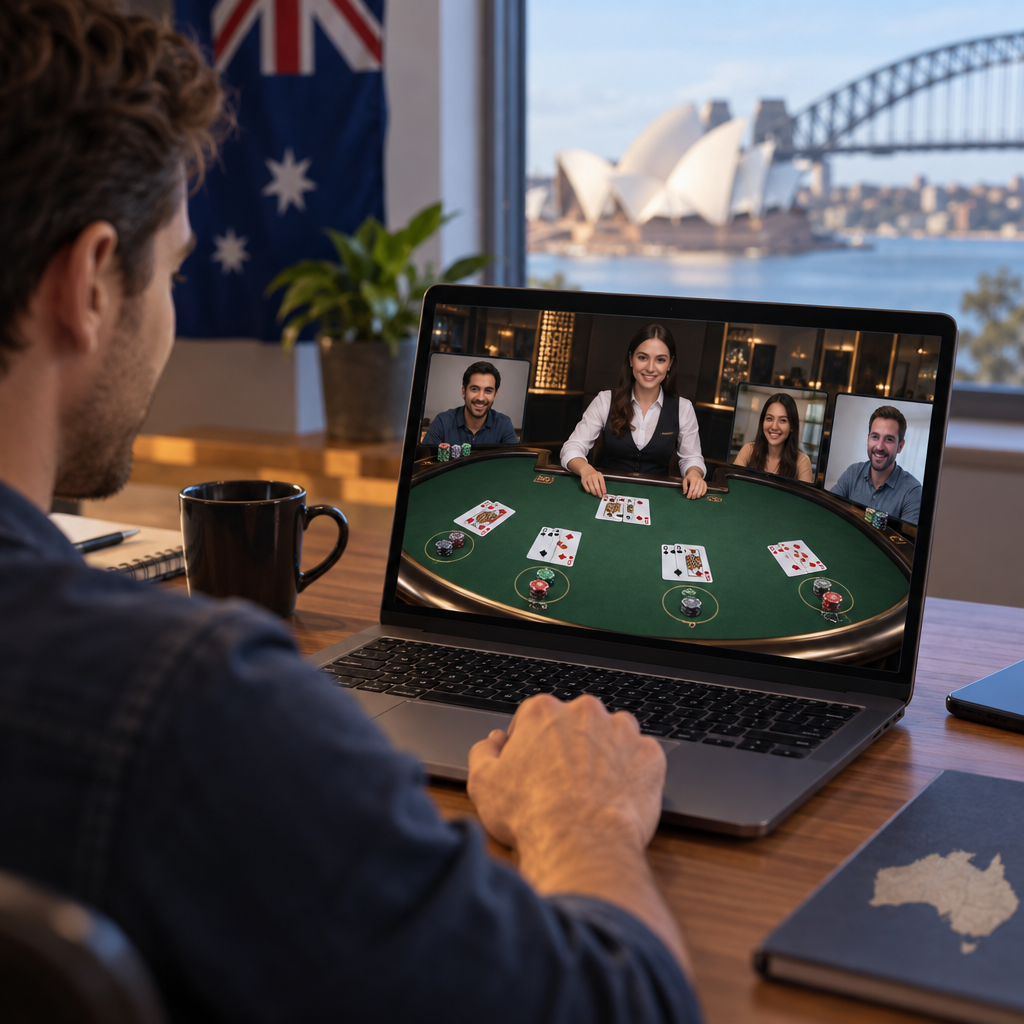
Blackjack multiplayer online can mean several people sharing a virtual table, but it does not necessarily mean a private game with friends. Some games use a computer dealer and play-money chips; others stream a human dealer and accept real-money wagers. That distinction matters in Australia, where providers cannot lawfully offer real-money online casino blackjack to people located in the country. This guide explains how shared tables work, what to check before sending an invitation and why a game described as free can still involve costs. It also covers the Australian legal position, common table rules and support options if gambling or in-game spending becomes a concern.
What makes an online blackjack game multiplayer?
Online multiplayer blackjack usually means that several people take seats in the same virtual table session and play their own hands against a common dealer. The aim is normally to beat the dealer’s hand without going over 21. Each player’s result is settled against the dealer, rather than by taking chips directly from another player.
For example, three friends might join one table, receive separate cards and choose independently whether to take another card. They share the dealer and the round, but one friend winning does not automatically mean the others lose.
A game is not necessarily multiplayer just because it has a leaderboard, shows computer-controlled opponents or lets one person play several hands. Look for a description that confirms multiple human players can join the same table. Even then, check whether they participate in the same rounds or merely compare results afterwards.
Tournaments can add a competitive layer. Players may still face the dealer in each hand, while their results are ranked against other participants under tournament-specific rules. A public table, a private room and a tournament can therefore offer quite different social experiences.
Is multiplayer blackjack legal in Australia?
The key distinction is between a real-money online casino service and a closed-loop social game. The Australian Communications and Media Authority (ACMA) identifies online casino-style blackjack as an illegal service when it is offered to people in Australia. Providers cannot lawfully offer real-money online casino blackjack to people located in Australia, whether a human dealer appears on video or software deals the cards.
If you are researching live dealer blackjack Australia options, the video stream does not change that position. Nor does the fact that a site loads on an Australian phone establish that its service is permitted. An offshore licence is not permission to offer prohibited online casino games to Australians.
The federal Interactive Gambling Act and the ACMA guidance discussed here focus on the provision and advertising of prohibited services. That is not a basis for saying every individual player has committed an offence. Equally, it does not establish that every possible playing arrangement is lawful or free from risk. State and territory rules can also differ; for an unusual arrangement or an individual legal question, seek qualified Australian legal advice.
Social games are different in their usual form. ACMA describes social casinos as games that do not offer real-money winnings, although players may be able to buy in-game items. Check each product’s currency and prize terms rather than assuming that every game labelled free is lawful.
ACMA’s register is useful for checking Australian-licensed interactive wagering providers, but a listing does not authorise every game a business might offer. In particular, it is not evidence that an online casino blackjack service may be offered to Australians.
Live-dealer, computer-dealt and social tables
These descriptions answer different questions. Live-dealer and computer-dealt describe how the cards are dealt and presented. Social or play-money describes the currency and intended use. A computer-dealt table can also be a social game, and either dealing format may have public or private features.
At a live-dealer table, participants watch a video stream of a human dealer and use on-screen controls to make decisions. Seeing the same dealer as other people does not mean you can reserve the table for your group. Invitations, chat and available seats depend on the product. As explained above, a real-money online casino version cannot lawfully be offered to people in Australia.
At a computer-dealt table, software handles the cards and dealer’s actions. Other participants may be real people, but that is not guaranteed: some games display simulated players or let one person control multiple positions. Check the multiplayer description before arranging a group session.
Free multiplayer blackjack usually refers to a game using virtual chips or points rather than redeemable cash. Some publishers advertise shared tables and invitation links, but their descriptions are not independent confirmation that a feature works or is available in Australia. Check current local availability, classification and terms before relying on a particular product.
Treat shared human play, a computer dealer, no cash-out and optional purchases as separate features. A game may have one without the others. In particular, no cash winnings does not necessarily mean there are no advertisements, subscriptions or opportunities to buy more chips.
How to play blackjack online with friends
Start by deciding whether your group needs a genuinely private room or simply wants to sit at the same table. A public table may work if enough seats are open when everyone arrives, but other people may join and a friend who arrives late may miss out.
A private-room setting can offer more control, but read how invitations work. A shareable link might be forwarded to someone outside the group, and a publisher’s use of the word private is not a guarantee of security. Check whether the host can approve or remove participants and whether the room appears in a public list.
Before anyone creates an account or downloads an app, agree on the following checks:
- Shared table: Can several real people join the same session, and is there enough room for your group?
- Invitations and access: Is there a private room, a link or a code? Can strangers enter, and can the host control access?
- Chips and prizes: Can virtual items be redeemed, transferred or sold? Are extra chips, a subscription or an upgrade needed for the features you want?
- Australian access: Is the game currently listed or available in Australia, and what age classification or age checks apply?
- Devices and connection: Can everyone use a supported phone, tablet, computer or browser? Check data use as well as download requirements.
- Privacy and accessibility: Review account requirements, permissions, chat controls, reporting tools and any features your group needs to take part.
- Table rules: Check the dealer’s rules, available decisions, timers and how results are settled before the first round.
How a shared blackjack round works
A typical round starts after players join a room and read the table rules. In a play-money game, each participant places virtual chips if the game uses them. The dealer then deals the cards, and players make decisions for their own hands, usually within a displayed time limit.
To hit is to request another card. To stand is to take no further card. The game may offer other decisions, but their availability depends on the cards and the table rules:
After players finish their decisions, the dealer completes its hand according to the game’s rules. The game then settles each player’s result. Dealer behaviour and payouts vary, so do not assume that rules shown in one app apply elsewhere.
For a simple sequence, imagine that one player has a hand below 21 and chooses whether to hit or stand. The other people at the table make their own choices. Once everyone has finished, the dealer completes the hand and each result is displayed.
At a shared table, use the timer and chat respectfully. Other people may make different decisions from yours, and pressuring them is not helpful. A decision can affect which cards are dealt subsequently from a shared shoe, but the ordinary format remains each player’s hand against the dealer. No decision guarantees a particular result.
- Double-down: Usually increases the initial stake and gives the player one further card.
- Split: Creates separate hands from an eligible pair and requires an additional stake.
- Insurance: Where offered, a separate wager connected with the dealer’s exposed ace.
What to check when a game says it is free
Free can describe the price of entry without describing every possible cost. A game might let you start without paying but offer chip purchases, advertising removal, subscriptions or paid access to certain room features. Check the current terms and the device’s purchase settings before you join.
Look separately at what happens to virtual chips and prizes. In a closed-loop social game, chips generally stay within the game and do not provide real-money winnings. If a product allows chips or prizes to be redeemed, transferred or sold, do not assume the same assessment applies. The details may require legal advice.
ACMA has reported a Federal Court poker case involving virtual chips that could be bought and sold for real money. It was not a ruling on every blackjack game, but it illustrates why the label virtual is not conclusive.
For a group, agree in advance whether everyone will use the free features only. If purchases are available, checking spending controls and notification settings can help prevent an unexpected charge. A virtual-chip balance is not evidence that a player can withdraw money.
Age classification, privacy and consumer risks
Australian Classification says computer games containing simulated gambling are subject to an R 18+ classification requirement from 22 September 2024. Its guidance also explains that games classified before that date generally are not reclassified unless an update triggers reclassification. Do not assume every older game already displays an R 18+ rating; check the current Australian listing and applicable age requirements.
Review what the game collects before creating an account. A multiplayer table may include usernames, messages, voice chat or invitations that reveal information to others. Check who can contact you, whether chat can be turned off and how to report unwanted behaviour. An invitation link should be shared only with people you intend to invite.
Be cautious with services that offer real-money online casino games to Australians. ACMA warns that customers of illegal gambling services may be unable to recover funds and may not have the same protections as customers of licensed services. You can report a suspected illegal service to ACMA.
If gambling or spending is causing concern, the Gambling Helpline is available on 1800 858 858. It is free, confidential and available 24 hours a day. Gambling Help Online also provides free, confidential online support across Australia.
BetStop is a self-exclusion register for Australian-licensed online and phone wagering providers. It does not cover illegally provided online casino games, so it should not be treated as a way to block offshore casinos.
FAQ
Can I play multiplayer blackjack online with friends?
Some play-money products advertise shared tables and private invitations. Friends may also be able to join the same public table, although seats can fill and strangers may join. Check the current features and Australian availability before making plans; publisher descriptions are not the same as independent testing.
Is free multiplayer blackjack available?
Some products advertise multiplayer blackjack using virtual chips. Check that multiple people can share the table, whether chips or prizes can be redeemed or sold, and whether purchases or subscriptions are needed for the features you want. Free entry does not necessarily mean that all features are free.
Is online multiplayer blackjack legal in Australia?
Providers cannot lawfully offer real-money online casino-style blackjack to people in Australia. Closed-loop social games are different, but a free label alone does not settle the legal status of every virtual-currency arrangement. The federal guidance discussed here focuses on providers and advertisers, not a blanket finding about every player.
Do players compete against each other at a shared table?
Usually, each player’s hand is settled against the dealer. Some tournaments also rank participants against one another by their results. Check the particular tournament rules rather than assuming its scoring works like an ordinary shared table.
Can I play on a phone?
Some publishers advertise phone access through a browser or app, but support varies. Check the Australian app-store listing or browser requirements, along with age checks, permissions and data use. A feature advertised elsewhere may not be available on your device or in Australia.
Is a live-dealer table private?
Not necessarily. Live dealer describes the video presentation; private describes who can enter. Friends may be able to sit together at a public table without being able to exclude strangers. Check invitations and room controls separately, and remember the Australian restriction on real-money online casino blackjack.
For a social game, first confirm that your friends can join the same human table and understand who else can enter. Then check the chip terms, optional costs, Australian classification and device requirements. A live dealer is a presentation format, not proof of a private room or a lawful real-money service. Providers cannot lawfully offer real-money online casino blackjack to people in Australia, while individual play-money games still need their own terms and features checked.