Betting Odds on Australian Politics: Markets, Prices and Rules
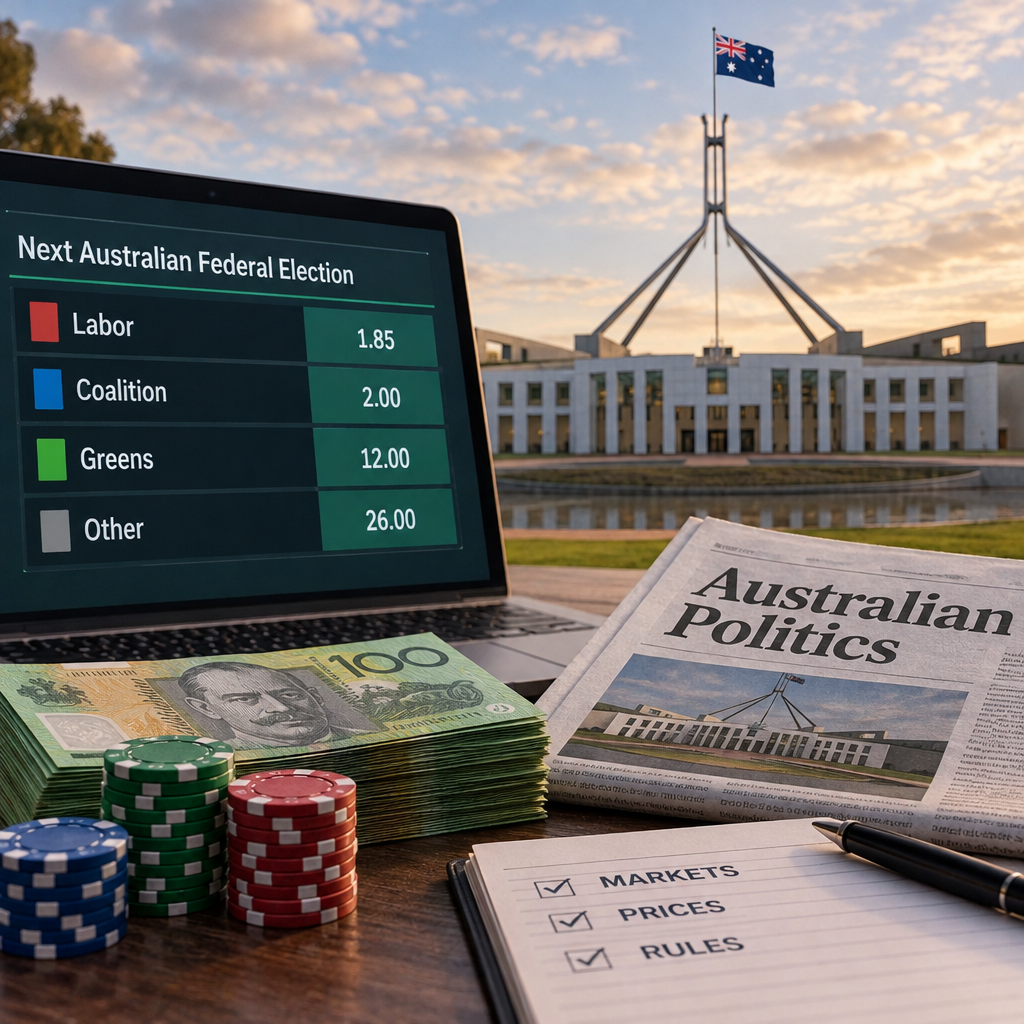
Betting odds on Australian politics are prices for specified outcomes, such as which party forms government or who wins a particular seat. They are not direct measurements of voter intention, and they cannot guarantee an election result. Before comparing prices, check exactly what each market settles on: a party winning the most seats is not necessarily the same outcome as that party forming government. Markets and prices can change, and availability depends on the provider, your account and your location.
Australian political betting markets
Political markets can cover elections, government formation and leadership. The exact selection matters more than a broad label such as “election winner”: two bets that sound similar may settle on different events.
Federal election odds may be offered on the party or coalition associated with the next government, the prime minister after an election, individual House of Representatives seats or the number of seats a party wins. These are possible market categories, not a claim that every market is currently open.
A most-seats market and a government-formation market can produce different results. Hypothetically, one party could win more seats than any other but fall short of a majority, while another party forms government with support from other MPs. The most-seats selection and the government-formation selection could then settle differently.
Similarly, a market on the prime minister after an election is not necessarily the same as a “next prime minister” market. The latter might concern a change of officeholder at any time, including a leadership change before a general election. Read the trigger and the operator’s definition before treating the prices as comparable.
State elections and events beyond polling day
State and territory contests have their own parties, electorates and government-formation rules. Where offered, markets may cover the government formed, an individual seat, party seat totals or whether parliament is hung. A listing for one jurisdiction does not establish that an equivalent market is available everywhere.
For example, the Victorian Electoral Commission lists the Victorian state election for Saturday 28 November 2026. Sportsbet’s Victorian politics page is a place to check its market categories, but a listing should not be treated as proof that a selection is still open or available to every reader. Confirm the election timetable with the commission and any market with the operator.
Political betting markets may also concern leadership changes and other events outside a general election. NSW’s declared-events rules contemplate political events such as referendums and plebiscites, subject to conditions. That regulatory category is not evidence that a particular referendum market is currently offered. A present Australian by-election or referendum market was not established by the available research.
NSW rules also contain jurisdiction-specific exclusions concerning state and council elections where betting is otherwise prohibited. Do not assume those provisions describe every operator or customer across Australia.
How to read decimal odds
Australian bookmakers commonly display decimal odds. For a winning bet, multiply the stake by the decimal price to calculate the total return. That return includes the original stake; profit is the return minus the stake.
Consider a hypothetical $10 bet at odds of 2.50. This is an illustration, not a current quote, and assumes a win without any special settlement adjustment:
- Total return: $10 × 2.50 = $25, including the $10 stake.
- Profit: $25 − $10 = $15.
- Raw implied probability: 1 ÷ 2.50 = 40%.
Implied probability, margin and comparable prices
If the hypothetical bet above loses, the $10 stake is lost. The 40% figure is derived from the price; it is not necessarily the outcome’s true chance, the bookmaker’s unadjusted assessment or an expected return.
Bookmakers generally price a complete market so that the raw implied probabilities add up to more than 100%. The excess is called the overround and is one measure of the margin built into the prices.
For a hypothetical market with exactly two mutually exclusive and exhaustive outcomes, odds of 1.80 and 2.00 imply approximately 55.56% and 50% respectively. Together they total 105.56%, giving an overround of 5.56 percentage points. That does not guarantee the operator a profit of 5.56%; actual results depend on factors including the stakes and prices accepted.
A simple overround calculation only works when the selections cover all possible outcomes and use consistent settlement definitions. If an “other” option is missing, the result may be misleading. Dividing each implied probability by the total can produce normalised figures, but those figures do not reveal the true probabilities.
When you compare political odds, the higher decimal price is meaningful only if the underlying bets are equivalent. Check the jurisdiction, outcome, coalition treatment and settlement trigger first. A most-seats price cannot be reliably compared with a price for a party being sworn into government.
Political odds versus polls and forecasts
Polls, betting prices and forecasts answer different questions. A poll estimates the responses of a surveyed sample at a particular time. An election forecast uses selected inputs and assumptions to model future outcomes. A betting price is a quote for a defined result and may reflect margin, information, customer demand and the operator’s exposure.
For example, a poll estimating 52% two-party-preferred support does not automatically mean a party has a 52% chance of forming government. Vote share and the probability of a particular parliamentary outcome are different measures.
Polls have sampling uncertainty as well as other methodological limitations, such as how respondents are selected and how results are weighted. Small movements between surveys may not represent a meaningful change. Forecasts also depend on their assumptions, while betting prices are not a random sample of voters.
None of these measures guarantees a result or is always the best predictor. If you want to follow an election without betting, electoral commission updates, published polling methodologies and forecasts that explain their assumptions are useful starting points.
Where to check current Australian election betting odds
Start with the Australian Communications and Media Authority’s register of licensed wagering operators. Then visit an eligible provider’s current politics page and look for the precise event and selection. A register entry helps identify the operator’s Australian licensing status; it does not establish that a particular market is open to your account or location.
Sportsbet is an example included in the supplied register research, and its Victorian politics page provides a starting point for checking that provider’s listings. Confirm both the register entry and the market yourself because registration details, selections and terms can change.
No synchronised, like-for-like comparison of current prices across multiple providers was established in the available research. An old search result is not a reliable current federal election quote. If you record prices, treat them as a dated snapshot rather than a live comparison.
For each quote, record enough detail to tell whether you are comparing the same outcome:
- The provider’s name and ACMA register entry.
- The jurisdiction, event, exact market and selection.
- The decimal price and the date, time and time zone checked.
- The settlement trigger, information source and treatment of coalitions or an “other” selection.
- Whether the market is open to your account and location, plus relevant stake restrictions, fees and withdrawal terms.
Political bet settlement rules
Settlement rules determine what makes a bet win, lose or, in some circumstances, become void. The market title alone may not answer those questions. Read both the operator’s general political rules and any wording attached to the individual market.
For example, Sportsbet’s published rules say specified next-party-leader, next-prime-minister and similar markets are generally “all in, run or not” unless otherwise stated. Under that wording, a person’s withdrawal, ineligibility or failure to stand does not necessarily mean a stake is refunded. This is a provider-specific example, not a rule for every candidate market.
Sportsbet’s rules also exclude certain temporary or caretaker leaders in specified next-leader markets. A different market could define its trigger differently, so check whether it concerns an interim appointment, a party ballot or an officeholder after an election.
An official final result is not always the only permitted settlement source. Sportsbet’s Australian politics rules refer to the party sworn in for government markets but allow the use of projections and early information. Its published Mildura seat-market wording describes settlement on the party of the winning candidate and identifies possible sources including projections, concessions and Victorian Electoral Commission results. Check the current wording before relying on either example.
Also look for terms covering dead heats, coalitions, cancellation and postponement. Sportsbet notes that dead-heat rules may apply to most-seats markets, but the effect on a payout depends on the applicable terms. No single postponement rule should be assumed for all Australian political bets.
- What exact event determines the winner?
- Is the market all-in, and what happens if a selection withdraws?
- Are caretaker leaders or coalition partners treated separately?
- Can the provider settle using projections or early information?
- What do the terms say about dead heats, cancellation and postponement?
Eligibility, payments and gambling support
Online wagering is for adults aged 18 or over. Check the operator’s identity and account requirements, your location and the terms for the particular market. An overseas site showing an Australian political event is not, by itself, evidence that the site is licensed to offer wagering to people in Australia.
ACMA reports that credit cards, including credit cards used through digital wallets, and digital currency are prohibited for deposits to licensed online wagering services. This should not be confused with a blanket prohibition on debit cards. Check the operator’s current payment and withdrawal conditions before depositing.
Political betting can cost you your stake, and a short price does not guarantee an outcome. Consider whether gambling is appropriate for you and set limits before spending. Support and self-exclusion are available:
- Gambling Help Online offers free, confidential telephone support on 1800 858 858, 24 hours a day, seven days a week.
- BetStop offers national self-exclusion from Australian-licensed online and phone wagering providers. For registration assistance, call 1800 238 786. BetStop does not replace separate venue-based or state exclusion arrangements.
FAQ
Are Australian election betting odds the same as polls?
No. Odds are prices for defined outcomes, while polls estimate responses from a surveyed sample, often including vote share. A 52% two-party-preferred poll estimate is not automatically a 52% chance of forming government. Both measures have limitations and neither guarantees a result.
What happens if a candidate or leader withdraws?
It depends on the operator and the individual market. Sportsbet’s specified next-leader and similar markets are generally all-in unless stated otherwise, so withdrawal does not necessarily lead to a refund. Do not assume that rule applies to every candidate or every provider.
Can political odds change before an election?
Yes. Providers can change prices or suspend markets as information, assessments, customer demand and their exposure change. Record the date and time of any quote and recheck the exact selection before relying on it. A movement should not automatically be attributed to money wagered alone.
Where can I find current federal election odds?
Check the ACMA register first, then look at an eligible provider’s current federal politics page. Confirm that the market is open to you and read the selection and settlement trigger. Older search results do not establish that a federal market or price is still available.
Does the party with the most seats always win a government-formation bet?
No. In a hung parliament, the party with the most seats may not be the one that forms government. A government-formation market can therefore settle differently from a most-seats market. Check the operator’s wording, including how it treats coalitions.
Are political bets settled only on official election results?
Not necessarily. Sportsbet’s published rules allow specified projections or early information to be used in some political markets, and its Mildura market wording identifies several possible information sources. Other operators and markets may use different rules, so check the applicable terms.
Start with the exact political outcome, then interpret the decimal price and compare it only with equivalent markets. Check the operator’s licensing status, your eligibility and the settlement terms before relying on a quote. Prices can change, and a bet can lose. For election information without gambling, consult electoral commission updates and polling or forecasts that explain their methods.