Betfair Dutching Calculator: Stakes, Commission and Outcomes
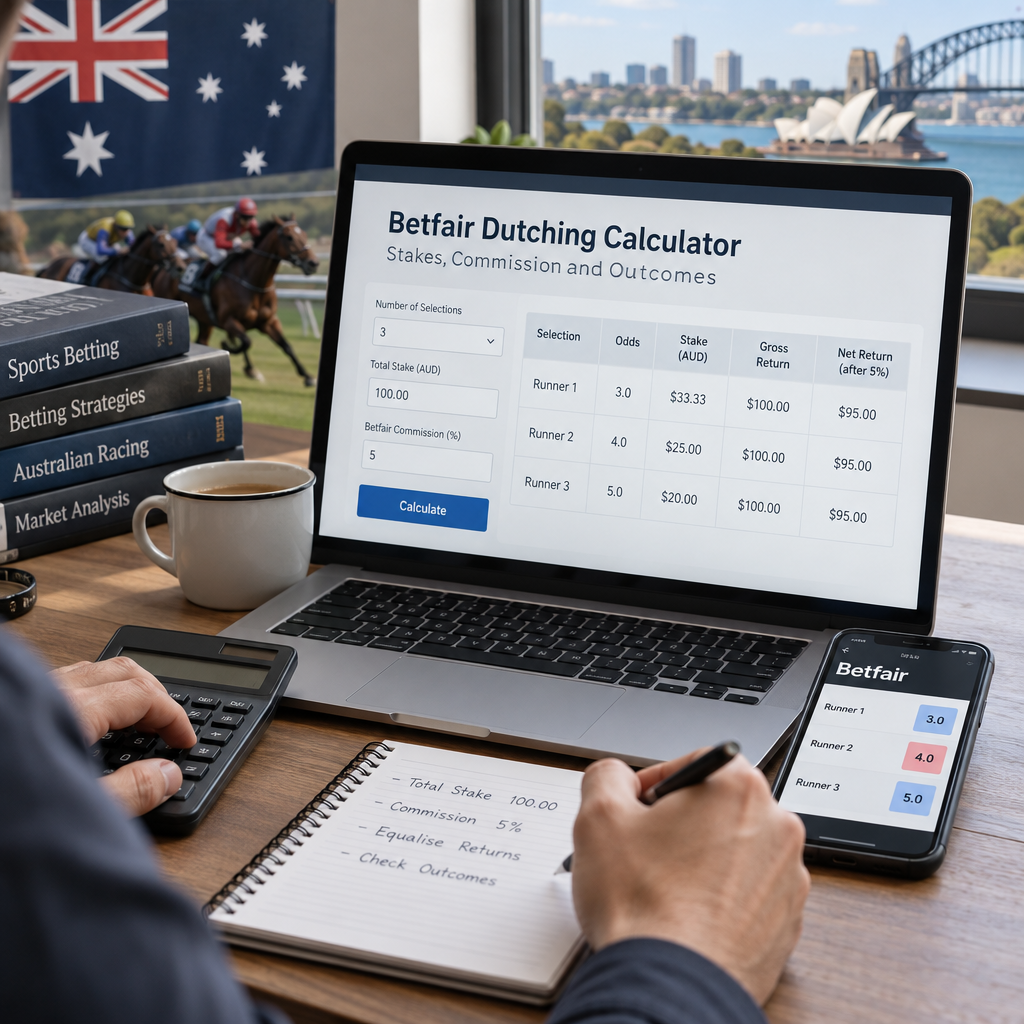
A Betfair dutching calculator helps you estimate how to split a budget across several back bets so that each selected winner produces a similar gross return. It is a planning aid, not a way to remove risk: an unselected outcome can still win, and your bets might not be matched at the prices you used. This guide explains the calculation, an Australian commission example and the checks to make before relying on the result.
What you need for a dutching calculation
Start with two or more mutually exclusive selections in the same market, their decimal back odds and the total amount you are prepared to stake. A back bet is a bet on a selection to win under that market’s rules. For the method below, assume the market has exactly one winner.
The calculation distributes Betfair dutching stakes across those selections. Shorter-priced selections receive a larger share because they need a bigger stake to produce the same return as a longer-priced selection.
For an estimated result after commission, you also need an applicable commission rate. Check the market’s Rules section and your account terms rather than assuming that a rate used in another example applies to you.
These are general calculation requirements, not verified features of the supplied calculator page. The page returned a 404 when checked on 5 November 2026, so its availability and functionality could not be confirmed.
- Selections: the outcomes you intend to back, plus awareness of any outcomes you will leave uncovered.
- Decimal back odds: the prices you expect to obtain for each selection.
- Total stake: the budget to divide across the bets, expressed here in Australian dollars.
- Commission assumption: the applicable rate to use when estimating a positive net market result.
How to read the estimated results
A stake is the amount risked on a selection. The gross return from a winning back bet is its stake multiplied by its decimal odds; that return includes the winning stake. It is not the same as profit.
In the isolated single-winner example below, subtract the total staked on all selections from the winner’s gross return to find the gross market result. If that result is positive, estimate ordinary commission on the net winnings for the market, not automatically on the winning bet in isolation.
Review the result for every relevant outcome, including an unselected winner. An allocation on paper is neither a placed bet nor evidence that the full amount will be matched at the assumed price.
- Stake per selection: how the budget is divided.
- Gross return: what the winning selection returns before the other stakes and commission are accounted for.
- Gross market result: the combined profit or loss across the market before commission.
- Estimated net result: the market result after the assumed ordinary commission, where applicable.
- Unselected outcome: the exposure if none of the backed selections wins.
The stake formula and a worked example
Let S be the total stake and each selection’s decimal odds be o. First calculate Q by adding 1 divided by the odds for every selected outcome. The stake for a selection is S multiplied by its inverse odds, then divided by Q.
In plain terms: stake = S × (1 / selection odds) / Q. The unrounded target gross return is S / Q. If a selected outcome wins, the unrounded gross market result is that return minus S.
Consider three runners at odds of 3.00, 4.00 and 6.00, with A$100 to divide. Q is 1/3 + 1/4 + 1/6, or 0.75. The unrounded target return is approximately A$133.33. Other runners in the market remain unselected.
The following figures assume exactly one winner, all bets fully matched at the stated prices, and no other market positions, voids, dead heats, reduction factors or additional charges. The 8% commission rate is illustrative, not a universal Betfair rate. Each line shows the outcome if that runner wins.
- A at 3.00: stake A$44.44; gross return A$133.32; gross market profit A$33.32; estimated profit after 8% commission A$30.65.
- B at 4.00: stake A$33.33; gross return A$133.32; gross market profit A$33.32; estimated profit after 8% commission A$30.65.
- C at 6.00: stake A$22.23; gross return A$133.38; gross market profit A$33.38; estimated profit after 8% commission A$30.71.
- An unselected runner wins: A$100 total staked; gross return A$0; market loss A$100, with no ordinary commission on that loss.
Why rounding and the odds sum matter
The exact stake allocations in the example are approximately A$44.444, A$33.333 and A$22.222. Rounding all three down to cents would allocate only A$99.99. Assigning the remaining cent to C uses the full budget but makes C’s return slightly higher. Other cent allocations are possible.
The displayed net figures are rounded illustrations, not a claim about Betfair’s settlement-rounding method. Small differences in matched stakes or prices can also affect the balance.
Q indicates whether a selected winner produces a gross profit or loss under the stated assumptions. Below 1, each selected winner produces a gross profit; at 1, the result is gross break-even; above 1, each produces a gross loss. Q is a sum of inverse prices, not the true probability that the selected set will win.
For a simple loss example, back two mutually exclusive selections at 1.80 with A$50 on each. Either selected winner returns A$90 against A$100 staked, leaving a A$10 market loss. Under the ordinary net-market commission assumption, no commission is charged on that loss.
Even when Q is below 1, an unselected outcome can win. That figure alone therefore does not establish an arbitrage or a profit across every possible outcome.
Betfair commission and Australian market rates
Betfair’s ordinary commission is based on positive net winnings for the market and is deducted at settlement. In the worked example, if A wins, the commission base is A$33.32: its A$133.32 return less the A$100 staked across the three selections. It is not the full return or A’s standalone profit.
At the assumed 8% rate, estimated commission on A’s A$33.32 market profit is A$2.6656. That leaves A$30.6544, displayed as A$30.65. Where P is the gross market result and c is the applicable commission rate, the simple estimate is P − c × max(P, 0).
This formula assumes the example is the entire market position and excludes other charges. At a rate between 0% and 100%, ordinary commission reduces a positive isolated market profit but does not by itself turn that profit into a loss.
When research was checked on 5 November 2026, Betfair Australia’s guidance stated that sport and international racing generally had a 6% Market Base Rate, except NRL at 10%. Australian racing rates were 8% or 10%, depending on state and code. Rates and account terms can change, and other charges may apply to some customers.
A dutching calculator with commission is only as useful as its assumptions. Check the particular market’s Rules section for its Market Base Rate, confirm whether a displayed figure is gross or net, and account for any other positions or charges. Do not apply the same-market formula blindly to bets spread across different markets or bookmakers.
Why exchange results can differ from the plan
Available prices and liquidity can change. A displayed back price does not establish that enough money is available to match your entire intended stake. A bet can be partially matched, leaving the rest as an unmatched offer.
If only part of the A$44.44 planned for A is matched, for example, the balanced results in the worked example no longer describe your actual position. Check each matched amount and price, then recalculate the outcome for every selection. An unmatched offer can later match unless it is cancelled or lapses.
Normal unmatched bets generally lapse at the event start, but relevant options can include Keep or Take SP under the applicable rules. Do not assume every unmatched offer disappears at the off.
Settlement can change the picture too. Under applicable racing rules, a non-runner may void its bet and trigger reduction factors affecting other matched prices. A dead heat or a void can alter the outcome. Check the rules for the specific market rather than assuming every scratching is treated identically.
The formula in this guide is for mutually exclusive back bets in a single-winner market. A place market can have multiple winners, while lay bets involve liability. Both require a suitable outcome-by-outcome calculation; support for either on the target page has not been verified.
How to dutch on Betfair: a practical checklist
Set a budget before betting and consider the loss you could incur, not just the return shown for selected winners. A stake split does not establish whether a bet is worthwhile.
For people physically in Australia, online in-play sports betting is prohibited subject to limited exceptions. Check the applicable rules rather than assuming an online in-play sports bet is available.
- Confirm the market, the number of possible winners, your selected outcomes and any outcomes left uncovered.
- Check current back prices, available liquidity, the market rules and the applicable commission rate.
- Calculate the stakes and review the gross and estimated net result for every relevant outcome.
- Submit only bets consistent with your budget and the applicable rules.
- Check each actual matched amount and price, and review any unmatched offers. Recalculate if the position differs from the plan.
- Revisit the market rules and any non-runners, voids or other changes before treating settlement as final.
FAQ
Can a Betfair dutching calculator guarantee a profit?
No. An unselected outcome can win, leaving all the selected back bets losing. Prices and matched amounts may also differ from the plan, while settlement rules and applicable charges can affect the result. A profit for each selected winner is not necessarily a profit across the whole market.
Does the target calculator include Betfair commission?
Its commission features are unknown because the page could not be tested when it was checked. If the page becomes available, check whether you can enter the relevant rate and whether its result is gross or after commission. Betfair ordinarily assesses commission on positive net market winnings, so a gross estimate may require a separate calculation.
What happens if an unselected outcome wins?
In the A$100 example, all three selected back bets lose and the market result is a A$100 loss. That assumes the bets were fully matched and there are no other positions or settlement adjustments. A different betting position could have a different result.
Can I use the calculation for lay bets or markets with multiple winners?
The target tool’s support for these cases is unverified. The single-winner back-bet formula is not sufficient: lay bets involve liability, and multiple-winner markets can have several backed selections win at once. Use a calculation designed for the bet type and assess each possible market outcome.
Is this calculation suitable for an Australian Betfair account?
The mathematics can be used with Australian-dollar stakes and an appropriate Australian market rate, but the target page’s availability and features in Australia are unverified. Betfair customers must be at least 18 and meet account eligibility requirements. Betfair Pty Ltd appears on the Northern Territory licensed-operator list; that listing does not establish that the calculator is licensed or affiliated with Betfair. Australian in-play restrictions are a separate consideration.
Where can an Australian reader get gambling support?
BetStop provides self-exclusion from Australian-licensed online and phone wagering providers, with a minimum registration period of three months. Gambling Help Online offers free, confidential support, and the Gambling Helpline is available 24 hours a day on 1800 858 858. Links to both services are included in the sources.
A dutching calculation can help you plan a stake split, but the estimate depends on the odds, commission assumption and outcomes included. Check uncovered outcomes and the market rate, then reconcile the plan with the bets actually matched. The final result remains subject to the market’s settlement rules and any applicable charges.