Betfair Calculator Back Lay: How to Calculate Stakes and Liability
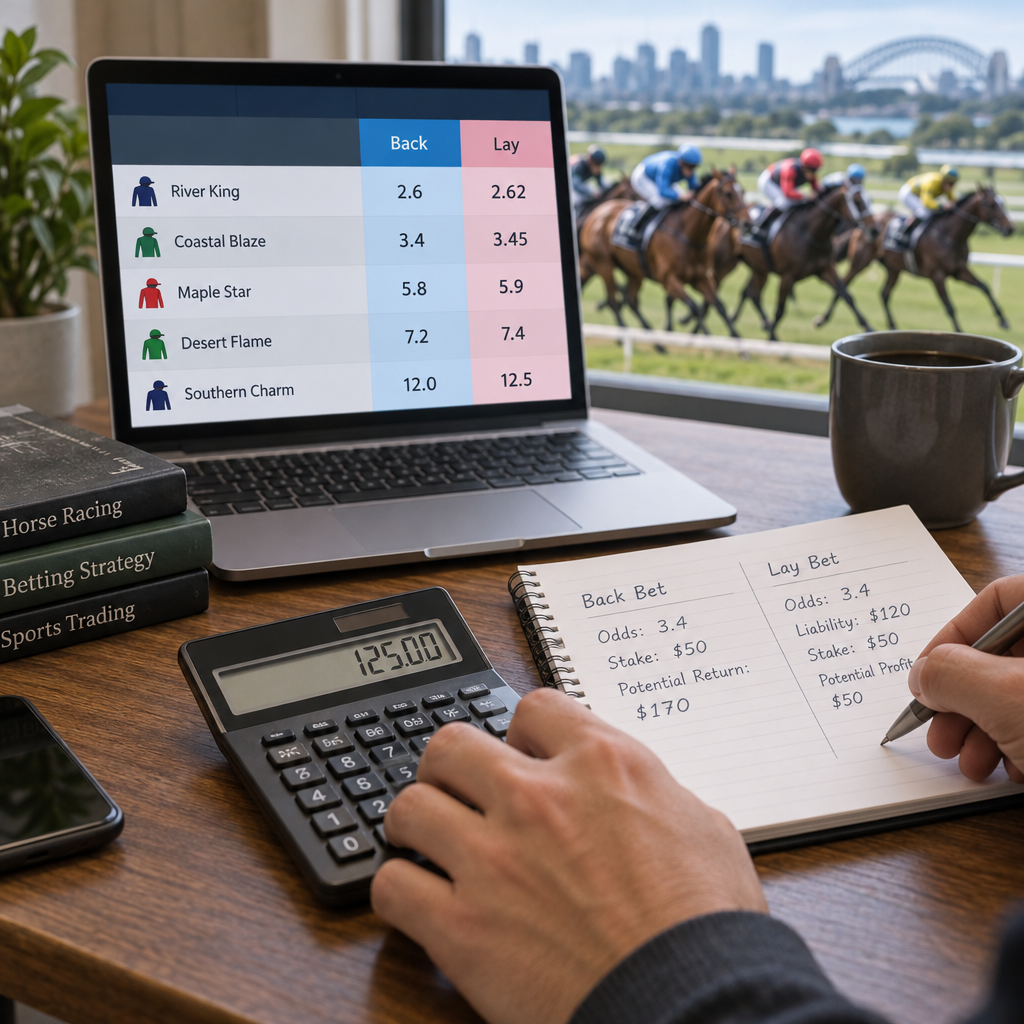
If you’re searching for a “betfair calculator back lay”, you’re likely trying to work out how much to lay and what each outcome could cost or return. A back and lay calculator estimates those figures from your stake, decimal odds and commission assumptions. It cannot confirm that a bet will be accepted, matched or settled as entered. The supplied page returned a 404 when researched, so its features and accessibility from Australia are unverified. The manual method below can help you check the arithmetic without relying on an untested tool.
Back and lay betting: the essential terms
A back bet supports a selection to win. A lay bet opposes it: when you lay, you take the position of the person offering the bet to another customer on the exchange.
Laying a team to win can succeed if that team loses or draws, depending on the market rules. Throughout this guide, “does not win” means the selection does not win under the relevant settlement conditions. Both sides of a calculation must cover the same outcome on equivalent terms.
Betfair normally assesses commission on net winnings in a market, rather than charging it separately on every winning transaction. This distinction matters if you have more than one bet in the same market.
- Back stake: the amount wagered on the selection.
- Back odds: the accepted decimal price. For an ordinary cash bet, the stake multiplied by the odds is the total winning return, including the returned stake, before any applicable exchange commission.
- Lay odds: the decimal price at which you oppose the selection.
- Lay stake: the opposing backer’s stake, which is the amount you can win before commission if the selection does not win.
- Lay bet liability: the stand-alone loss on the lay if the selection wins. Calculate it as lay stake × (lay odds − 1).
How to use a typical back-and-lay calculator
For an ordinary cash back bet at a bookmaker and a separate exchange lay, start with the accepted back stake and back odds. Add the proposed lay odds and the commission rate that applies to your exchange winnings. These are general inputs, not verified features of the supplied page.
For example, the calculation later in this article uses a hypothetical A$100 back stake at odds of 3.00, lay odds of 2.80 and an assumed 6% commission. When calculating manually, write 6% as 0.06.
Check the market’s Rules section and your account terms for the applicable commission. A market base rate is not necessarily your effective rate. The example’s 6% is an assumption, not a rate that applies to every Australian market or customer.
A calculator seeking an equal result proposes a lay stake intended to make the combined outcome approximately the same whether the selection wins or not. Check all four outputs below rather than looking only at the stake.
- The proposed lay stake.
- The lay liability if the selection wins.
- The combined result if the selection wins.
- The combined result if the selection does not win.
What an equal-result calculation does
Equalising outcomes is not the same as creating a profit. Depending on the prices and commission, the calculation can show a profit on both outcomes, a loss on both, or a result close to zero.
You can choose a different lay stake if you want the outcomes to be unequal. For example, a smaller lay stake than the equal-result figure leaves a larger combined result if the selection wins and a smaller one if it does not. Calculate both outcomes before deciding whether that exposure is acceptable.
A calculator’s result is only as useful as its assumptions. A stake-not-returned bonus bet needs a different calculation from the ordinary cash bet used here. Likewise, when both bets are on the same exchange market, commission needs to be considered at the market level.
How to calculate the lay stake
A Betfair lay stake calculator may perform the following arithmetic for you. The first method applies to a normal cash back bet with a bookmaker and a separate exchange lay, with no other bets affecting the exchange market’s result.
Let S be the back stake, B the decimal back odds, O the decimal lay odds, c the exchange commission as a decimal and L the lay stake. The equal-result lay stake is L = (S × B) ÷ (O − c).
To check the result, calculate the lay liability as L × (O − 1). If the selection wins, the combined result is S × (B − 1) − L × (O − 1). If it does not win, the combined result is L × (1 − c) − S.
The commission adjustment appears in the second outcome because the exchange lay wins when the selection does not win. In the first outcome, the bookmaker back bet wins and the exchange lay loses. The formula balances those combined results; it does not ensure they are positive.
This method assumes full matching at the entered lay odds, equivalent settlement on both sides, no other relevant exchange-market bets and no additional charges. Actual rounding can also leave the displayed outcomes slightly different.
When both bets are in the same exchange market
Do not automatically use the separate-bookmaker formula if both the back and lay are on Betfair in the same market. Betfair assesses commission on net market winnings, so the two bets are considered together for that market.
With only those two bets, equalise the gross results first: L = (S × B) ÷ O. Then calculate the market result for each outcome and apply the applicable commission only if the net market result is positive.
As a separate comparison, suppose both bets are in one exchange market, with an A$100 back stake at 3.00 and lay odds of 2.80. The unrounded equalising lay stake is A$300 ÷ 2.80, or approximately A$107.14. Each gross market outcome is approximately A$7.14. At a hypothetical 6% commission, that is approximately A$6.71 after commission in either outcome.
This is not the same arrangement as the bookmaker example below. Other bets in the market, additional charges, rounding or different settlement conditions can change the result.
Worked example: a bookmaker back and an exchange lay
Consider an ordinary A$100 cash back bet at a bookmaker at decimal odds of 3.00, paired with a lay at 2.80. Assume 6% lay-side commission, full matching, equivalent settlement, no other bets in the exchange market and no other charges. These prices and amounts are hypothetical, not an available offer.
The unrounded equal-result lay stake is A$100 × 3.00 ÷ (2.80 − 0.06), or A$109.489051 and so on. Rounded to cents for this illustration, the proposed lay stake is A$109.49.
The stand-alone lay liability is A$109.49 × (2.80 − 1) = A$197.082, displayed here as approximately A$197.08. That is the loss on the lay if the selection wins, before considering the bookmaker result.
If the selection wins, the bookmaker bet makes A$200 profit and the lay loses approximately A$197.08. The combined result is approximately A$2.92 profit.
If the selection does not win, the bookmaker bet loses A$100. The exchange lay wins A$109.49 before commission; after the assumed 6% commission, that is approximately A$102.92. The combined result is again approximately A$2.92 profit.
The figures are not exactly equal after rounding the lay stake: before final display rounding, the combined results are A$2.918 and A$2.9206 respectively. Providers may round settlement differently. The positive result is illustrative; different prices can produce a loss in both outcomes.
Check liquidity, matching and available funds
A displayed exchange price is not a completed bet. The amount available at that price is liquidity, and it can change before you submit an order. A lay may match in full, match only in part or remain unmatched.
If only part of your proposed lay matches, the original calculation no longer describes your position. Recalculate using the actual matched stakes and prices. An unmatched remainder may be cancelled, but a matched bet cannot simply be cancelled.
Also check the liability and overall account exposure displayed before placing the lay. The lay stake is not the stand-alone amount at risk, and the funds needed for the exchange position are not necessarily the same as the bookmaker back stake.
- Confirm the lay price and the amount available at that price.
- Review which portions are matched and which remain unmatched.
- Check the displayed lay liability and account exposure.
- Recalculate both outcomes using the actual matched amounts and odds.
Check settlement rules, commission and charges
A two-outcome calculation assumes both bets settle on equivalent terms. Check the event, selection and market carefully: two bets that appear to oppose one another may be treated differently if their providers use different settlement rules.
In racing, non-runners can lead to odds reductions or cancellation of unmatched lay offers under the applicable exchange rules. A bookmaker may handle the same change differently. If a bet is voided or its odds are adjusted, recalculate rather than relying on the original estimate.
Also review any settings for unmatched bets. Depending on the available options and rules, an unmatched order may be set to remain in play or convert to a starting-price bet. The starting price is not known in advance, so it is not the fixed lay price used in the original calculation.
Betfair’s Australian commission information describes different market base rates and potential additional charges for some customers. Its published racing-rate summaries are not entirely consistent, so check the individual market’s Rules and your account terms rather than assuming one rate applies everywhere. Allow for any relevant charges and rounding when evaluating the result.
- Check that the selection and settlement conditions match across providers.
- Read the relevant non-runner, cancellation and void rules.
- Confirm the applicable commission and any other account charges.
- Revisit the calculation whenever odds, matched stakes or settlement assumptions change.
FAQ
What is the difference between a lay stake and lay liability?
The lay stake is the amount you can win before commission if the selection does not win. Lay liability is the stand-alone loss on that lay if the selection wins. At odds of 2.80, an A$109.49 lay stake creates approximately A$197.08 liability. Your combined result also depends on the back bet.
Does the calculator include Betfair commission?
It depends on the calculator. Some provide a commission input, but the supplied page’s functionality was not verified. Before relying on any tool, check whether it includes commission and how it applies it. Betfair assesses commission on net winnings in a market.
What commission rate should Australian readers enter?
Check the relevant market’s Rules and your applicable account terms. Betfair market base rates vary, and a base rate is not necessarily your effective rate. The 6% used in the worked example is hypothetical and should not be treated as a universal Betfair commission rate.
Why might the actual result differ from the estimate?
The lay price may change or only part of the proposed stake may match. Other bets in the market, commission, additional charges, rounding and differences in settlement rules can also affect the result. Recalculate from the actual accepted and matched bets, not just the original inputs.
Can a back-and-lay calculation guarantee a profit?
No. An equal-result calculation can produce a loss in both outcomes. Even where the estimated result is positive, the bets may not be accepted, matched or settled on the assumed terms. The worked example illustrates the arithmetic rather than predicting an available profit.
Can Australian readers use the supplied calculator?
Its accessibility from Australia was not verified; the supplied page returned a 404 when researched. Access to a calculator is also separate from eligibility for a Betfair account. Betfair requires customers to be at least 18 and says new customers must verify their identity before account creation and exchange access. Other current account terms and location restrictions may apply.
Does the same formula work if both bets are on Betfair?
Not automatically. If the back and lay are the only two bets in the same exchange market, equalise the gross market results first, then apply commission to positive net market winnings. Other bets, charges or settlement differences can change the calculation.
A back-and-lay calculation is a way to inspect potential outcomes, not a promise of profit. Check the stake, odds, applicable commission and liability, then compare the estimate with your actual matched bets and the providers’ settlement terms. Recalculate whenever a price, stake or other assumption changes.