Betfair Back to Lay Calculator: Stakes, Liability and Commission
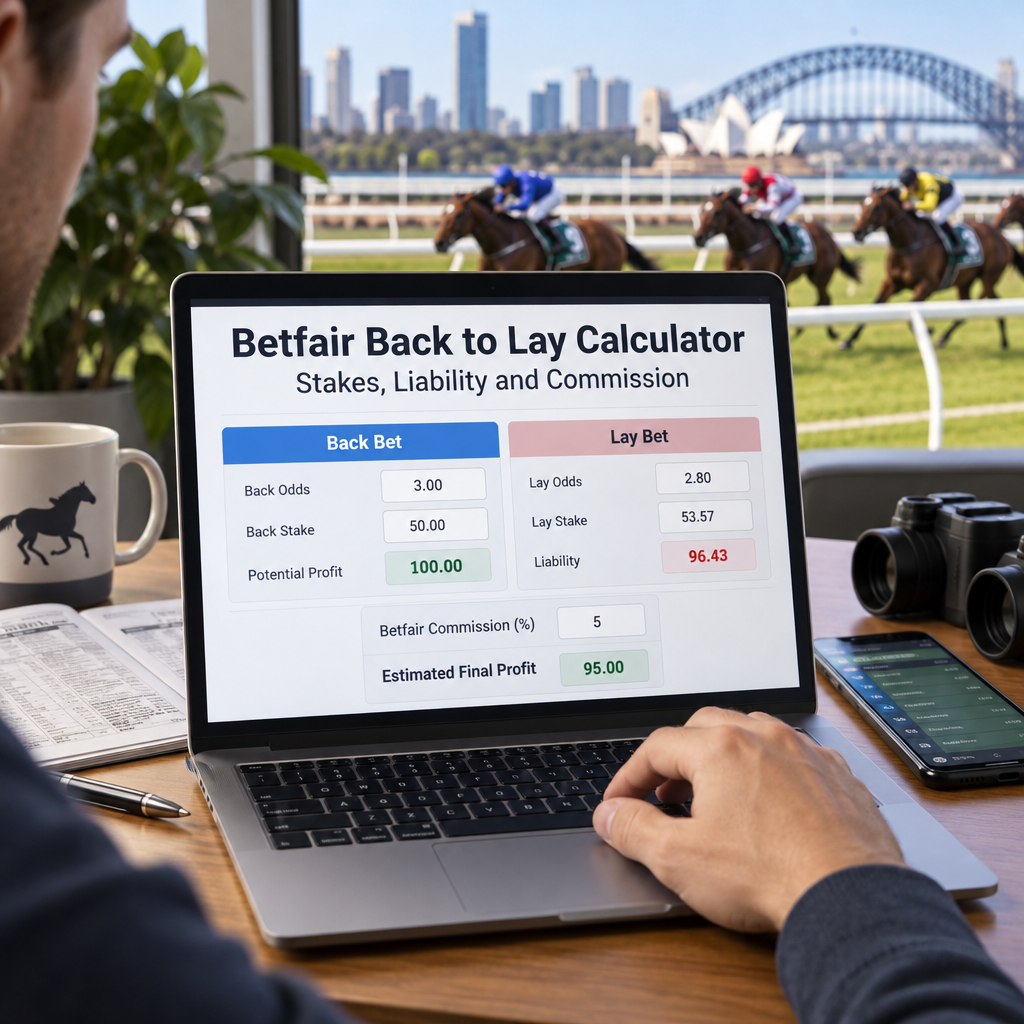
A betfair back to lay calculator estimates the lay stake needed to change your exposure after backing a selection. It can also help you compare the possible outcomes and the liability on the lay bet. The right calculation depends on where you placed the back bet: two bets in the same Betfair Exchange market are treated differently from a bookmaker back paired with an exchange lay. This guide explains both approaches using Australian dollars and decimal odds. The figures are estimates based on stated assumptions, not guarantees that a bet will be matched or that the final outcome will be a profit.
How to use a back-to-lay calculation
Start by identifying the exact selection and where the back bet was placed. Check that the proposed lay concerns the same selection and that the two bets have compatible settlement conditions. Bets that look similar can produce different results if operators apply different rules.
Next, use the matched back stake and its actual decimal odds, rather than an earlier requested price. Add the proposed lay odds and check the commission applicable to the exchange market. If you already have other bets in that market, include their effect in a broader assessment.
Choose the relevant formula below to estimate an equal-outcome lay stake. Then calculate the lay liability and compare the result if the selection wins with the result if it loses. Once you place an offer, reassess using the amounts and prices actually matched.
A back to lay calculator and a Betfair lay stake calculator do not necessarily solve the same problem. Some calculations size a lay to equalise outcomes; others only calculate liability for a lay stake you already know. Check the purpose and assumptions of any tool before relying on its output.
- Gather: the matched back stake and odds, proposed lay odds, applicable commission and details of any existing market bets.
- Check: the proposed lay stake, lay liability, results under both outcomes and any difference caused by rounding.
- After placing an offer: check what has actually matched, at which prices and whether an unmatched amount remains.
How back-to-lay betting and liability work
Backing a selection means betting that the specified outcome will occur. Laying it means taking the opposing side: if the selection loses under the market rules, the lay bet wins; if it wins, the lay bet loses. For example, laying a team to win can also cover a draw, provided a draw is a losing result for that selection under the relevant rules.
In back-to-lay betting, you back first and later lay the same selection to alter your exposure. The aim might be to equalise the result, reduce a possible loss or retain more exposure to one outcome. The equal-outcome formulas in this guide address the first of those objectives.
The lay stake is the amount the layer seeks to win from the opposing backer. Lay liability is the amount lost on the lay leg if the selection wins. Calculate it as: lay stake × (decimal lay odds − 1).
For example, a $64 lay at odds of 2.50 has liability of $64 × 1.50, or $96. That $96 is not necessarily the loss on the whole position: a winning back bet and any other market bets also contribute to the final result.
The back-to-lay formula depends on where you placed the back bet
Use the following definitions for both versions of the back-to-lay formula: S is the matched back stake, B is the matched decimal back odds, L is the proposed lay stake, O is the decimal lay odds and c is the exchange commission rate expressed as a decimal. For example, 6% is written as 0.06.
Both formulas assume ordinary cash bets on one selection, a simple win-or-lose settlement, no other bets affecting the exchange market, and full matching at the stated prices. They exclude special charges, voids, deductions and other settlement adjustments. They are designed to equalise outcomes, not to calculate every possible hedge.
Formula 1: back and lay in the same Betfair market
When both bets are in the same Betfair Exchange market, the equal-outcome lay stake is: L = S × B ÷ O.
Before commission, the result if the selection wins is S × (B − 1) − L × (O − 1). If it loses, the result is L − S. Setting those two expressions equal produces the formula above.
Betfair ordinarily charges commission on positive net winnings in a market, rather than separately on each winning bet. If the two market outcomes are equal and positive, the same commission percentage reduces each by the same amount. It therefore does not change the stake needed to equalise them under these assumptions.
Ordinary commission is not charged on a net market loss. This does not mean commission can always be ignored: it reduces a positive final result, while other bets or special charges can require a broader calculation.
Formula 2: bookmaker back and Betfair Exchange lay
When the back is an ordinary cash bet with a separate bookmaker and the lay is the only Betfair bet in that market, the equal-outcome lay stake is: L = S × B ÷ (O − c).
Here the bookmaker result is outside Betfair’s net market calculation. If the selection wins, the combined result is S × (B − 1) − L × (O − 1). If it loses, the exchange lay wins and the combined result, after ordinary commission on that lay win, is L × (1 − c) − S. Equating those results gives the commission-adjusted formula.
Do not apply this version automatically to free bets, a back on another exchange or a market with other existing positions. Different settlement rules can also change the outcome. Even if the lay odds are shorter than the back odds, commission and other costs must be considered before concluding that an equalised result is positive.
Worked examples in Australian dollars
Suppose you have backed a selection for $50 at decimal odds of 3.20 and can lay it at 2.50. The examples use 6% commission for illustration only; it is not necessarily the rate for your account or market. All figures are net results, not account balances.
If both bets are in the same Betfair market, the back’s potential return, including stake, is $50 × 3.20 = $160. Divide $160 by the lay odds of 2.50 to get an equalising lay stake of $64. Its liability is $64 × 1.50 = $96.
If the selection wins, the back leg wins $110 and the lay leg loses $96, leaving $14 before commission. If the selection loses, the back leg loses $50 and the lay leg wins $64, again leaving $14 before commission. At the illustrative 6% rate, commission on the $14 net market win is $0.84, leaving $13.16 in either outcome.
Now suppose the $50 back was instead placed with a separate bookmaker, with the lay as the only Betfair bet in that market. The formula gives $160 ÷ (2.50 − 0.06) = $65.573770…. A rounded $65.57 lay has a calculated liability of $98.355.
At that rounded stake, the combined result is $110 − $98.355 = $11.645 if the selection wins. If it loses, it is $65.57 × 0.94 − $50 = $11.6358. The outcomes are approximately $11.64–$11.65 rather than exactly equal. Actual stake and settlement rounding depend on the platforms involved.
Equalising does not always produce a profit. For instance, with the same $50 back at 3.20 in one market, a lay at 4.00 would require a $40 stake to equalise the outcomes. The result would be a $10 net loss whether the selection wins or loses, before any other charges. No ordinary commission applies to that net market loss.
- Same-market example: $64 lay stake, $96 liability and $13.16 net in either outcome after illustrative commission.
- Separate-bookmaker example: approximately $65.57 lay stake, with approximately $11.64–$11.65 net depending on the outcome and rounding.
What happens if the lay is only partly matched?
An offered lay stake is not a completed hedge until it is matched. Available prices and amounts can change, so an intended lay may be partly matched or not matched at all. The unmatched portion does not yet provide the exposure shown in your calculation.
Return to the same-market example and suppose only $32 of the intended $64 lay matches at 2.50. Liability on the matched lay is $32 × 1.50 = $48. If the selection wins, the market result is $110 − $48 = $62 before commission, or $58.28 after the illustrative 6% commission.
If the selection loses, the result is $32 − $50 = a net loss of $18. There is no ordinary commission on that net market loss. The two outcomes are very different because only half the intended lay has matched.
The remaining $32 is an unmatched offer. Whether it remains available, is cancelled or receives other treatment depends on the market and bet settings. If further portions match at different prices, calculate the liability and result for each matched portion, then combine them with the back position.
- Check the matched lay amount and each matched price.
- Check whether an unmatched offer remains and how it will be treated.
- Recalculate both outcomes using the completed bets, not the original target stake.
Australian eligibility and in-play restrictions
ACMA’s licensed-provider register lists Betfair Pty Ltd as an Australian-licensed interactive wagering provider. Betfair’s terms require customers to be at least 18, and its identity guidance says new customers must verify their identity before account creation and exchange access. Account eligibility and market availability remain subject to the operator’s terms.
In-play rules are particularly important when planning a later lay. Online in-play sports betting in Australia is generally prohibited, with limited exceptions including qualifying telephone betting. Betfair identifies a telephone channel for in-play sports bets. Do not assume you can place the lay through the app after a sports event has started.
Betfair separately describes online and telephone in-play horse-racing betting. Check the specific market, permitted channel and current operator rules before relying on either route. A permitted channel does not ensure that a suitable market or price will be available, or that an offer will match.
Costs, settlement and spending limits
Check the live market commission and your account terms before calculating. Rates vary by market and account treatment, and Betfair describes additional charges that can apply to certain customers or activity. Other bets in the same exchange market can also change net winnings and the commission calculation.
Settlement can differ from the simple examples. Racing non-runners can trigger reductions, while market rules can void or adjust bets. When the back and lay are with different operators, one leg could be voided while the other stands. Read both sets of rules, especially where the events or settlement conditions are not identical.
Set a personal spending limit before betting and consider whether the potential loss fits within it. If gambling is causing concern, Gambling Help Online offers free, confidential support on 1800 858 858, 24 hours a day. BetStop provides national self-exclusion from Australian-licensed online and phone wagering.
- Confirm the applicable commission rate and any other charges.
- Review existing market exposure, actual matched prices and available funds for liability.
- Check operator settlement rules, possible non-runner adjustments and unmatched-bet settings.
- Compare both outcomes against your personal spending limit.
FAQ
Does a back-to-lay calculator guarantee a profit?
No. It models the inputs and assumptions supplied. An equalised outcome can be a loss, and an apparently positive result depends on the intended bets being matched and settled as assumed. Commission, other charges and rounding can also change the final result.
How is lay liability calculated?
Multiply the lay stake by the decimal lay odds minus one. A $64 lay at 2.50 has liability of $64 × 1.50, or $96. That is the potential loss on the lay leg; the overall market result also depends on the back leg and any other bets.
Does Betfair charge commission on both sides of a hedge?
Ordinary exchange commission is calculated on positive net winnings in the market, not separately on every winning back or lay bet. A back placed with a separate bookmaker is outside that Betfair market calculation. Check your applicable rate and any other charges.
What should I do if my lay bet is partly matched?
Recalculate your exposure using only the matched amounts and their actual prices. The unmatched remainder is still an offer, not a completed lay. Check the market rules and bet settings to see how that offer may be handled, and reassess if more of it matches.
Can Australian customers use Betfair Exchange for back-to-lay betting?
Eligible, verified adults can use the Australian-licensed exchange, subject to account and market conditions. Australian online in-play sports restrictions are an important limitation: check the permitted channel and the specific market before planning a lay after play starts.
What if the lay odds are longer than the back odds?
An equal-outcome hedge can lock in a loss rather than a profit. Calculate both outcomes using the appropriate venue and commission assumptions, and include any other applicable costs instead of assuming that every hedge produces a positive result.
Choose the formula that matches where the back bet was placed, then compare the proposed liability and both possible results. Check the applicable commission, settlement rules and actual matched amounts before relying on the figures. An equalised outcome can be a loss, and a calculated lay is not a guaranteed match. If the price or matched amount changes, reassess your exposure.