Betfair Back and Lay Calculator: Stakes, Liability and Commission
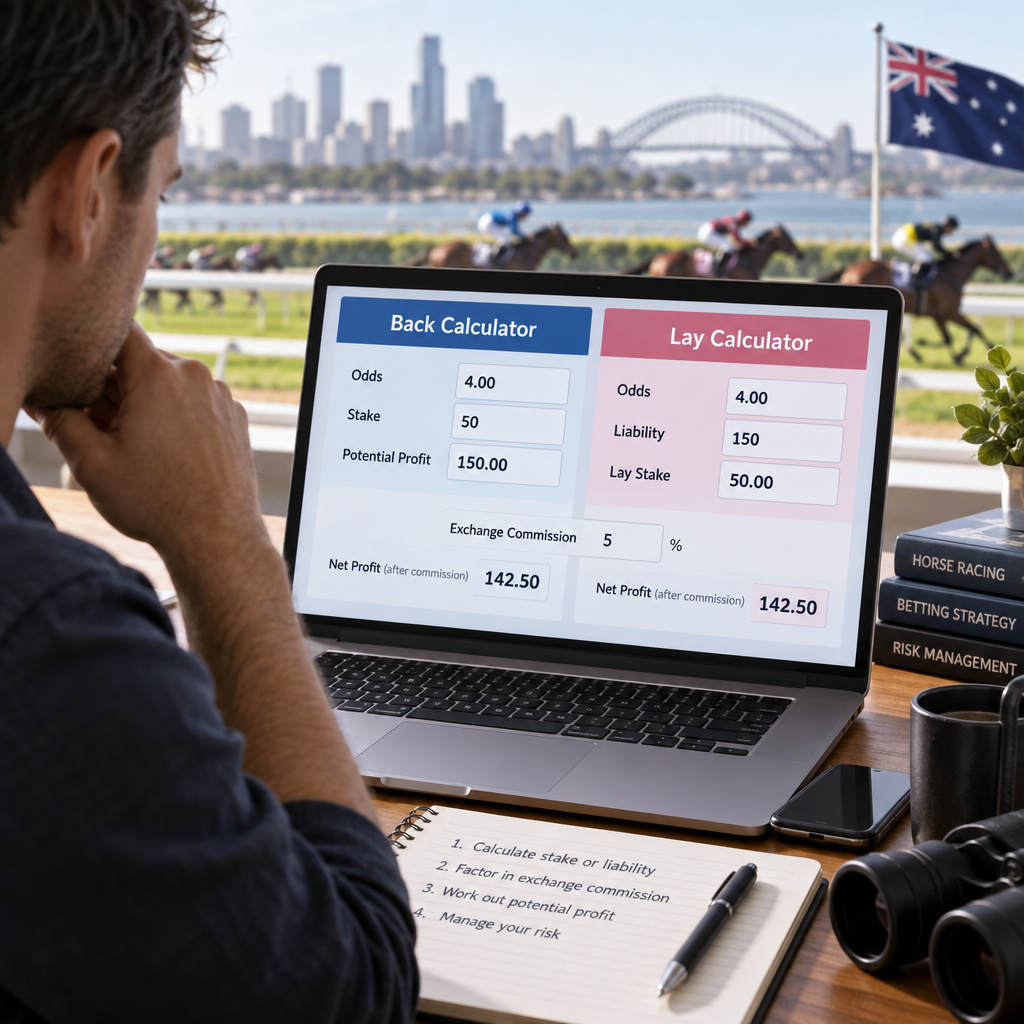
A Betfair back and lay calculator can help estimate the lay stake, liability and possible results of opposing bets. The important first step is choosing the right calculation: a back and lay in the same Betfair market are treated differently for commission from a bookmaker back paired with a Betfair lay. This guide explains both models with hypothetical Australian-dollar examples. Results depend on the prices actually matched, the applicable commission and how each bet settles. The supplied calculator page returned a 404 when researched on 5 November 2026, so its features and calculations could not be verified.
Back and lay betting: the amounts that matter
A back bet supports a selection. With a cash stake at decimal odds, multiply the stake by the odds to find the gross return if it wins. That return includes the original stake. Subtract the stake to find gross profit before any applicable commission.
For example, a $100 back bet at 3.50 has a $350 gross return and a $250 gross profit if the selection wins. If it loses, the $100 stake is lost.
A lay bet opposes a selection. The lay stake is the opposing backer's stake that the layer aims to win. If the selection loses, the layer wins that stake before commission; if it wins, the layer loses the lay bet liability.
For an ordinary fixed-odds lay, liability equals the lay stake multiplied by the lay odds minus one. A $50 lay at 3.00 therefore has a $100 liability: $50 × (3.00 − 1). Its gross lay win is $50 if the selection loses.
Standalone liability is not necessarily the extra balance required to place a lay when existing market positions are taken into account. Check Betfair's displayed market exposure and available balance. Starting-price lays use a different input convention and are outside the calculations below.
How to prepare a back and lay calculation
First decide what you want to calculate. Equalising aims for similar overall results whether the selection wins or loses. You might instead want a particular result on one outcome or only need to check the liability of a proposed lay. Those objectives do not all use the same calculation.
For the equalising examples, identify where each bet is held and gather the inputs below. A liability-only calculation needs just the lay stake and lay odds. Use the same currency throughout, and express commission as a decimal in the formulas: 8% becomes 0.08.
The result of a lay stake calculator should be read alongside the nominal liability and both projected outcomes. Balancing, sometimes called greening up, means redistributing exposure; it does not necessarily mean making a profit. Hedging a bet can also turn an uneven position into a loss on either outcome.
A calculated stake is not a placed or matched bet. The supplied page could not be inspected, so this is a general workflow rather than a description of its fields or functionality.
- Identify the objective and whether both bets are in the same Betfair market or the back is with a separate bookmaker.
- Record the back stake and decimal back odds.
- Choose the intended decimal lay odds and check the applicable commission assumption.
- Check that both bets refer to the same selection and settle on compatible terms.
- Compare the proposed lay stake, liability and outcomes, then check actual matched amounts and exposure.
Why commission depends on where the back bet is placed
Betfair Australia says commission is charged on net winnings in a market, not on a net market loss. The market's Rules show its base rate. The rate applicable to an individual can depend on the market and customer circumstances, and other charges may apply.
If the back and lay are the only positions in the same Betfair market, combine their gross results for each outcome before applying commission. A winning bet and a losing bet are not automatically treated as separate commission calculations.
If the back is with a separate bookmaker, its result is outside the Betfair market. In the simplified example below, a winning exchange lay is subject to the assumed commission even though the bookmaker back has lost.
For these examples, a positive combined Betfair market result is multiplied by 1 minus the assumed commission rate. A zero or negative market result is left unchanged. The 8% rate used throughout is hypothetical, not a rate that applies to every Australian customer or market.
The assumptions behind the two formulas
Both models use ordinary cash stakes and fixed decimal odds in a single-winner market. They assume the back and lay have matching win-or-lose definitions, both legs are fully matched, and there are no other positions, voids, deductions, special settlement terms or additional charges.
In the formulas, B is the back stake, OB is the decimal back odds, L is the lay stake, OL is the decimal lay odds and c is the effective commission rate expressed as a decimal. For example, a $100 back at 3.50 gives B = 100 and OB = 3.50.
These formulas aim to equalise the two overall results. They are arithmetic models, not evidence that particular odds or stakes are available or can be submitted.
Same Betfair market: back first, then lay
When both bets are your only positions in the same exchange market, calculate the gross market result by combining the back and lay for each outcome. If the selection wins, the back produces a profit and the lay incurs liability. If it loses, the lay stake is won and the back stake is lost.
To make those gross results equal, divide the gross back return by the lay odds. Commission is not included in the equalising denominator: equal gross results in the same market receive the same simplified commission treatment. If the combined result is positive, apply commission afterwards.
Consider a hypothetical back-to-lay calculator example: back $100 at 3.50, then lay at 3.00 in the same market. Assume 8% effective commission and no other positions. The exact equalising lay stake is $350 ÷ 3.00, or $116.666… . For this illustration, it is rounded to $116.67.
- Selection wins, gross: B × (OB − 1) − L × (OL − 1).
- Selection loses, gross: L − B.
- Equalising lay stake: B × OB ÷ OL.
- Nominal lay liability: $116.67 × (3.00 − 1) = $233.34.
- Selection wins: $250 back profit − $233.34 liability = $16.66 gross, or approximately $15.33 after 8% commission.
- Selection loses: $116.67 lay win − $100 back stake = $16.67 gross, or approximately $15.34 after 8% commission.
Reading the same-market result
The one-cent difference in the displayed net outcomes comes from rounding the illustrative lay stake to cents and then rounding the results. Check the platform's actual rounding rather than assuming it will handle every amount in the same way.
The example shows a favourable price movement in the model, not proof that those prices were available. It also does not mean every back-to-lay position makes a profit: a less favourable lay price can produce a balanced loss.
Betfair's terms specify a void condition for certain same-selection, same-price back and lay bets matched against other customers. Check the applicable terms before relying on a position involving identical prices.
Separate bookmaker back and Betfair lay
Now assume the back is an ordinary cash bet with a separate bookmaker, with no bookmaker commission, and the lay is your only position in the Betfair market. The bookmaker result and exchange result must be combined to assess the overall outcome, but Betfair does not net the bookmaker loss against its market winnings.
If the selection wins, the bookmaker back profit is reduced by the exchange lay liability. If it loses, the exchange lay wins and is reduced by commission, while the bookmaker stake is lost. Commission therefore appears in the equalising formula's denominator.
Use the same hypothetical back: $100 at 3.50. Lay at 3.00 on Betfair and assume 8% effective exchange commission. The exact equalising lay stake is $350 ÷ (3.00 − 0.08), or $119.863… . Rounded for this illustration, the stake is $119.86.
- Selection wins: B × (OB − 1) − L × (OL − 1).
- Selection loses: L × (1 − c) − B.
- Equalising lay stake: B × OB ÷ (OL − c).
- Nominal lay liability: $119.86 × (3.00 − 1) = $239.72.
- Selection wins: $250 bookmaker profit − $239.72 exchange liability = $10.28.
- Selection loses: $119.86 less 8% commission, then less the $100 bookmaker stake = approximately $10.27.
Comparing the two calculations
The same hypothetical back and lay odds produce different equalising stakes: $116.67 when both bets are in the same exchange market, compared with $119.86 when the back is at a separate bookmaker. The difference follows from which results Betfair combines before charging commission.
Neither formula should be extended unchanged to bonus bets, stake-not-returned offers, other exchange positions or bets with different settlement terms. Each can change the cash flows or commission calculation. Use a separate model and check the relevant terms.
In both examples, the assumed prices and commission are illustrative. The small difference between rounded outcomes is also not a prediction of the amount a platform will settle.
Why a calculated hedge can differ from settlement
A quoted lay price is not a completed hedge. Available offers can disappear, only part of a stake may match, or portions may match at different prices. Recalculate using the actual matched stakes and prices; do not count an unmatched remainder as protection.
Other bets in the same Betfair market change the combined market result and potentially its commission. Likewise, the standalone nominal liability may differ from the incremental funds required once existing positions are considered. Check displayed exposure and available balance before acting.
Market definitions also matter. A bookmaker and exchange may have different rules for draws, dead heats, place terms or particular events. Racing withdrawals can lead to adjustments under the applicable market rules, and a bookmaker and exchange need not make identical adjustments. A void or deduction affecting only one leg can leave an unexpected position.
Equal outcomes can be losses. For example, back $100 at 3.00 and lay $75 at 4.00 in the same market. If the selection wins, the $200 back profit less $225 lay liability is −$25. If it loses, the $75 lay win less the $100 back stake is also −$25. Under the simplified model, neither net market loss incurs commission.
Check the current terms as well as the arithmetic. A model cannot establish how a disputed, adjusted or unusually settled market will ultimately be paid.
Australian access, in-play rules and support
ACMA's operator register lists Betfair Pty Ltd under the Northern Territory Racing and Wagering Commission. That is Betfair's licensing information; it does not establish that the publisher of the supplied calculator page holds a licence.
Betfair says customers must be at least 18 and that new customers must verify their identity before account creation and exchange access. Account, location and market conditions can also restrict access.
ACMA says online in-play sports betting is prohibited in Australia. Qualifying telephone circumstances and racing are treated differently, so do not assume an online sports lay can be placed after play starts. Check current rules and the relevant market before making a decision.
Before betting, check the exposure and funds involved and consider setting a deposit limit. For support, the National Gambling Helpline is available on 1800 858 858. Gambling Help Online offers assistance, while BetStop provides a way to self-exclude from licensed Australian online and phone wagering services.
FAQ
How do I calculate a lay stake from a back bet?
First identify where the bets are held. Under the same-market assumptions in this guide, divide the back stake multiplied by the back odds by the lay odds. For an ordinary bookmaker back and an isolated Betfair lay, divide the same back return by the lay odds minus the assumed commission rate. Both formulas aim to equalise outcomes and depend on the stated settlement assumptions.
Does the supplied calculator include Betfair commission?
Its commission treatment is unknown. The supplied page returned a 404 during research, so its interface and calculations could not be tested. Generally, Betfair charges commission on net market winnings, but a calculator must use the right model for the location of the back bet and any other exchange positions.
What is the difference between lay stake and lay liability?
For an ordinary fixed-odds lay, the stake is the amount the layer aims to win before commission if the selection loses. Liability is the amount lost on that lay if the selection wins. A $50 lay at 3.00 has a $100 liability before it is combined with any other market position.
Can a calculator lock in a profit?
A favourable set of fully matched positions can show a positive result under the model's assumptions, but the calculation itself cannot guarantee matching or settlement. Commission, other positions, withdrawals and different market rules can change the result. Equalising can also produce a loss on both outcomes.
Can Australians place the calculated bet on Betfair?
Eligible adults with verified accounts may be able to access Betfair's licensed exchange, subject to account, location, market and legal restrictions. A calculated result is not a placed bet. In particular, Australian online in-play sports betting restrictions should be checked before attempting a hedge after play starts.
What happens if only part of the lay bet matches?
Only the matched portion forms part of the exchange position. Recalculate both outcomes using the actual matched stake and price, or each matched portion if prices differ. Check what remains unmatched and do not assume it will be accepted later.
Start by identifying whether both bets are in the same Betfair market or the back is with a separate bookmaker. Use the corresponding formula, check the lay liability and compare both outcomes. Before relying on an estimate, confirm the actual matched prices and stakes, applicable commission and market rules. A balanced result can be a loss, and a calculation does not guarantee settlement as modelled.