Best Casino Table Games in Australia: How to Compare Rules and Odds
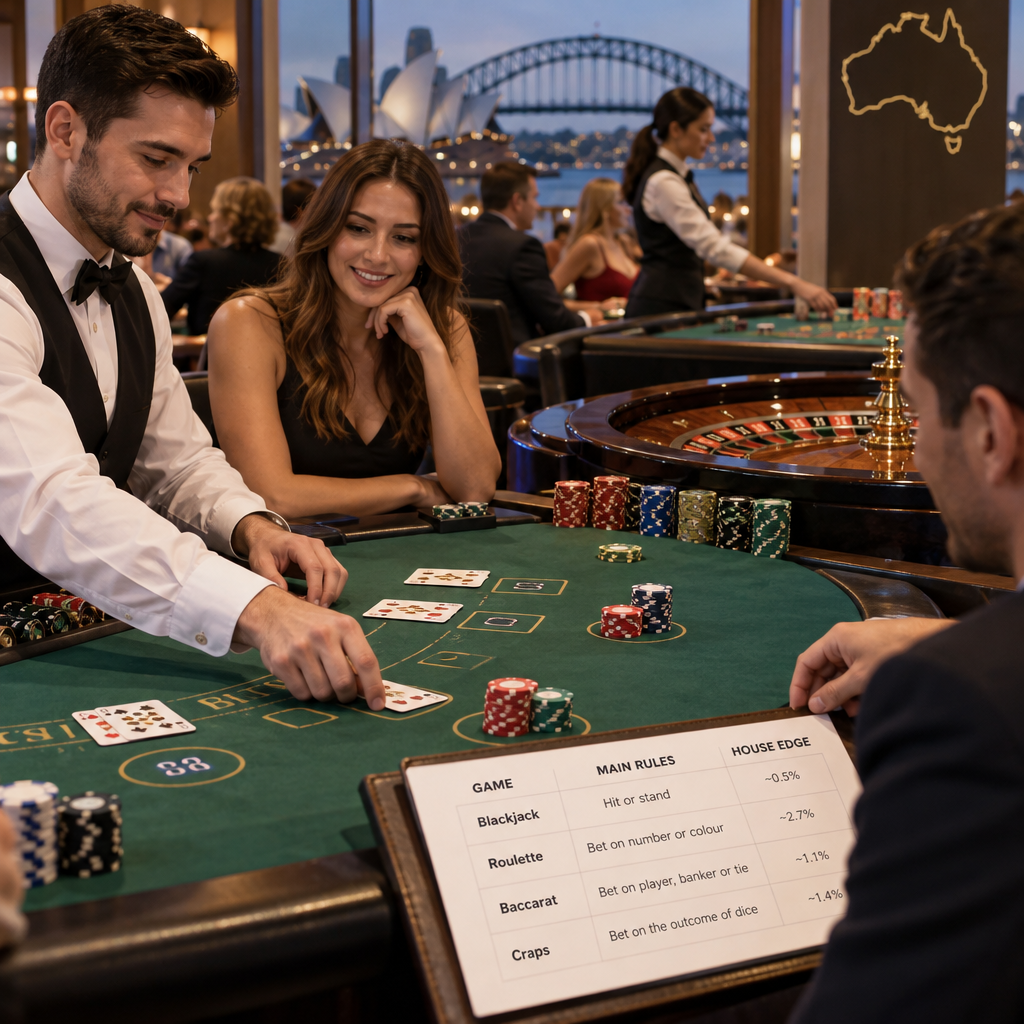
The best casino table games depend on what you want to understand and experience: a simple wager, a game with more decisions, or interaction with other players. This guide looks at casino table games, not board games, for adults considering a visit to a licensed physical venue in Australia. The comparisons are about rules and playing experience, not a promise of profit or a ranking of safety. Every gambling game can lead to losses, and no strategy guarantees a win.
How to compare casino table games
Start with the experience you are looking for. Some games ask you to choose a wager and then wait for the result; others require decisions as a hand develops. A simple game may be easier to learn, but that does not mean it is inexpensive or free from risk.
Next, compare the specific wager rather than relying on the game’s name. A single table can offer several bets with different payouts and odds. Table limits, commissions and fees also matter, as does the amount you might stake repeatedly during a visit.
The Victorian Gambling and Casino Control Commission publishes approved rules and amendments for Melbourne Casino. Those documents are useful examples, but an approved game is not necessarily operating at a particular venue today. Check the table and its current rules before making a comparison.
- Game and variant: identify the wheel, cards, dice or poker format being used.
- Specific wager: find out which outcome you are betting on and whether extra bets are optional.
- Payout and charges: read the paytable and check for commission, rake or tournament fees where relevant.
- Table limits: ask for the current minimum and maximum and how they apply.
- Player decisions: learn which choices you will need to make after placing a bet.
House edge, turnover and the cost of play
House edge is the long-run expected loss expressed as a proportion of the relevant amount wagered, under specified rules and, where applicable, player decisions. It is a way to compare bets on consistent assumptions, not a prediction of what will happen on one visit.
For example, at a 2.70% house edge, A$100 in qualifying turnover corresponds to an expected loss of about A$2.70. A session could instead end with a gain or a much larger loss. The expected figure is not a fixed charge or a guaranteed result.
Turnover means the total amount staked across bets. It is not necessarily the same as your starting balance: money returned from one bet can be staked again. If A$10 is wagered repeatedly, each qualifying bet adds to turnover even when some of the same money is reused.
Pace matters because faster play can produce more turnover in the same amount of time. The edge per wager might stay the same while total exposure increases. Game procedures, the number of players and the venue can all affect pace, so a game name alone does not tell you how much you will wager.
Best casino table games for different preferences
The following choices describe different experiences rather than a best-to-worst ranking. The house-edge figures are historical examples from a 2018 Victorian casino review. They apply to the stated bets and assumptions and may not describe a table available now.
Roulette offers a relatively straightforward individual wager; baccarat has few decisions after the initial choice; blackjack involves decisions during a hand; sic bo offers a choice of dice bets; and poker can appeal to people who want to play against other people. Each still requires a check of the actual rules and costs.
- Single-zero roulette: a simple wager to learn, subject to the wheel and payouts.
- Baccarat: a choice between named hands and a tie, with substantially different odds for each bet.
- Blackjack: decisions during play, with results affected by rules and choices.
- Sic bo: a dice format with many wagers and different payouts.
- Poker: player interaction in some formats, but costs and opponents vary by game.
Single-zero roulette: a straightforward wager to learn
In roulette, you choose a number or group of numbers and the wheel determines the outcome. A red-or-black wager is one way to understand the basic process: select a colour, place the bet and see where the ball lands. The full layout offers many other wagers, each with its own payout.
The zero matters. On a standard single-zero wheel, zero is neither red nor black, so a red-or-black bet loses if the ball lands there. A double-zero wheel has an additional zero pocket. The 2018 Victorian review reported a 2.70% house edge for its single-zero example and 5.26% for its double-zero example, assuming the relevant standard wheels and payouts.
Those figures are not a substitute for inspecting the table. Other roulette variants have been approved in Victoria, and a game label does not necessarily explain every feature of the wheel or paytable. Ask which wheel is in use and how the wager pays.
Calling a red-or-black bet straightforward is an editorial judgement about learning its rules. It does not mean the wager is safe, that a win is due after a run of losses, or that a particular session will cost only the expected amount.
Baccarat: few decisions after the initial bet
Baccarat begins with a choice of wager on the Player hand, the Banker hand or a Tie. Player and Banker are names of the two hands; they do not necessarily identify the customer and dealer. Cards are dealt to the hands, and prescribed rules determine whether additional cards are drawn.
The limited decisions after the initial wager can make the structure easier to follow than a decision-heavy card game. The important comparison, however, is between the individual bets. A single house-edge figure for all baccarat bets would conceal substantial differences.
In the 2018 review’s six-deck example, Banker paid 19-to-20 and had a 1.06% house edge; Player paid even money and had a 1.24% edge; and Tie paid 8-to-1 and had a 14.32% edge. Those historical figures depend on the stated rules and payouts, including the treatment of winning Banker bets.
Before comparing a current table, check its commission, payouts and other rules. A different arrangement can change the odds. Fewer decisions do not prevent losses, and a high payout on a particular outcome does not by itself make the bet a better value.
Blackjack: more choices during a hand
In blackjack, the aim is to beat the dealer’s hand without going over 21. During a hand, a player may need to decide whether to take another card or stand, and some rules allow additional choices. Going over 21 loses the hand; other outcomes depend on the dealer’s hand and the table rules.
This can suit someone interested in learning decisions as well as the initial bet. It also makes the comparison more demanding. Deck count, the payout for a blackjack, the dealer’s drawing rules and the player’s decisions can all affect expected results.
The 2018 Victorian review reported a historical house-edge range of 0.5% to 3% depending on variation. It did not establish a universal current edge for every blackjack table or player. In particular, the lower end should not be treated as an automatic result simply because a table is called blackjack.
Before sitting down, ask for the rules or read the displayed information. Check the blackjack payout and what the dealer must do with their hand, as well as the minimum and any optional side bets. A strategy may change expected results under particular rules, but it cannot guarantee a winning session.
Sic bo: a choice of dice wagers
Sic bo is based on the outcome of three dice. Players can choose from wagers relating to different dice results, with the payout depending on the precise bet. That variety gives readers a dice-based alternative to cards and roulette, but it can also make the layout less immediately clear.
The Victorian review reported historical house edges ranging from 2.78% to 16.2% across sic bo bets. The range is a reminder that there is no useful single figure for every wager on the layout. It does not establish the payout or edge of a current venue’s table.
Identify the exact bet and its paytable before comparing it with another option. If you cannot tell what outcomes win or how a winning bet pays, ask for an explanation before wagering. As with other games, understanding the rules does not eliminate the possibility of loss.
Poker: distinguish opponents and costs
Poker can mean a game against other players or a casino poker variant played against the house. The distinction matters: the rules, decisions and costs are not interchangeable, so there is no single poker house-edge figure that makes a useful comparison across all formats.
In player-versus-player poker, decisions are made in response to the cards and the actions of other participants. A venue may take a rake, meaning an amount taken from play, or charge tournament fees. Ask how the relevant charge works and read the rules for the specific game before deciding whether to participate.
A house-banked variant has a different structure. Check which bets are required, what the dealer’s role is and how winning hands are paid. No current fee amounts are assumed here, and neither player skill nor familiarity with a format guarantees a profit.
Getting started at a physical venue in Australia
First decide whether gambling is appropriate for you at all. If it is not, a no-stakes game is an alternative. For adults considering a visit, check the licensed venue’s admission and identification requirements, current game availability and any applicable exclusion conditions before travelling.
A table minimum is a required stake for a qualifying bet, not the price of a complete session. Crown Melbourne’s published blackjack rules provide for notices about table minimums and increments, but they do not establish a nationwide minimum. If you meet a minimum on several bets, your total turnover can exceed the amount displayed as the minimum.
Ask the venue for its current minimum and maximum and whether any additional wager is optional. Read the rules for the actual table: Victorian approvals do not establish game availability or conditions at venues elsewhere in Australia.
Set money and time limits before play, and do not borrow money or chase losses. Limits can help you set boundaries, but they do not make gambling risk-free. Stop if gambling is no longer affordable or enjoyable.
- Confirm admission, identification requirements and whether the game is operating.
- Check the table minimum, maximum, paytable and any commission or fees.
- Decide in advance how much time and money you can afford to spend.
- Avoid treating a loss as a reason to increase the next wager.
- Ask the venue or relevant state authority about physical-venue exclusion if you need it.
Online casino restrictions and gambling support
The Australian Communications and Media Authority says providers must not offer prohibited online gambling services, including online casinos, to people in Australia. This guide focuses on physical venues; an offshore licence or a website’s availability does not establish that a real-money online casino may lawfully offer its games to Australian customers.
Simulated casino games are a different category. ACMA describes a closed-loop model in which credits cannot be withdrawn as money or traded, although optional purchases may be available. Check the terms of an individual simulation rather than assuming that a game labelled free has no purchases or redeemable prizes.
For support, the National Gambling Helpline is 1800 858 858. It is free, confidential and available 24 hours a day. BetStop covers Australian-licensed online and phone wagering, not self-exclusion from a physical casino. For a physical venue, ask about the relevant venue or state process; South Australia, for example, describes venue barring separately.
FAQ
What is the best casino table game for beginners?
A simple single-zero roulette wager is one accessible example because a single bet is relatively easy to understand. Baccarat has few decisions after the initial wager, while blackjack offers more choices but requires more learning. This is a comparison of rules, not a claim that any game is safest or guarantees a better outcome. Check the actual wheel, wager and paytable.
Do I need a group to play a casino table game?
You may be able to join a dealer-operated game without organising a group, subject to venue rules and available places. Poker is different: participation requirements depend on the particular game or tournament. Ask the venue what is operating and whether a seat is available.
How much does it cost to start playing?
Ask the venue for its current table minimum and maximum. The minimum is a stake requirement for a qualifying bet, not a fixed session price. Repeated bets increase turnover, and optional side bets or other charges may add to your spending. No current nationwide table minimum is assumed in this guide.
Can I play casino table games online in Australia?
Real-money online casino services must not be offered to people in Australia. Simulations are a separate category, but their terms vary: some may offer optional purchases, while the closed-loop model described by ACMA uses credits that cannot be withdrawn as money or traded. Check whether purchases or redeemable prizes are involved.
Does a lower house edge guarantee a cheaper session?
No. House edge describes a long-run expectation under specified conditions, not the result of an individual visit. A session can end with a gain or a substantial loss, and total turnover matters. Faster or repeated betting can increase exposure even when the edge on each wager remains unchanged.
Does BetStop exclude me from a physical casino?
No. BetStop covers Australian-licensed online and phone wagering. For exclusion from a physical casino, ask the venue or relevant state authority about the applicable self-exclusion or barring process. The National Gambling Helpline can also provide confidential support on 1800 858 858.
There is no single best casino table game for every reader. A simple roulette wager is relatively easy to learn, baccarat involves few decisions after the initial bet, blackjack offers more choices, and some poker formats involve other players. Compare the actual wager, rules and costs rather than the game name alone. If you choose to gamble, set boundaries beforehand and remember that any session can end in a loss.