Best Online Casino Ranking: What Australian Readers Should Check
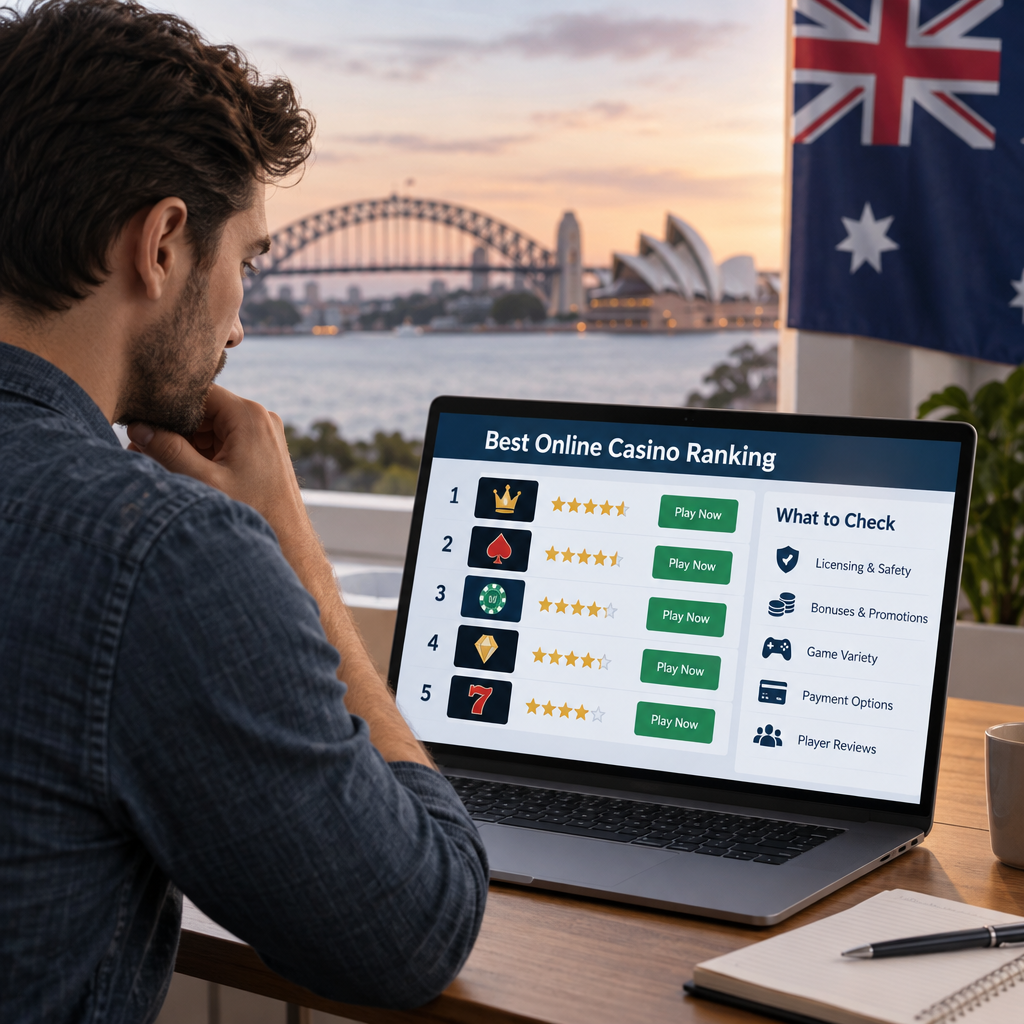
A best online casino ranking should do more than award scores for games, payments and promotions. It should first establish whether the services can lawfully be offered to the reader, then explain what evidence supports its claims. For people physically in Australia, that first check is decisive: providers cannot lawfully offer prohibited online casino games, including real-money pokies and roulette. An overseas licence, Australian-dollar payments or a high ranking does not change that position. This guide therefore does not recommend or rank casino operators. Instead, it explains the legal distinction, shows how to assess common ranking claims and points to help if gambling is affecting you or someone close to you.
Are online casinos legal in Australia?
Australia’s Interactive Gambling Act 2001 restricts the provision of certain online gambling services to customers physically in Australia. The Australian Communications and Media Authority (ACMA) identifies online casino services, including online pokies, roulette and poker, as prohibited services. A website can be accessible from Australia without being authorised to offer those games to people here.
Physical location matters to the federal Australian-customer link. An Australian citizen overseas and a visitor physically in Australia are not necessarily in the same position for that test. Nor does a site’s offshore address, currency or claimed licence determine whether it can provide casino games to a customer in Australia.
The provider prohibition should not be confused with a complete statement about every player’s legal position. The federal provisions discussed here principally address providers and advertising; they do not establish that a customer automatically commits an offence merely by accessing a site. This guide does not assess every state and territory law or every individual circumstance. Seek qualified legal advice if you need an answer about your own position.
Online gambling products are not all treated alike. Appropriately licensed online wagering is distinct from an online casino, and state and territory authorities regulate permitted products and physical venues under their own rules. A provider’s appearance on ACMA’s register for wagering does not authorise it to offer online roulette or pokies.
The statutory compilation used for the federal provisions is dated October 2024. Laws and commencement dates can change, so consult current legislation and ACMA guidance for the latest position. A physical casino, licensed wagering service or lottery is a different product, not an exception that makes a conventional online casino lawful.
How should a trustworthy ranking be built?
When considering how to compare online casinos, start by assessing the comparison site itself. A score is useful only if readers can understand what was measured, where the evidence came from and whether the comparison applies to their location. For an Australian reader assessing online casino games, legal eligibility comes before any score for payment speed, game selection or support.
For a product that can lawfully be offered in a relevant jurisdiction, a useful methodology would explain its criteria and any weights, how it handles missing information and when it reviews its findings. It should also distinguish desk research from actual account or payment tests. This guide has not tested casino accounts or withdrawals.
Commercial relationships matter too. A ranking may earn money when a reader follows a link or becomes a customer, creating a possible incentive to favour certain businesses. Disclosure helps readers understand that incentive, but disclosure alone does not make promotion of a prohibited service lawful. ACMA has investigated affiliate promotion directing users to illegal online casinos.
- Legal scope: Does the ranking specify the products and customer locations it covers?
- Evidence: Does it link to regulator records, terms or other identifiable sources rather than relying on badges?
- Dates: Can you tell when each important claim was last checked?
- Independence: Does it say whether claims were independently verified or supplied by an operator?
- Commercial influence: Does it explain how sites are included, ranked and paid for, and how errors can be corrected?
Casino licences and operator identity
Casino licences can provide evidence that a regulator has authorised a particular business to conduct specified activities in its jurisdiction. They are not blanket permission to serve customers everywhere. A genuine overseas licence does not override Australia’s prohibition on supplying online casino games to people physically in Australia.
A meaningful licence claim should identify the issuing regulator and the legal entity behind the website. Check the regulator’s own register rather than treating a footer logo or licence number as conclusive. Where the register provides the information, compare the company, trading name, website domain, licence status and authorised activity with the claim being made.
The UK Gambling Commission’s register guidance is an example of how such checks can work. A match there may tell you something about a business’s status in that regulatory system; it does not grant Australian permission. Equally, ACMA’s register helps users check Australian-licensed interactive gambling providers, but it is not a list of approved online casinos.
A mismatch deserves further investigation, although it does not by itself establish every detail of a business’s status. For example, a ranking might display a licence for one company while the site names another. Without a clear explanation and matching official records, the ranking has not adequately supported its claim.
- Identify the regulator independently.
- Match the legal company and trading name.
- Check the domain, licence status and authorised activity where available.
- Consider separately the law that applies where the customer is physically located.
Payments, withdrawals and identity checks
A prominent payment logo tells you little about whether a withdrawal will be paid. ACMA reports complaints about illegal gambling providers withholding winnings and warns that Australian regulators have limited ability to help customers who experience problems with them.
Read payment claims closely. A service may advertise a deposit method without offering the same route for withdrawals. It may also quote the time it aims to approve a request rather than the time until the money arrives. A ranking that calls withdrawals fast should say whether it is repeating a published target, observing an approval or reporting a completed payment received by a tester.
Withdrawal terms may include minimums, limits, fees or currency conversion costs. They may also explain when identity or source-of-funds documents can be requested. Those conditions can affect access to funds even when a payment method looks familiar.
No operator-specific payment methods, processing times, fees or limits have been verified for this guide. Even a documented payment to one person would not guarantee another withdrawal, establish that a service is lawful or remove the risk of loss.
Game fairness, RTP and account security
Claims about game fairness are often presented as part of online casino safety, but no checklist guarantees safety. A meaningful independent testing claim should identify the testing body, the game or random-number generator covered, the relevant version and the date or scope of the test. A laboratory logo alone does not establish that the current games on a site have been tested.
Scope matters. A certificate for one version of one game is not evidence that every game on a website is certified, or that the operator’s payments and customer service have been independently assessed. The UK Gambling Commission’s requirements for game and random-number-generator test reports illustrate a regulated testing regime; they are not proof that an unnamed offshore service meets it.
Return to player, or RTP, is a theoretical long-run measure of the proportion of stakes a game returns under its specified rules. It is not a prediction for one person’s session, a promise that a particular amount will be returned or a way to ensure a win. Individual outcomes can differ substantially from the long-run measure.
Account protections and privacy terms are also worth understanding: they describe how access to an account and personal information may be handled. They cannot establish Australian eligibility or eliminate the financial and data risks of using an illegal service.
Promotions and wagering requirements
A headline amount tells you little about the value of casino bonuses without the conditions attached. A wagering requirement specifies how much qualifying play an offer requires under its terms. The multiplier may apply to the bonus alone or to the deposit and bonus together, which can produce very different totals.
Consider a purely hypothetical $10 bonus with a 30-times requirement applying to the bonus alone. The arithmetic is $10 multiplied by 30, or $300 in qualifying wagers. This is not a real offer, and it does not mean the customer will lose exactly $300 or receive a $300 payout.
Other terms can affect whether play counts towards the requirement and whether funds can be withdrawn. An offer may expire, exclude particular games, count games at different rates or restrict maximum bets and withdrawals. It may also impose verification conditions or affect access to deposited money.
No named promotion has been verified here. Even where terms appear straightforward, an advertised benefit does not remove the risk of loss, make gambling worthwhile or make a prohibited service lawful.
- What amount does the wagering multiplier apply to?
- Which games qualify, and do they contribute at different rates?
- When does the offer expire?
- Are there maximum bet or withdrawal restrictions?
- Do the terms affect deposited funds or require additional verification?
Risks, complaints and gambling support
A ranking cannot protect against gambling losses, an operator withholding money or a website becoming inaccessible. ACMA warns that consumers may have limited avenues for assistance when dealing with illegal providers. If you are unsure about a service or its legal status, choosing not to gamble avoids relying on claims you cannot verify.
You can report a prohibited online gambling service through ACMA’s interactive gambling complaint form. A report may help the regulator investigate, but it does not guarantee that money will be recovered. For a dispute involving an Australian-licensed provider, check ACMA’s guidance on contacting the relevant licensing authority.
For gambling support in Australia, call the National Gambling Helpline on 1800 858 858 or use Gambling Help Online’s chat. Phone and chat support are free, confidential and available across Australia 24 hours a day. Family members and friends affected by someone else’s gambling can seek help too.
Spending limits may help some people manage their gambling, but they do not eliminate harm. If gambling is causing distress, financial difficulty or conflict, support is available without waiting for the situation to become more serious.
What BetStop covers—and what it does not
BetStop is a free national self-exclusion service for Australian-licensed online and telephone wagering. It can help someone who wants to exclude themselves from those providers, rather than arranging separate exclusions with each one.
Its scope is important: BetStop does not cover illegally provided online casino games or every other form of gambling. Exclusion from licensed telephone wagering, for example, should not be mistaken for a universal block on offshore online casinos.
Self-exclusion can be one part of a broader support plan, but it is not a guarantee against harm. Gambling Help Online can discuss available support with the person affected or with their family and friends.
FAQ
Can Australians play at offshore online casinos?
Some offshore online casinos may be accessible, but providers cannot lawfully supply prohibited casino games to customers physically in Australia. An offshore licence does not change that restriction. The federal prohibition on providers should not be described as automatically making every customer a criminal; this guide does not resolve all possible state or territory issues. Seek qualified legal advice for your circumstances.
How can I check whether a casino licence is genuine?
Consult the issuing regulator’s own register and, where its records allow, match the legal entity, trading name, domain, current status and authorised activity. A domain or company mismatch is a reason to investigate further. Even if an overseas licence is genuine, you must separately consider the law where the customer is physically located; the licence is not Australian authorisation.
Does a casino ranking guarantee withdrawals?
No. A score, payment logo or advertised processing time cannot guarantee that funds will arrive. Check whether withdrawal claims refer to a published target, an approval or an independently observed completed payment, and read the conditions. ACMA reports complaints about illegal providers withholding winnings; making a complaint does not guarantee recovery.
Are casino bonuses worth considering?
A headline amount alone is not enough to judge a promotion. Wagering requirements, expiry, eligible games, game contributions and withdrawal restrictions can all matter. The $10 and 30-times example in this guide illustrates arithmetic, not a real offer. A bonus does not remove the risk of loss or make a prohibited service lawful.
Where can I get gambling support in Australia?
Call the National Gambling Helpline on 1800 858 858 or use Gambling Help Online’s free, confidential 24/7 chat. Support is also available to family and friends. BetStop offers free self-exclusion from Australian-licensed online and telephone wagering providers, but it does not cover illegally provided online casino games or every form of gambling.
Does ACMA’s gambling register list approved online casinos?
No. ACMA’s register helps people check Australian-licensed interactive gambling providers and their licensing authorities. An entry for a wagering service does not mean the provider is authorised to offer online casino games such as pokies or roulette to customers physically in Australia. Check the specific product as well as the provider.
For Australian readers, the first question is not which online casino has the highest score, but whether the service can lawfully be provided at all. An offshore licence, accessible website or appealing payment claim does not authorise prohibited casino games for customers physically in Australia. Treat rankings as claims to examine, not assurances of safety or payment. Check the evidence and its limits, be wary of commercial incentives, and remember that help is available for you and those affected by gambling.