Arbitrage Sports Betting Finder: How to Compare Tools in Australia
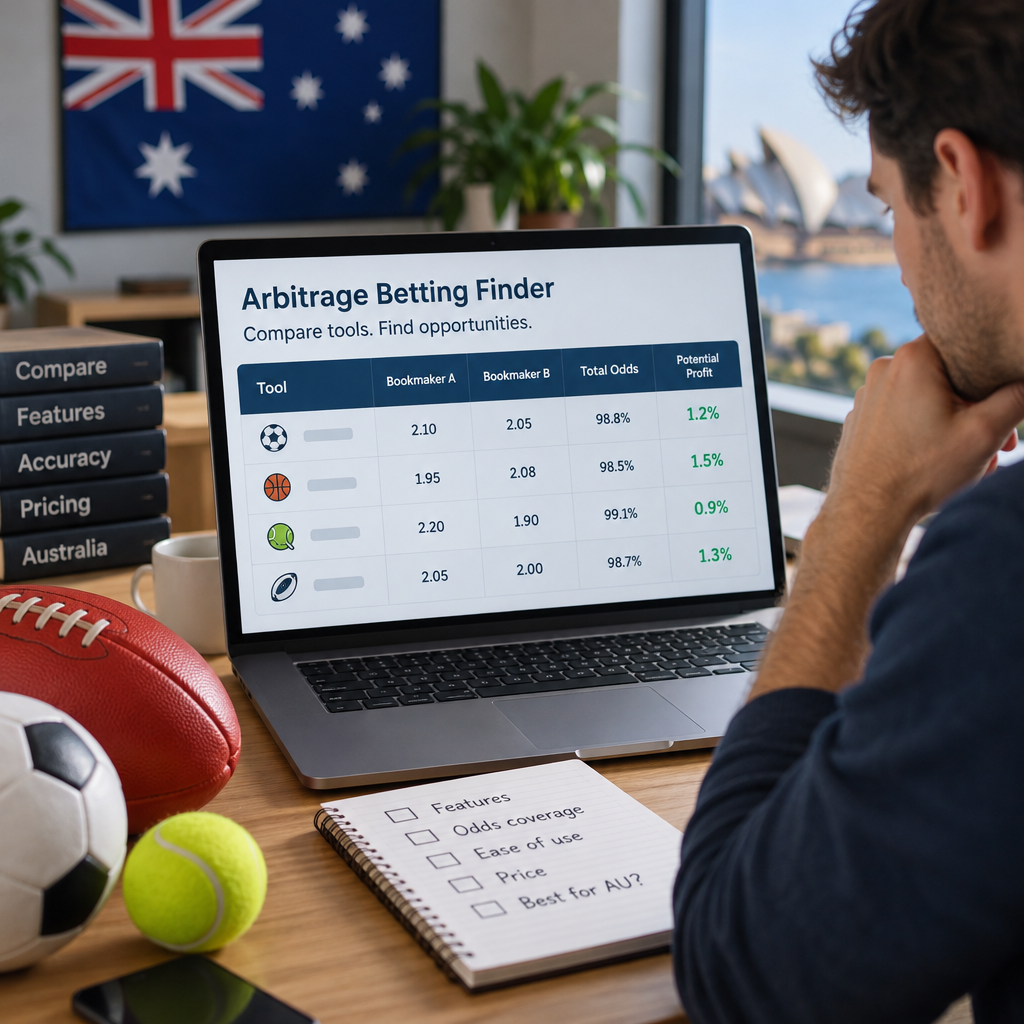
An arbitrage sports betting finder compares odds and flags combinations that appear to cover every outcome for a theoretical profit. But does it show prices you can actually use with Australian bookmakers? A displayed opportunity is only a starting point: the odds and stakes must be accepted, the markets must settle compatibly, and costs must not erase the return. This guide explains the calculation, compares provider-described features and sets out the checks to make before relying on a result. The named tools are examples, not an independently tested ranking.
How an arbitrage finder works
Sports betting arbitrage software looks for differences in prices across outcomes. For example, one bookmaker might offer the highest price on one team while another offers the highest price on its opponent. A finder can flag the combination if its calculation suggests the combined stakes could return more than the amount bet.
An arbitrage odds scanner does not necessarily check everything that matters. Its result depends on the prices it receives, how it matches markets and how quickly the information is updated. A near-arbitrage is a combination close to the threshold; it may not produce a positive return.
A positive expected value, or +EV, finder is different again. It identifies a bet judged favourable against an estimated fair price. It does not necessarily cover all possible outcomes, and an individual +EV bet can lose. AussieOdds, for example, describes separate pre-match arbitrage, +EV and odds-screen functions; those are provider descriptions rather than independently verified results.
- An odds comparison site displays prices from different sources, but may not identify a complete arbitrage.
- A finder or scanner flags combinations that meet its criteria, subject to its coverage and data.
- An arbitrage betting calculator uses entered odds and stakes to calculate a split; it cannot confirm that the prices remain available or the markets settle alike.
Calculating an opportunity and its stake split
For ordinary back bets, start by checking that the outcomes are mutually exclusive and cover every possible result under compatible settlement rules. Divide 1 by each decimal price and add the answers. If the sum, called S, is below 1, the combination indicates a theoretical arbitrage before costs and settlement complications.
To calculate equal-return stakes, multiply the total stake by each outcome’s implied probability, then divide by S. The unrounded gross return is the total stake divided by S. The theoretical return on the total stake is 1 divided by S, minus 1.
Consider this hypothetical example, not live odds. Assume two genuinely complementary outcomes, compatible rules, ordinary back bets and no fees. The unusually clear prices are used to demonstrate the maths, not to suggest a typical return.
The combined implied probability is approximately 93.074%, below 100%. If A wins, A$51.16 at 2.10 returns approximately A$107.44. If B wins, A$48.84 at 2.20 returns approximately A$107.45. After the A$100 total stake, the theoretical profit is about A$7.44–A$7.45 before costs and any operator rounding.
The unrounded theoretical return on total stake is about 7.44%. That differs from the approximately 6.93 percentage-point gap between 100% and the implied-probability sum. Recalculate using the odds and rounded stakes actually accepted.
Do not use a two-outcome calculation for a three-way football match-winner market without covering the draw. Other markets may have two outcomes but different rules for draws or overtime. ARB//HQ’s calculator provides a third-outcome option; it does not verify a live opportunity.
- Outcome A: decimal odds 2.10, implied probability 47.619%, rounded stake A$51.16.
- Outcome B: decimal odds 2.20, implied probability 45.455%, rounded stake A$48.84.
- Total stake: A$100.00; combined implied probability: approximately 93.074%.
Compare Australian bookmaker and market coverage
When choosing a sports arbitrage finder in Australia, start with the bookmakers and markets you can actually access. A large global bookmaker count does not establish coverage of an Australian website or a particular competition. Check the exact operator names and domains, then look at sports, pre-match markets, two- and three-way outcomes, and whether overtime is included.
Also look for the timestamp of the underlying prices, not just the time an alert appears. An opportunity can remain on screen after a bookmaker changes its odds. The following examples are based on provider descriptions; their current lists, access and performance have not been independently tested.
Sharp Odds says it scans Australian bookmakers three times daily and lets users adjust the total stake on a displayed opportunity. That schedule makes a fresh price check particularly important. Its complete current bookmaker list and accuracy were not independently verified.
Arbifold says its finder covers specified two-sided head-to-head, totals, spreads and player over/under markets using Australian bookmakers. It says it excludes Betfair and skips soccer head-to-head because of the third outcome. It also displays near-arbitrages, which are not necessarily profitable. Its full current bookmaker list and access conditions were not established.
Check each wagering operator separately against the Australian Communications and Media Authority’s register. An operator appearing there does not prove that a finder covers it, that every market is permitted or that you can open an account.
Compare calculation features, access and costs
A useful finder should let you narrow results to operators and markets you can use and make the calculation understandable. Check whether it supports a third outcome, the stake precision you need and, for exchange bets, relevant commission and lay-liability inputs. A lay bet is a bet against an outcome and creates a liability that may exceed the amount another person stakes.
AussieOdds advertises a pre-match finder, stake splits and alerts. ARB//HQ offers a two- or three-outcome calculator and advertises Australian scanner coverage. Neither provider’s alert performance or current bookmaker coverage was independently measured for this guide.
For occasional checks, manually comparing odds and entering them into a separate calculator is an alternative. It involves more work and still requires you to check current prices and settlement rules, but it avoids assuming a scanner alert is executable.
Before subscribing, check whether the calculator and scanner are separate products and read the actual checkout terms. Trial descriptions, billing and cancellation conditions can change. Find out what credentials a tool requests, how it handles data and whether it only displays or links to opportunities or also attempts to place bets.
- Accessible bookmakers: confirm the Australian names and domains you intend to use.
- Markets: check the sport, competition, outcomes and relevant settlement periods.
- Odds age: check timestamps, update frequency and whether expired alerts are removed.
- Calculation controls: check stake rounding, third outcomes and exchange inputs if needed.
- Full terms: check trial payment, renewal amount and currency, taxes, cancellation method and notice period.
What can go wrong between an alert and settlement
A theoretical result assumes every required leg is placed at the calculated price and stake. In practice, a bookmaker can reject, limit or reprice a bet. If one leg has already been accepted when the second price changes, the original equal-return calculation no longer applies and you may be left with an uncovered position.
Check the event, participants, line and time period at each operator. Settlement rules can differ for overtime, a draw, player participation, postponement, abandonment or later resettlement. If one operator voids a bet, the other does not necessarily void its leg.
Account limits, minimum stakes or insufficient balances may prevent the proposed split. Money can also be tied up across accounts while events are pending. Recalculate using accepted stakes and include applicable subscription, conversion and other costs; even a small cost can eliminate a narrow theoretical return.
On an exchange, a displayed price may not have enough liquidity to match the full amount. Lay bets require sufficient funds to cover liability, while commission and applicable charges affect the net result. Betfair describes commission on net market winnings rather than a flat charge on every stake.
If a leg fails, do not assume that placing another bet is automatically the right response or chase a loss. The exposure depends on the accepted position and available alternatives.
Responsible gambling: this strategy remains gambling and can result in losses. Decide on a limit before betting and do not use money needed for essentials. Gambling Help Online offers free, confidential support 24/7 on 1800 858 858. BetStop provides national self-exclusion from Australian-licensed online and telephone wagering services.
- Confirm the current price and available stake for every leg.
- Match the event, outcome, line and settlement rules.
- Check balances, account limits and exchange liquidity or liability.
- Recalculate with accepted odds, rounded stakes and applicable costs.
Australian licensing and online in-play restrictions
A finder that displays information is distinct from the wagering services it points to. The legality of a particular tool depends on its functionality and circumstances; a betting operator’s registration is not blanket legal clearance for a finder’s automation or affiliate features.
ACMA says the Interactive Gambling Act prohibits providers from offering specified services to people in Australia, including unlicensed sports betting and online in-play sports betting. A scanner’s live feature is therefore not proof that an Australian user can place the displayed online sports bet.
For each operator, check the brand, legal entity and Australian website against ACMA’s register, then consult the named state or territory regulator and the rules for the relevant market. Registration does not establish that a scanner covers the operator or that every bet it offers is available to you.
Some distinctions apply to telephone and certain place-based services, and racing is treated differently in the in-play framework. Those distinctions should not be assumed to permit a particular app or market.
ACMA reports that gambling reforms passed in August 2026, with most commencing on 1 January 2027. Operators and publishers, including affiliates, should check current commencement and compliance requirements rather than treating future measures as already in force. This is general information, not individual legal advice.
Wagering payments and tax treatment
Funding a wagering account is different from paying for a separate scanner subscription. ACMA says that since 11 June 2024, online and telephone wagering operators cannot accept deposits using credit cards, credit-linked funds including digital wallets, or digital currency. That rule does not by itself establish the payment terms for a separate software service.
The Australian Taxation Office says gambling wins are generally non-assessable unless a person carries on a betting or gambling business. Its community guidance similarly says gambling losses are generally not deductible unless a business is being carried on.
Arbitrage activity does not automatically make someone a hobbyist or a business for tax purposes. Treatment depends on individual circumstances. If the amounts are material or your situation is unusual, seek advice from a qualified tax professional.
FAQ
Is an arbitrage sports betting finder legal in Australia?
An information tool is distinct from a wagering service, but the legality of a particular product depends on what it does and the circumstances in which it operates. The available guidance does not establish blanket clearance for every finder, automated tool or affiliate arrangement. Check each betting operator on ACMA’s register and seek legal advice where needed.
Can a finder guarantee a profit?
No. Its displayed calculation depends on complete outcome coverage, compatible settlement rules and all required bets being accepted at the stated prices and stakes. A second leg may be rejected or repriced after the first is accepted, and fees or rounding can change the result.
Do I need a separate arbitrage betting calculator?
Not necessarily. Some finders include stake calculations, while a separate calculator can provide an independent arithmetic check and may support a third outcome. Neither option confirms that the prices are current, the bets will be accepted or the operators will settle them in the same way.
How much do arbitrage finders cost?
Available models include free calculators, scanners described by providers as currently free, trials and recurring subscriptions. Check the current checkout and terms for any trial charge, renewal amount, currency, cancellation method and notice period before committing. A trial description alone may not explain the full billing conditions.
Can Australian users place every bet a finder shows?
No. An alert may involve an operator or market the user cannot access, an outdated price, an account limit or insufficient exchange liquidity. Check the exact Australian operator and market, then verify the current price and available stake for each leg.
Why does a football draw matter in an arbitrage calculation?
In a three-way match-winner market, a draw is a separate possible outcome. Betting only on the two teams does not cover it. A different two-outcome market may handle a draw through its own settlement rules, so check those rules rather than assuming the markets are interchangeable.
Choose a finder by checking its usable Australian operator and market coverage, the age of its odds, its calculation controls and its full subscription terms. Verify each operator through ACMA, and check current prices, accepted stakes and settlement rules before relying on a calculation. A displayed theoretical opportunity is not the same as a set of accepted and settled bets. Set a gambling limit and seek support if betting is becoming difficult to control.